
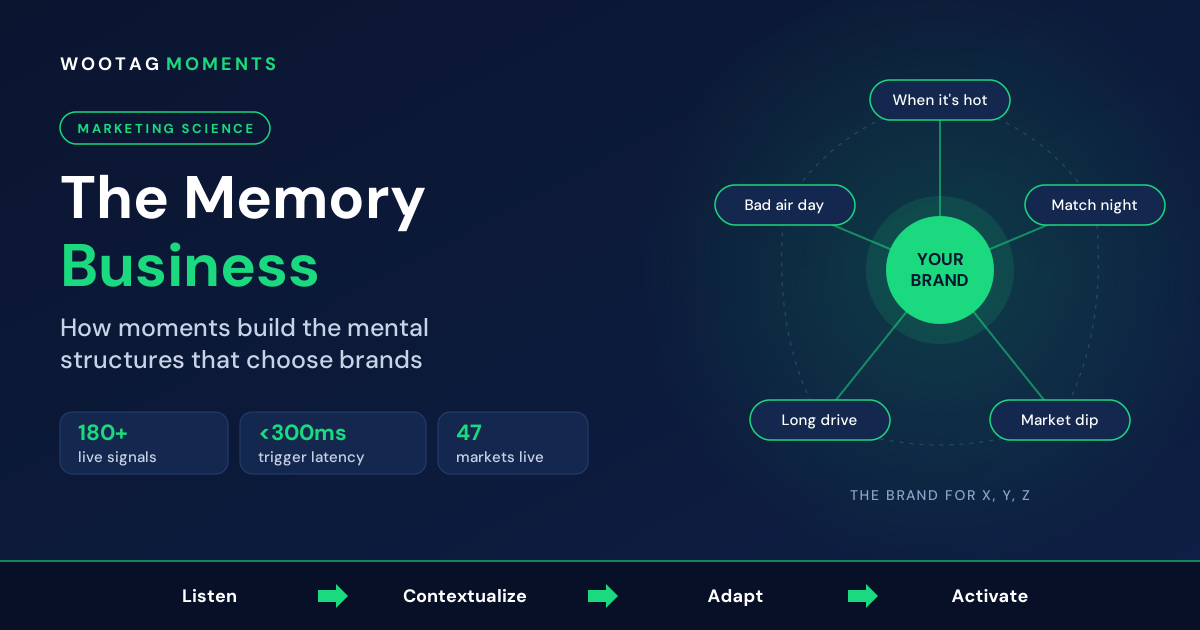

A science-led look at memory structures, category entry points, persuasion and bonding, and why the real-world moment is the most underused tool a brand has for all four
In short
- People rarely choose brands in the moment of choice. Memory chooses for them, and memory is built and retrieved through context. The closer a brand’s communication sits to the real situations people live in, the stronger and more retrievable the memory it leaves behind.
- Category entry points (“the brand for when it’s hot”, “the brand for match night”, “the brand for when the market drops”) are the hooks memory hangs on. Real-world signals like weather, sports events and market moves are those same situations happening live, which makes them the most natural place to build and refresh these links.
- Wootag Moments listens to live signals and activates the right communication at the right moment, so brands can build new memories, refresh existing ones, persuade with relevance and earn emotional bonds at scale, instead of hoping a calendar slot lands at the right time.
The penalty kick problem
Think about the last time you watched a penalty in a big football match. You probably remember where you were, who you were with, maybe even what you were drinking. You almost certainly do not remember the brand communication you saw three days earlier on a quiet Tuesday afternoon.
That gap is the whole story of this post. Brands spend enormous budgets trying to get remembered, yet most of that spend lands in moments the brain has no reason to store. Meanwhile, the moments the brain is built to store, the ones charged with emotion, context and shared attention, pass by unclaimed.
Marketing science has spent decades explaining why. The answer sits at the intersection of cognitive psychology, memory research and the brand growth work of the Ehrenberg-Bass Institute. When you put those bodies of work side by side, a clear conclusion appears: real-world moments are not a tactic for engagement. They are the mechanism by which brand memory is formed, strengthened and retrieved.
Let’s walk through the science, one mechanism at a time.
1. Brands are memory structures, not messages
The Ehrenberg-Bass view of brands is refreshingly unromantic. A brand, in this view, is a network of associations in a buyer’s memory. Some links connect the brand to its distinctive assets (colours, logos, sounds, characters). Others connect it to the situations in which people buy the category. The bigger, fresher and better connected that network is, the more likely the brand comes to mind when a need arises.
This matters because buying is mostly fast and low effort. People do not run a fresh evaluation every time they reach for a drink, book a cab or top up their engine oil. They retrieve whatever comes to mind first and act on it. Researchers describe this as mental availability: the likelihood that a brand is noticed or thought of in buying situations.
So the job of brand communication is not primarily to inform. It is to build and maintain memory structures that will fire at the right time.
And here is the first scientific lever. Memory is not stored in isolation. It is stored with its context.
Encoding specificity: memory carries its context with it
In the 1970s, Endel Tulving and Donald Thomson proposed what became known as the encoding specificity principle. In plain terms, a memory is easiest to retrieve when the cues present at recall match the cues that were present when the memory was formed. A famous follow-up by Godden and Baddeley showed that divers who learned words underwater recalled them better underwater than on land.
Consumer researchers have applied the same logic to brand communication. Work from Stanford’s Graduate School of Business has proposed a cue compatibility principle for advertising effects: what gets stored at exposure needs to match what is present as a cue later on, or the message effectively goes missing.
Now apply that to brand building.
If your brand is encoded during a heatwave, the next heatwave becomes a retrieval cue for your brand. If your brand is encoded at the moment of a goal, the next goal pulls your brand back into mind. If your brand is encoded in a generic, context free slot, there is no natural cue in the real world that will ever bring it back.
A moment is a retrieval cue that the world will repeat for you, for free. Weather returns. Matches return. Market swings return. Every time they do, they reactivate whatever a brand managed to encode against them.
2. “The brand for X, Y, Z”: category entry points are memory hooks
Professor Jenni Romaniuk of the Ehrenberg-Bass Institute developed the idea of Category Entry Points, or CEPs. These are the needs, occasions and situations that send someone into a category. “I’m thirsty and it’s hot.” “Friends are coming over for the game.” “Markets fell today and I’m worried about my savings.” “I’m driving a long way this weekend.”
Ehrenberg-Bass research shows that the more of these relevant situations a brand is linked to in memory, the higher its mental availability. Growth comes less from being liked more and more from being thought of in more situations, by more people.
This is where marketers usually stall. CEPs get identified in a research deck, translated into a few positioning lines and then broadcast evenly across a quarter. The brand says “perfect for hot days” in March, in the rain, to people who are cold.
The science suggests a better route. A CEP is strongest when the brand is linked to it while the situation is actually happening. The person is hot. The match is on. The market just dropped. The cue and the brand are encoded together, which is exactly what encoding specificity says produces the most retrievable memory.
That is how a brand genuinely becomes “the brand for X”:
| CEP (the situation) | The live signal that is that situation | The memory link a moment builds |
|---|---|---|
| “When it’s really hot” | City temperature crossing a threshold | Brand linked to relief and refreshment |
| “When we’re watching the game together” | Kick-off, goal, half-time, final whistle | Brand linked to shared celebration |
| “When the market is shaky” | Index falls past a set band | Brand linked to stability and reassurance |
| “Before a long drive” | Long weekend, fuel price change, travel spike | Brand linked to preparation and care |
| “When the air feels bad outside” | AQI or haze crossing a level | Brand linked to protection and wellbeing |
Each row is a CEP that a brand can claim. Each signal is a live, repeatable moment. When you activate against the signal, you are not just “being relevant”. You are doing CEP building in the exact context where the link forms most strongly.
3. Mental availability has two jobs: building and refreshing
Memory fades. Hermann Ebbinghaus showed this over a century ago with his forgetting curve: retention drops quickly after learning, then levels off. His other big discovery, the spacing effect, shows that repeated exposures spread over time produce far stronger learning than the same exposures crammed together.
Both findings hold up in marketing. A Stanford field experiment on brand exposure found evidence for the spacing effect in purchase behaviour: purchase likelihood was higher when exposures were spread apart rather than bunched, even when spreading them meant moving some away from the purchase occasion. A widely cited Journal of Consumer Research study by Appleton-Knapp, Bjork and Wickens adds an important nuance. Part of why spacing works is that each repetition gets encoded in a slightly different context, and that variety makes the memory easier to retrieve from more directions.
Put those findings together and you get two distinct jobs for mental availability.
Building new memories. This is linking the brand to a CEP it does not yet own, or reaching people who have little memory of the brand at all. Building needs repetition, it needs emotionally salient contexts, and it needs those contexts to be the ones people will meet again.
Refreshing existing memories. This is reactivating links that already exist before they fade. Refreshing is cheaper, faster and, as commentators like Faris Yakob have argued in WARC, a big reason why communication tends to work harder for brands people already know.
Moments do both jobs naturally.
- Moments create natural spacing. Signals arrive when the world produces them: the next match, the next heatwave, the next market swing. That rhythm spreads exposures over time in a way a flighted calendar plan rarely does.
- Moments create encoding variety. Each moment carries a different context, so the brand gets encoded against a goal one day, half-time the next and a team win the weekend after. That variety is exactly what Appleton-Knapp and colleagues identify as a driver of stronger recall.
- Moments refresh at the point of need. When a signal fires, the CEP is live, so refreshing the brand link at that point catches memory right where it is about to be used.
A calendar plan asks, “When do we have budget?” A moments approach asks, “When is the memory most likely to form, and when is it most likely to fade?” Those are very different questions, and only the second one is grounded in how memory actually works.
4. Persuasion mechanisms: why relevance changes how people process a message
Memory gets a brand into consideration. Persuasion shapes what people think once it is there. The science of persuasion offers three mechanisms that moments strengthen directly.
Personal relevance and the Elaboration Likelihood Model
Richard Petty and John Cacioppo’s Elaboration Likelihood Model, one of the most tested theories of attitude change, says people process persuasive messages along two routes. When motivation and ability are high, they take the central route and weigh the actual merits. When they are low, they take the peripheral route and rely on simple cues. A key driver of motivation is personal relevance: issues that feel relevant to the person are far more likely to be processed carefully.
Most brand communication is processed peripherally because it arrives with no reason to care. A moment changes that. A sunscreen message on the hottest afternoon of the year, or a reassurance message on the day the market drops, is relevant by construction. It gives people a reason to pay attention, and attitudes formed through more careful processing tend to be more durable.
Emotional arousal and memory consolidation
Neuroscientist James McGaugh and colleagues have shown over decades of work that emotional arousal activates the amygdala, which in turn helps strengthen how memories are stored in other brain regions. Emotionally arousing events are remembered better than neutral ones, and research even shows arousal can enhance memory for neutral information that came just before it.
Live moments are emotionally loaded by nature. The tension of a penalty, the joy of a win, the relief of a cool drink on a scorching day. A brand that shows up inside that emotional window benefits from the same consolidation boost. A brand that shows up in a flat, neutral moment does not.
Context as a frame for judgment
The same Stanford work on cue compatibility also points out that retrieval cues frame brand judgments. They shape which thoughts come to mind and how much weight each one gets. In practice, the moment a brand appears in changes how its message is evaluated. “Stay steady” means something very different on a calm market day than on a volatile one. Moments let brands match the frame to the message instead of leaving it to chance.
There is one more persuasion mechanism worth naming: restraint. Showing up in the wrong moment can damage the frame. Signal-led systems make it possible to stay silent when the context does not suit the message, which protects persuasion as much as activation drives it.
5. Bond mechanisms: from being remembered to being belonged to
Memory and persuasion explain why people choose a brand. Bonding explains why they keep choosing it, forgive its mistakes and pay a little more for it.
Emotional attachment
In a widely cited 2005 Journal of Consumer Psychology paper, Matthew Thomson, Deborah MacInnis and C. Whan Park developed a scale to measure emotional attachment to brands, drawing on attachment theory from psychology. Their work, and the research that followed, links attachment to outcomes like commitment, loyalty and willingness to pay a price premium. Their starting observation is telling: people interact with thousands of brands, but form real emotional attachment to very few.
Attachment does not form through information. It forms through shared experience, repeated over time, in emotionally meaningful contexts. That is a close description of what a moment is.
Basking in reflected glory
In 1976, Robert Cialdini and colleagues ran three field studies at US universities. They found that students were more likely to wear their university’s apparel after its football team won, and more likely to say “we won” after victories than after losses. They called it basking in reflected glory. A 2016 replication found students were more than twice as likely to wear school-affiliated apparel after wins.
The insight for brands is simple. People want to associate themselves with moments of shared pride and joy. When a brand shows up at the moment of a win with the right message, in the right tone, it becomes part of the “we”. It joins the celebration rather than interrupting it. Repeated across a tournament or a season, that is how bonds form.
Showing up when it matters
Bonds also form through care. A brand that recognises a hard moment, like bad air, a storm, a stressful market day, and responds with empathy or useful help, signals that it understands the person’s world. The relationship research literature consistently shows that responsiveness at moments of need is one of the strongest drivers of trust. Brands can earn the same credit, but only if they notice the moment.
Why most brands still miss these moments
If the science is this clear, why do so many brands still run communication that ignores real-world context?
Planning cycles are built around dates, not signals. Annual and quarterly plans lock in flighting weeks ahead. Moments, by definition, are not on the calendar. A goal, a heatwave or a market swing cannot be booked in advance.
Signals are fragmented. Weather, sports, financial and commodity data all live with different providers, in different formats, at different speeds. Stitching them together is an engineering project most marketing teams never get to.
Speed kills relevance. The window in which a moment carries its emotional and contextual charge is short. If it takes hours to approve and push a message, the encoding window has closed. The memory forms around something else.
Creative is treated as the whole answer. Teams often try to solve relevance by making more variants. But the real decision is upstream: what to say, to whom, in what tone, at which moment, and when to say nothing. Creative is one output of that decision, not the decision itself.
The result is that most brands do CEP research, believe in mental availability and talk about emotional connection, and then activate in ways that work against all three.
Memory science is channel independent
None of the mechanisms above depend on a particular platform. Encoding specificity works the same way whether the brand is seen on a connected TV screen, in a social feed, in a push notification or on a retail screen. The spacing effect does not care which DSP served the exposure. Emotional arousal strengthens memory regardless of format.
That has a practical implication. The moment, not the channel, is the unit of memory. A brand that orchestrates moments consistently across every touchpoint builds one coherent memory network. A brand that leaves each channel to run its own calendar builds scattered, weakly connected fragments that rarely fire together.
The strongest memory structures come from aligning every channel to the same live context at the same time, so the brand gets encoded against the moment from several directions at once.
How Wootag Moments puts the science to work
Wootag Moments is a signal orchestration platform. It connects real-world signals to brand communication and activates them in real time, using a four-stage loop that maps closely to the memory mechanisms above.
Listen. Moments ingests 180+ live signals across sports, weather, financial markets, commodities and more. This is the CEP detection layer: it notices when the situations people buy in are actually happening.
Contextualize. Each signal is matched to the right brand message, tone and offer, using the brand’s own approved creatives mapped to each moment. This is where encoding specificity and persuasion framing come in: the right message is paired with the context that will make it most memorable and most relevant. It is also where brands define the moments to stay out of.
Adapt. Messages are shaped to the format and environment of each channel, so the same moment is expressed consistently across touchpoints.
Activate. The communication goes live across CTV, social, programmatic, retail screens and commerce surfaces, with trigger latency under 300ms, so the brand lands inside the encoding window rather than after it has closed.
Here is how that looks in practice, through the lens of memory science.
Valvoline (FIFA). Valvoline matched a distinct CTV message to each live match event: goal, half-time, penalty and team win. In memory terms, the brand was encoded against several emotionally charged, repeatable moments in the same match, which is encoding variety and emotional arousal working together. Wootag reports a 99.03% average video completion rate and 37% cost efficiency, with Penalty emerging as the top moment.
Budweiser 0.0 (FIFA). Budweiser’s display activations carried live scorelines across pre-match, goal, half-time, penalty and team win moments. This is basking in reflected glory in action: the brand joins the shared celebration as part of the “we”. Wootag reports a 3.2x engagement uplift and 39% cost efficiency, with Pre-Match as the top moment.
Everyuth (weather). Everyuth matched creatives to the live temperature in each viewer’s city across Instagram and Facebook. This is CEP building at its most literal: the brand gets linked to “when it’s hot” while it is actually hot. Wootag reports a 2.3x engagement uplift and 41% cost efficiency.
Franklin Templeton (markets). Franklin Templeton activated a growth-led film when the index rose past a set threshold, a stability-led film when it fell past one, and stayed silent inside the band. This is persuasion framing and restraint in one design: the message matches the emotional frame of the day, and the brand never appears in a context that undermines it. Wootag reports an 8.3x CTR uplift and 24% budget saved.
Mapping memory mechanisms to verticals
The examples below are illustrative, showing how the mechanisms apply by category. They are not specific client deployments.
| Vertical | Live moment | CEP the brand can own | Primary mechanism | Typical activation |
|---|---|---|---|---|
| Beverages and FMCG | Heatwave, match day | “When it’s hot”, “when we’re watching together” | Encoding specificity, reflected glory | Social and CTV messages matched to temperature or match events |
| Personal and home care | Temperature, humidity, AQI | “When my skin feels the heat”, “when the air is bad” | CEP building, care-based bonding | Location-led creatives with product and safety messaging |
| Financial services | Index moves, rate decisions | “When markets are uncertain” | Persuasion framing, restraint | Growth or stability messaging by market band, silence in neutral zones |
| Automotive and mobility | Long weekends, fuel prices, rain | “Before a long drive”, “when roads are wet” | Spaced refreshing at point of need | Care and preparation messages across CTV, social and push |
| Travel | Weather at destinations, events, holidays | “When I need a break” | Emotional arousal, CEP building | Destination messaging tied to live conditions and occasions |
| Telecom and electronics | Big launches, live sports, streaming peaks | “When everyone is watching the same thing” | Reflected glory, encoding variety | Live event messaging across social and CTV |
| Retail and QSR | Weather, match results, local events | “When we want a treat”, “when we’re celebrating” | Point of need refreshing, bonding | Moment-led offers with in-stock products by store |
A note on sources
We want to be clear about where each claim in this post comes from.
Independent research cited:
- Category Entry Points and mental availability: Jenni Romaniuk and Byron Sharp, Ehrenberg-Bass Institute for Marketing Science (How Brands Grow Part 2; Category Entry Points in a B2B World, LinkedIn B2B Institute).
- Encoding specificity: Tulving and Thomson (1973); context-dependent memory, Godden and Baddeley (1975).
- Cue compatibility in brand communication: Stanford Graduate School of Business research on processing goals and retrieval cues.
- Forgetting curve and spacing effect: Hermann Ebbinghaus; spacing effect in purchase behaviour from a Stanford GSB field experiment; encoding variability and spacing, Appleton-Knapp, Bjork and Wickens, Journal of Consumer Research (2005).
- Building versus refreshing memories: Faris Yakob, WARC.
- Elaboration Likelihood Model: Petty and Cacioppo (1981, 1986).
- Emotional arousal and memory consolidation: James McGaugh, Larry Cahill and colleagues.
- Emotional attachment to brands: Thomson, MacInnis and Park, Journal of Consumer Psychology (2005).
- Basking in reflected glory: Cialdini et al., Journal of Personality and Social Psychology (1976); replication in “Forty Years of BIRGing” (2016).
Wootag platform specifications and case study results:
- Platform figures (180+ live signals, under 300ms trigger latency, 47 markets) are from wootag.com/moments.
- Case study results for Valvoline, Budweiser, Everyuth and Franklin Templeton are self-reported by Wootag and published at wootag.com/moments/case-studies.
- The mapping of each case study to specific memory mechanisms is our interpretation, not a claim made in the original research.
Build the memory, not just the message
The science is consistent across psychology, neuroscience and brand growth research. Memory forms around context. It strengthens with emotion. It lasts longer with spaced, varied repetition. It gets retrieved when the world recreates the original cue. And it turns into a bond when a brand shows up, again and again, in moments that matter to people.
Every day, the world produces thousands of those moments. Most brands let them pass.
Wootag Moments helps brands claim them. If you want your brand to be the one people think of when it’s hot, when the match is on or when the market turns, let’s talk about which moments your category should own first.
The Memory Business: How Moments Build the Mental Structures That Choose Brands
