

Picture a football fan in the 80th minute. Their team is losing 3 to 0. Their phone buzzes. A food delivery brand wants them to “celebrate tonight” with a discount on a dish they browsed two weeks ago.
Nothing about that message was technically wrong. The data was accurate. The offer matched a past interest. The timing was the problem. The brand knew who the customer was and had no idea what was happening in the customer’s world.
A recent Campaign India piece on the limits of personalisation asks the question this scenario raises: when should a brand stay silent? It is the right question for every marketer working with real-time communication today.
The theme: more messaging is not better communication
The article’s central idea is simple. When brands keep pushing recommendations built on outdated intent, customers stop trusting the message and start tuning out the brand. Some unsubscribe. Many just stop paying attention.
Three supporting ideas sit underneath it, and they matter well beyond any one tool.
Autonomy needs guardrails. The more a system decides on its own, the more clearly marketers must define business goals, frequency limits and brand rules. Trust in automation is earned in stages, backed by evidence.
The human role moves up a level. As individual level decisions get automated, agencies and brand teams spend less time producing assets for preset segments and more time setting the creative principles, brand boundaries and cultural context the system works within.
The real test is incremental value. The question is not whether a message was delivered or clicked. It is whether it changed behaviour profitably without costing goodwill. Sometimes the best result is a message that was never sent.
The gap: knowing the person is not the same as knowing the moment
Most communication systems are built to answer one question: what should we send this person? They are good at it, because they hold a lot of history about what people did.
History is not context. A browse from three weeks ago is a memory. What is happening in the world right now is the signal: a penalty in the 89th minute, a heatwave alert, a market sell off, a flight delay, a sudden downpour over a city.
Brands that only have the first end up speaking at the wrong time. Brands that add the second can decide not just what to say, but whether to say anything at all.
Why the gap persists
Intent data ages quickly. Yesterday’s interest gets treated as today’s need.
Live world signals sit outside the usual stack. CDPs, CRMs and automation platforms are rich in first party history, but weather, sports, markets and commodities rarely sit inside them in a usable, real-time form.
Rules are scattered. Frequency limits in one tool, brand safety in another, creative approval in a third. No single layer decides whether a moment deserves a brand voice.
Silence is invisible. A send shows up in a report. A message that was wisely held back shows up as nothing, so restraint never gets credit.
How Wootag helps: communication decided at the moment, not scheduled in advance
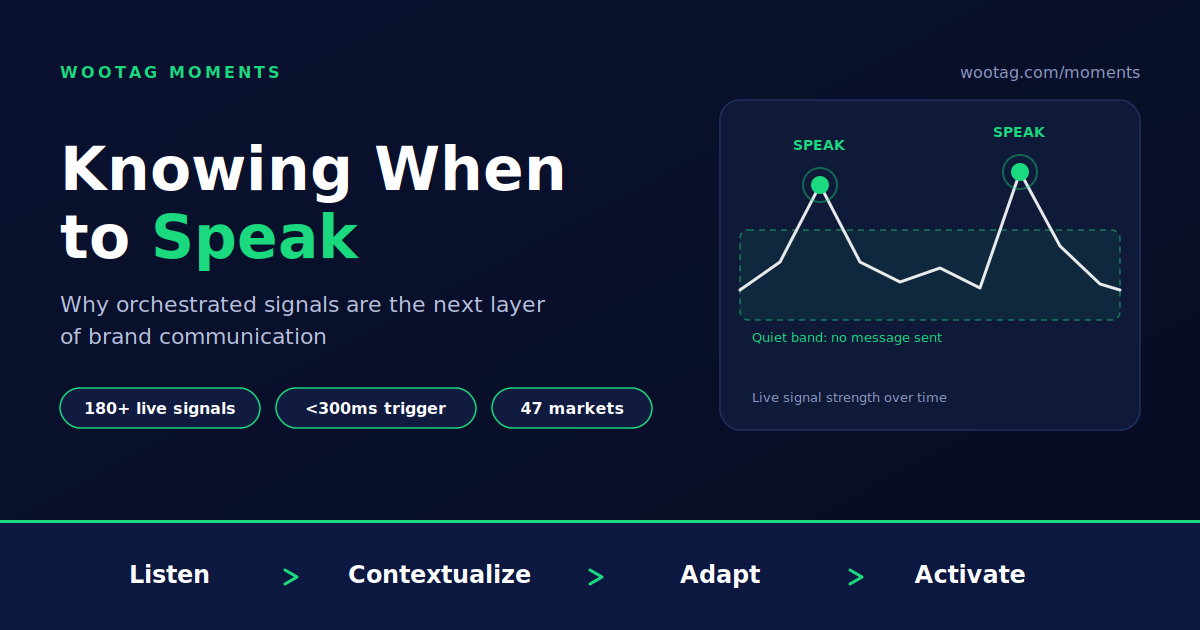
Wootag Moments is a signal orchestration layer. It listens to the real world, decides what a signal means for your brand, and controls what goes out across every surface. Every moment runs through four steps.
Listen. More than 180 live signal feeds across sports, weather, markets and commodities are watched continuously.
Contextualize. Each signal is mapped to brand safe creative, offers and local triggers. This is where your rules live: thresholds for when a signal is strong enough to matter, tone for how the brand should sound, and conditions under which the answer is no.
Adapt. Assets are reshaped to suit the context, format and message of each surface.
Activate. Activations fire across social, CTV, programmatic, push, shoppable and retail screens, with trigger latency under 300 milliseconds.
The result is a single decision on what a brand says, to whom, in what tone and at what moment, including the decision to say nothing. Creative is one output of that decision, not the whole of it.
How this answers each part of the theme
Guardrails. Brand rules, thresholds and sensitive contexts are set once at the signal layer and apply everywhere. You can start with a few signals and tight limits, then widen as results come in.
The human role. Brand and agency teams stop producing one more asset for one more segment. They define the principles: which signals suit the brand, what tone each deserves, and where the brand should never appear. Smart assets then carry that thinking into every format.
Incremental value. Every moment should earn its place. Holdout groups and uplift analysis belong in any moments programme, so you can see which moments change behaviour and which should be retired.
Proof that silence can be a feature
The clearest example is Franklin Templeton, which ran a mutual fund activation on a live stock index signal.
A move of 0.3% or more upward triggered a growth led film. A move of 0.3% or more downward triggered a stability led film. Anything inside the narrow band in between, and the activation paused on its own. No ad served and no budget spent on a moment that did not matter.
The brand reported an 8.3x CTR uplift, 24% budget saved and zero wasted impressions. The uplift is the headline, but the lesson is the restraint: the brand wrote its silence into the rules.
The same discipline shows in the sports work. Valvoline on connected TV and Budweiser on display each treated every FIFA moment as its own decision, with a different creative for Goal, Halftime, Penalty, Team Win or Pre-Match. The message changed because the moment changed.
Why this has to sit above the channel
If restraint lives inside one channel, it only works in that channel. A brand might hold back on social during a sensitive event while push and programmatic carry on as usual. The customer experiences one brand, not four tools.
That is why orchestration works best as a layer beneath the channels. One decision is made once, then expressed natively on every surface. It also sits beneath your existing CDP, CRM and automation platforms rather than replacing them.
Where this applies, by vertical
| Vertical | Live signal | When to speak | When to stay silent |
|---|---|---|---|
| Home care and FMCG | Temperature, rain, air quality | A threshold is crossed that changes the need | Conditions are ordinary, or local stock is low |
| Mutual funds and fintech | Index and market moves | A meaningful swing in either direction | Inside the quiet band, as in the Franklin Templeton activation |
| QSR and F&B | Match events, local weather | Halftime, a goal, a cold snap | The store is closed or the item is unavailable |
| Automotive and lubricants | Live match events | A penalty, a goal, a final whistle | A moment that does not fit the brand’s tone |
| Travel and mobility | Weather, delays, disruptions | A clear, helpful reroute or offer | Severe disruption where a promotional tone would land badly |
Where store level signals such as inventory are connected, they sharpen the silence rules further. Public signal use cases like fintech or FMCG need no physical retail infrastructure.
The takeaway
Personalisation asks who the customer is. Orchestrated signals ask what is happening in their world right now, and whether your brand has anything worth saying about it. The brands that earn trust will answer both, and will treat a held back message as a result, not a miss.
Want to see how this works on your category? Tell us the signal that matters to you and we will show you a live moment built on your brand in 20 minutes. Book a demo at wootag.com/moments
Knowing When to Speak: Why Orchestrated Signals Are the Next Layer of Brand Communication
