

Meta remains the default home for brand budgets. Retail and ecommerce alone push over $180 billion into digital advertising, and a large share of that still lands on Facebook and Instagram feeds, stories, and reels. Financial services, technology, automotive, and CPG brands sit right behind them, all fighting for the same scroll.
Most teams read the problem as a creative one: the ad gets old, engagement drops, someone briefs a new visual. That diagnosis is too narrow. Creative is just the visible layer. What actually stays frozen is the whole communication, the message, the offer, the tone, the format, and the moment it gets shown, all locked the instant a campaign goes live. A brand sets a plan, ships assets, and lets the campaign run for weeks while the world underneath it keeps changing, weather shifts, matches turn, prices move, paydays land, and the entire communication logic stays exactly as it was on day one.
That mismatch is now measurable and it is getting worse. Creative fatigue on Meta used to take six or more weeks to set in. In 2026, it shows up in two to three weeks, largely because Meta’s newer ranking systems read creative-level signals far more aggressively than before, so a stale ad gets penalized faster than it used to. Once frequency on a cold audience crosses roughly 2.5 exposures a week, engagement starts to slide, and past 4.0 it falls off a cliff. Cost per action can climb 40 percent within two weeks of a brand ignoring the early warning signs. None of this is a Wootag number. It is simply what is happening across Meta’s own auction right now, and it is a symptom of a missing layer, not a missing creative variant.
Why swapping creative doesn’t fix this
Most teams already know their ads go stale. What they lack is not more creative, it is a system that decides, in real time, what a brand should be saying, to whom, and on which surface, based on what is actually happening in the world right now. Producing new visuals for every weather swing, match moment, or market move would require an agency retainer built for daily output and a media team watching signals around the clock. That is not a creative problem to be solved with a bigger production calendar. It is an infrastructure gap: nothing sits between the real world and the ad account, translating one into the other.
This is also true regardless of which channel carries the campaign. The same static-communication problem shows up on connected TV, programmatic display, and DCO just as much as it does on Meta. A signal layer that sits underneath the entire martech stack, not bolted onto one ad account, is what actually closes that gap. That is the idea behind a Moments OS: a layer that listens to the world and decides communication, independent of which platform ends up carrying it.
Moments OS as the layer beneath Meta
Wootag Moments works on a simple loop: Listen, Contextualize, Adapt, Activate. Listen means ingesting live signals, weather, live sports events, market and index movements, news, payday cycles, across 180-plus signal feeds. Contextualize means matching a signal to the right audience, market, and moment for that specific viewer. Adapt is where the decision actually happens, not just which image to show, but which message, which offer, which tone fits the moment, with creative as one output of that decision rather than the decision itself. Activate is where it fires, in under 300 milliseconds, across every live surface.
On Meta specifically, that loop plugs in through the Business Manager, Page, and Ad Account in a single setup, no code, no engineering ticket. But what gets connected is not a creative delivery tool, it is a decision layer. Once it is live, a signal, weather, a sporting event, a market move, a news trigger, decides the full communication that fires across organic posts, display ads, video ads, Instagram stories, and reels. The brand’s existing account structure and creative library stay exactly where they are. What changes is that Meta stops running on a fixed plan and starts running on a live decision made for that viewer, in that market, at that moment.
That is a meaningfully different model from most creative tools on Meta today. Dynamic creative optimization on the platform mostly recombines a brand’s own assets against audience and placement signals it already has. A Moments OS adds an input most brands are not using at all: real-world context. A viewer’s local temperature, the state of a live match, a currency or index move, a payday cycle, all become part of the decision, not just the audience segment an ad happens to be shown to.
Where the shift shows up
Personal care and CPG brands running weather-linked communication see the most direct read on this. Everyuth ran a tan-removal scrub campaign across Instagram and Facebook where the live city temperature decided the full communication a viewer saw, which image, which video, which message. Once the moment matched the weather, engagement lifted 2.3x, video moments performed 2.7x better, and cost efficiency improved 37 percent, a self-reported result from Wootag’s own campaign data, not a third-party audited benchmark. The creative changed because the underlying decision changed, not the other way around.
The same logic scales across categories that already spend heavily on Meta:
Retail and ecommerce: the offer itself shifts with weather, paydays, or live events, not just the banner promoting it Food and beverage, QSR: the message pivots between hydration and comfort framing based on temperature and time of day, not a fixed content calendar Financial services and fintech: tone and framing move with market or index conditions, useful for awareness and consideration content, not conversion-styled offers Automotive: the communication shifts toward tires, fluids, or accessories based on the actual conditions a driver is in that week Personal care and beauty: messaging moves with heat, humidity, and UV levels rather than a seasonal campaign calendar Telecom and consumer electronics: communication concentrates around live-event and sports moments during major tentpole matches and launches, when attention spikes hard and briefly
None of these need a new creative brief every time. They need a decision layer connected to signals that decides what gets said and when, with creative simply following that decision.
Sourcing, kept transparent
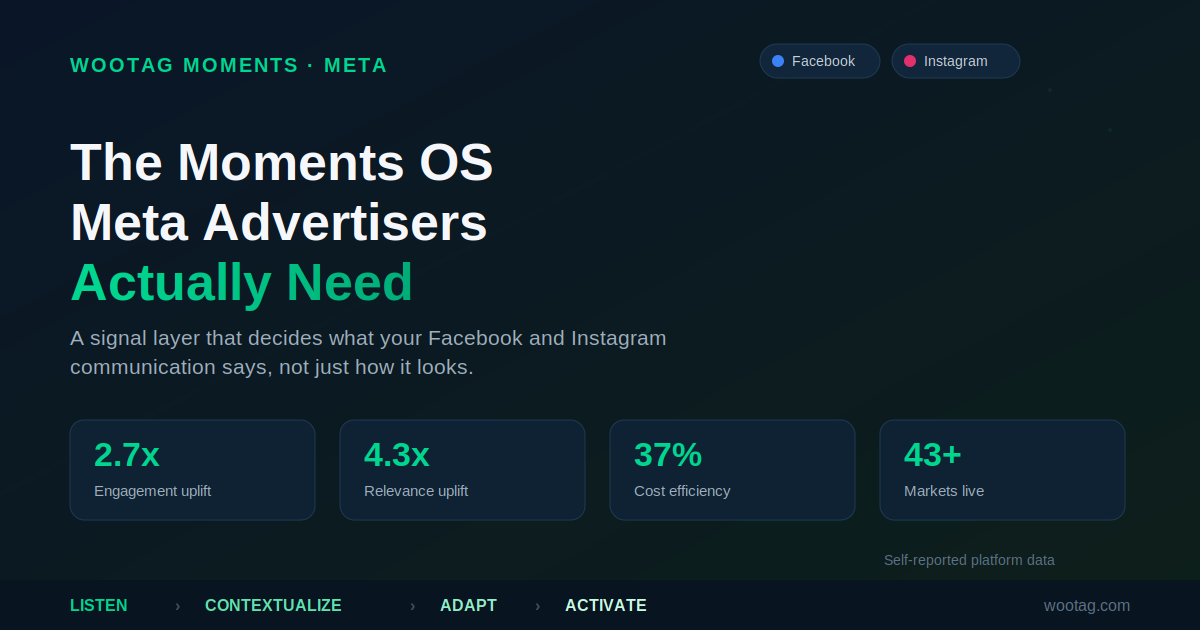
Two different kinds of numbers sit in this post, and they should not be read the same way. Wootag’s own platform figures, the 2.7x engagement uplift, 4.3x relevance uplift, 37 percent cost efficiency, and 43-plus market coverage on Meta, along with the Everyuth case study results, are self-reported outcomes from Wootag campaigns and should be treated as such, not as independently audited industry benchmarks. The creative fatigue and frequency data referenced earlier, the two-to-three-week fatigue window, the 2.5 to 4.0 weekly frequency thresholds, and the 40 percent CPA rise, come from independent Meta advertising research published in 2026 and are cited as third-party findings. Any statistic that could not be traced to a credible source has been left out rather than approximated.
Where this leaves a Meta media plan
None of this replaces a brand’s existing Meta strategy, and it does not live only on Meta either. It sits underneath the stack, alongside the CDP, the CRM, and whatever automation platform already runs the account, as the layer that decides communication before any of those systems execute it. The Business Manager, the Pages, the ad accounts, the creative library, all stay exactly where they are. What changes is whether the communication sitting inside that structure reflects what is true right now, or what was true when someone last opened the ad account. For brands already spending seriously on Facebook and Instagram, that is the difference between paying for reach and paying for reach that actually says something relevant when it lands.
See what a live moment looks like on your own Meta account at wootag.com/moments/meta, or look through more results across categories at wootag.com/moments/case-studies. Setup takes under five minutes and nothing about the existing creative library needs to change to start.
