
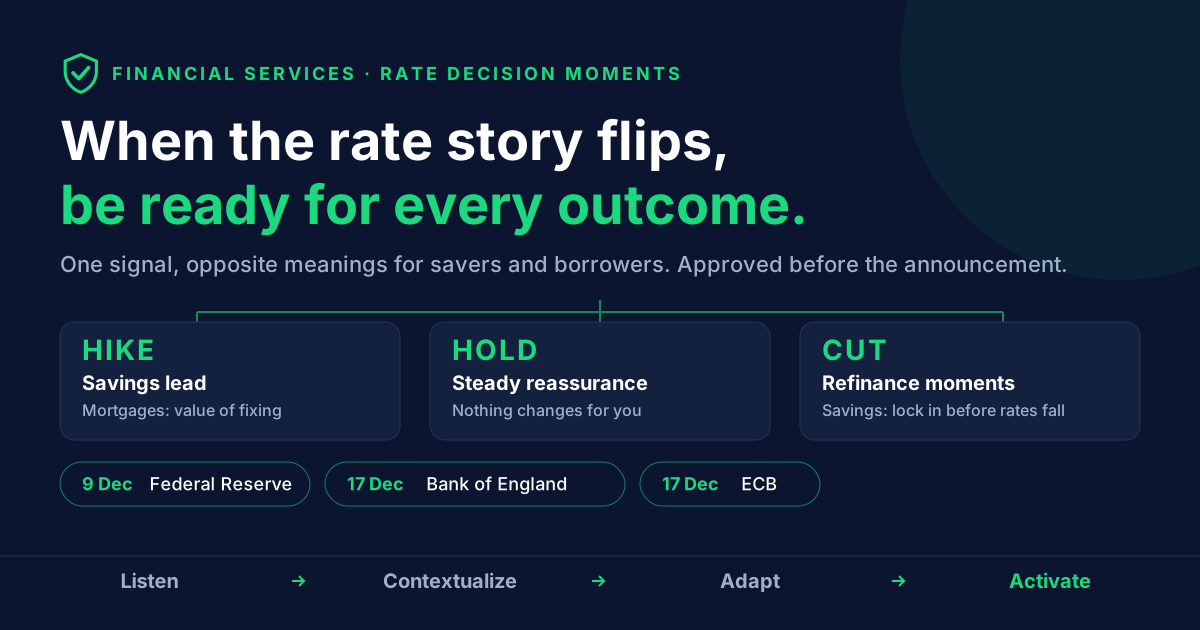

A central bank decision is one signal with opposite meanings for savers and borrowers. Here’s how financial brands can be ready for every outcome before the announcement lands.
In short
- A rate decision is good news for a saver and bad news for a borrower, at the exact same moment. A single “rates have changed” message serves neither.
- Brands that prepare approved communications for every outcome (hike, hold or cut) and by product can activate the minute the official decision is published, without speculating and without waiting on a review queue.
- With the Fed deciding on 9 December and the Bank of England and ECB on 17 December, financial brands have about four weeks to build their rate decision moments.
It’s 2:00 pm in Washington on 9 December. The Federal Reserve publishes its decision.
Within seconds, the same news means something completely different to three of your customers. One has savings sitting in an account that pays almost nothing. One is about to remortgage. One carries a balance on a card.
Most banks will send all three the same thing, or nothing, a few days later.
This time the decision carries more weight than usual. The Fed held rates at 3.75% to 4.00% at its October meeting, and after a strong October jobs report, prediction markets now put the odds of a December hike above 75%. For a year that began with talk of cuts, the direction of the story may be about to reverse. Moments like that are the ones customers act on.
The gap: rate decisions are scheduled, yet most brands still react late
Few moments in marketing are as predictable as a central bank decision. The date is published a year ahead. The time is fixed to the minute. Only a handful of outcomes are possible.
And customers do respond to them. In September 2025, the Mortgage Bankers Association recorded a jump of almost 30% in weekly mortgage applications as rates fell ahead of an expected Fed cut, with refinance applications up nearly 60% on the prior week. On the savings side, an April 2026 survey of 1,000 US savers by Credit One Bank found that 48% had moved savings to another bank in the previous 12 months. Two thirds said a one point rate cut would push them to shop around.
So the demand is real and the timing is known. Yet in most financial brands, communication around a rate decision follows the same slow path. The decision lands, product teams update rates, marketing drafts copy, compliance reviews it, and the communication goes out days later, when the customer has already compared options somewhere else.
Why the gap persists
The usual reason is not a lack of data. It’s that one decision creates several conflicting messages, and nobody has prepared them ahead of time.
A hike means “earn more” for savings and fixed deposits, “lock in now” for anyone weighing a fixed mortgage, and “be careful” for variable-rate borrowers and card holders. A cut flips all of that. A hold says something else again. Multiply that by every product line and every market a brand operates in, and the work feels too big to do in advance.
Then compliance rules out the easy shortcut. Financial brands can’t publish speculation about what the central bank will do, and they can’t have AI write rate claims on the fly. So they wait until the announcement, and the moment passes while the work gets done.
The fix is to flip the order. Do the thinking, the writing and the approvals before the decision. Then let the decision itself pick which approved communication goes out.
How a rate decision becomes a set of moments
On Wootag Moments, a central bank decision isn’t a single trigger. It breaks into distinct moments, each with its own rules.
Before the decision: inform, never predict
In the days leading up to a decision, interest builds and search spikes. Brands can stay useful here with approved educational content: what a rate decision means for your savings, how a fixed rate differs from a variable one, what to check on your mortgage renewal date. The rule is simple. Explain, never forecast. Moments that would require a prediction stay switched off.
The announcement: one signal, three branches
The moment the official decision is published, the signal resolves to hike, hold or cut. Brands upload approved creatives for each branch and each product, and the platform pairs the right one automatically.
- Hike: savings and deposit products lead with better returns. Mortgage communications shift to the value of certainty. Messaging around variable-rate credit becomes careful, or stays silent.
- Hold: a quieter moment, good for steady reassurance and “nothing changes for you” clarity.
- Cut: borrowing and refinance communications come forward. Savings communications focus on locking in today’s rates before they fall further.
Nothing activates on speculation. The guardrail is the official announcement itself.
After the decision: when your own rates move
The central bank decides. Your product rates follow a day or a week later. That pass-through is a moment in its own right, and brands can feed their own rate changes into Moments as a custom signal. The communication then reflects the real rate a customer will get, not a general statement about the market.
Compute adds the moments a single reading misses
Not all hikes are the same moment. A hike after a long run of holds is a turning point. A third hike in a row is a continuation. A larger move than expected lands differently from one the market had already priced in.
Wootag’s compute framework reads a signal against its own history: direction, duration and size. That turns one decision into richer moments. A brand can save its “the cycle has turned” communication for a genuine first move, and use a lighter touch when the change is simply more of the same.
Compliance stays in control
Everything here sits on the guardrails financial brands need, which we covered in detail in our recent post on compliance:
- Signals from verified sources, so the decision your activation responds to is the official one.
- Moments you switch on or off, by product and by market, so a brand never speaks where it shouldn’t.
- Creatives your team has already approved, uploaded by moment and paired automatically, never written by AI at runtime.
- Activation guardrails, such as firing only after the official announcement or only within a market’s business hours.
We have seen this threshold-led approach work in financial services. Franklin Templeton activated only when the Sensex moved past a ±0.3% threshold, which delivered an 8.3x CTR uplift, 24% of budget saved and zero wasted impressions. Rate decision moments apply the same discipline to a different signal.
The channel shouldn’t decide the message
Customers will hear about a rate decision across news apps, social feeds, push notifications, search and connected TV. If each channel is planned separately, each becomes a separate place for the message to be late, wrong or inconsistent.
The stronger approach is to make the decision once, in a layer above the channels. Which outcome occurred, which product it affects, which approved communication matches, and when it can go live. Every channel then receives the same governed decision at the same time. Adding a channel adds reach, not more work.
How rate decision moments map across financial services
| Segment | Hike moment | Cut moment | Guardrail to apply |
|---|---|---|---|
| Savings and deposits | Better returns, open or top up now | Lock in today’s rate before it falls | Only show rates that are live on the product |
| Fixed deposits and CDs | Higher fixed returns for a set term | Secure a fixed term before rates drop | Match term and rate to the published rate card |
| Mortgages and home loans | Value of fixing for certainty | Refinance and switch moments | Activate only after the official decision |
| Credit cards, personal loans, BNPL | Careful, helpful messaging or silence | Balance transfer and consolidation offers | Consumer credit promotion rules by market |
| Insurers and annuity providers | Improved annuity and savings plan rates | Long-term protection value | Product availability by market |
| Remittance and FX | Currency moves that follow the decision | Currency moves that follow the decision | Fire only within a defined FX value range |
The December calendar is already set
Three of the world’s most watched decisions land within nine days of each other:
- Federal Reserve: Wednesday 9 December, 2:00 pm ET
- Bank of England: Thursday 17 December, 12:00 pm UK time
- European Central Bank: Thursday 17 December
Other central banks follow their own calendars, and the same playbook applies to each. Four weeks is enough time to map products to outcomes, get approvals done and switch the moments on. It is not enough time to start after the announcement.
Sourcing and transparency
From Wootag : Wootag’s published platform specifications are 180+ live signal feeds, sub-300ms trigger latency and availability in 47 markets. The Franklin Templeton results (8.3x CTR uplift, 24% of budget saved, zero wasted impressions, Sensex ±0.3% threshold) come from Wootag’s own case study at wootag.com/moments/case-studies. The capabilities described here, including moment configuration, approved creative upload by moment, activation guardrails, custom signals and the compute framework, describe how Wootag Moments works.
From independent and third-party sources:
- Fed funds target range of 3.75% to 4.00% after the 28 October 2026 hold, and market odds of a December hike, from Kalshi’s Fed rate market (kalshi.com), accessed 10 November 2026. Prediction market odds change daily.
- Reporting that a strong October jobs report raised hike expectations, from Crypto Briefing.
- Mortgage Bankers Association weekly survey data (week ending 12 September 2025: composite index up 29.7%, refinance applications up almost 60%), as reported by RISMedia.
- Credit One Bank’s April 2026 survey of 1,000 US adults with savings accounts or CDs, distributed via Stacker. This is a bank-commissioned survey and should be read as such.
- Central bank dates from the Bank of England’s published MPC calendar and FinanceCalendar’s ECB and FOMC schedules.
Wootag Moments supports a financial brand’s compliance process. It doesn’t replace the brand’s own legal and compliance review, which stays in control of what is approved and where it can run.
Be ready before the announcement
A rate decision is one of the few moments in marketing where you know the date, the time and every possible outcome in advance. The brands that win it won’t be the fastest writers on the day. They’ll be the ones who wrote, approved and mapped everything before it.
If you want to build rate decision moments for your products and markets before December, talk to us at wootag.com/moments.
When the Rate Story Flips: Why Banks and Lenders Need Rate Decision Moments
