
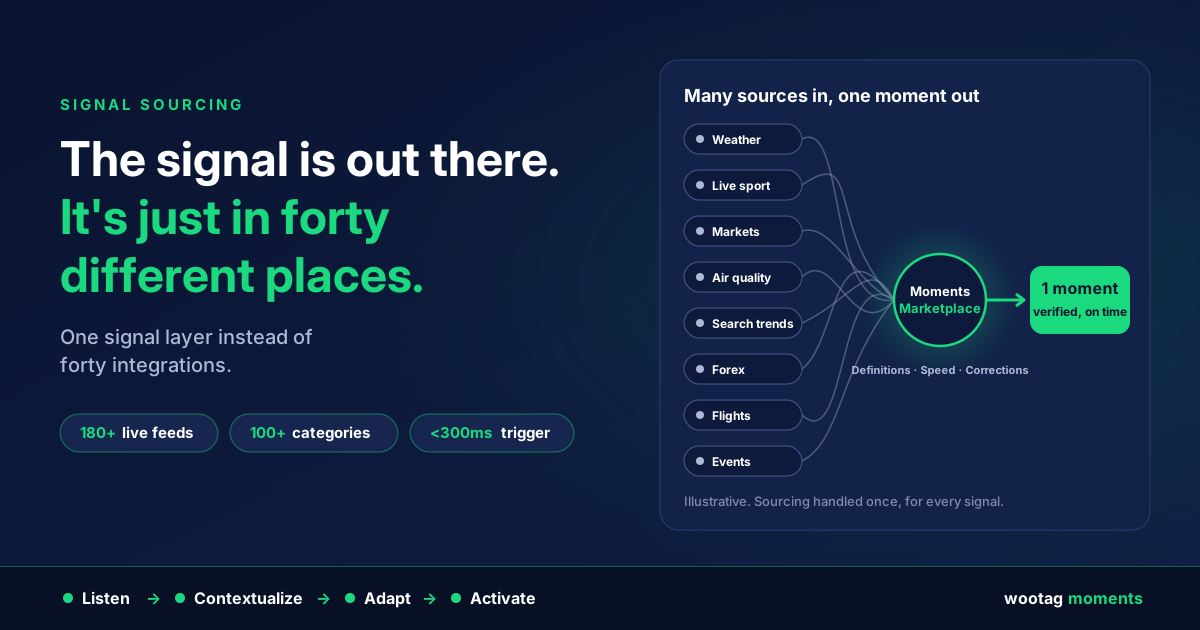

Weather, sport, markets and air quality are public. Turning them into something a brand can act on in under a second is the hard part, and most teams find that out too late.
In short
- Real-world signals are easy to find and hard to use. Each one sits with a different provider, in a different format, with its own speed, licence and quirks.
- Stitching them together yourself turns a marketing idea into a data engineering project, and the moment usually passes before it’s finished.
- A unified signal layer handles sourcing, verification and timing once, so your team spends its time deciding what to say, not chasing feeds.
It usually starts with a good idea in a planning meeting.
“Let’s react when it gets hot. And when our team scores. And when the market moves.” Everyone agrees. It sounds simple, because all of those things are public. The weather is on your phone. The score is on every screen. The index is on the news.
Then someone tries to build it.
Weather needs one provider, and it has to cover every city you sell in, not just the capitals. Live match data needs another, with its own licence and its own names for teams and players. Market data needs a third, and the terms for using it commercially are stricter than anyone expected. Air quality comes from a fourth, and it updates on a different schedule from the rest.
That’s four contracts, four formats, four speeds and four ways for something to break. And that’s before anyone has written a single message.
By the time it all works, the heatwave is over and the season has finished.
Available isn’t the same as usable
Most of the signals brands want are public in the sense that anyone can see them. That isn’t the same as being ready to drive a marketing activation in real time.
The problem isn’t unique to outside signals, either. Salesforce’s latest State of Marketing research, based on around 4,450 marketers, found that the average organisation already manages data across seven different sources. Only 26% said they were completely satisfied with how well that data is connected. That’s just the customer data a brand already owns. Real-world signals add another layer on top.
Adding more tools hasn’t solved it. Gartner’s 2025 Marketing Technology Survey found that martech utilisation has dropped to 49%. Half of what marketers already pay for goes unused. Another point tool for each signal won’t fix that.
Why sourcing signals is harder than it looks
Every signal lives somewhere different. Weather, sport, markets, commodities, air quality, search trends, events and flight data all come from different specialist providers, and coverage varies by region. A provider that’s strong in Europe may be thin in Southeast Asia.
The same word means different things. A “heatwave” in Singapore and a heatwave in London are different temperatures. A “goal” can be scored and then cancelled by VAR two minutes later. Unless the definitions are set and tested, the moment fires on the wrong thing.
Speed and reliability vary. A feed that arrives 90 seconds late fires a celebration after the replay has already moved on. A feed that drops out during a final fires nothing at all. A real-time moment is only as good as the slowest and least reliable signal behind it.
Corrections matter as much as events. If a goal is overturned, the celebration needs to stop straight away. If a market figure is revised, the message built on it needs to change. Most homegrown setups handle the first event and forget the correction.
Licences and verification aren’t optional. Market and sports data come with usage terms. For regulated brands, especially in financial services, the source of a figure has to be verified before it appears in anything customer-facing.
It never stays finished. Providers change their APIs. New tournaments, new markets and new cities get added every year. Someone has to maintain all of it, and that someone is rarely in marketing.
What a signal needs before a brand can act on it
Before a signal can safely trigger a communication, it needs:
- A verified source you’re allowed to use commercially.
- A clear definition of what counts as the moment, per market.
- Event-level detail, so you know who scored, not just that the score changed.
- Location mapping that matches the cities and stores you actually sell in.
- A speed you can rely on, measured from the event to the trigger.
- Correction handling for overturned, revised or cancelled events.
- History, so growth, volatility and patterns can be computed, not just the latest reading.
Miss any one of these and the moment either fires late, fires wrong or doesn’t fire at all.
One signal layer instead of forty integrations
This is why we think the signal source matters as much as the orchestration. Deciding what to say at a moment is only possible once the moment has been detected reliably.
At Wootag, signals come together in one place, the Moments Marketplace. Today that covers 180+ live data feeds across 100+ signal categories, from sports, weather, stocks and commodities to box-office openings, flight delays and festival calendars, with custom signals available on request. Moments trigger in under 300 milliseconds. For regulated brands, signals come from verified sources, and brands can set guardrails such as exchange time bands and value ranges.
A brand chooses the signals that matter, sets the rules, and uploads its own approved creative for each moment. Inside signals, like stock, pricing and store data, connect through API and join the same layer. On top of that, the compute framework turns raw readings into extra moments, such as whether a market is trending up or down across a day, or whether a heatwave is a one-off or a pattern.
The result is that a marketing team works on the message and the rules, while sourcing, definitions, speed and corrections are handled once, for every signal.
Building it yourself vs using a signal layer
| Building it yourself | Using a unified signal layer | |
|---|---|---|
| Sources | One contract and integration per signal type, per region | Choose signals from one place |
| Definitions | Written and tested in-house for every market | Defined per signal and market, configurable by brand |
| Speed | Varies by provider and integration | Under 300ms from signal to trigger |
| Corrections | Often missed until something goes wrong | Handled as part of the signal |
| Verification | Checked case by case | Verified sources for regulated categories |
| New signals | A new project each time | Added to the marketplace or requested as custom |
| Who maintains it | Engineering, on top of everything else | The platform |
The moment shouldn’t depend on one channel
Once a signal is reliable, the same moment can reach people wherever they already are: social feeds, short video, CTV, programmatic display, push notifications, email, retail screens and marketplaces. The signal layer and the rules sit above all of them.
Your CDP, CRM, customer engagement platform and media buying stay where they are. What changes is that every one of them can now respond to the same real-world moment, at the same time, with a message that fits.
How many feeds each vertical would need
| Vertical | Signals it typically uses | What you’d otherwise stitch together |
|---|---|---|
| FMCG and beverages | Weather, live sport, festivals | A weather provider, a sports data licence, a holiday and events calendar |
| Personal and home care | Temperature, humidity, air quality | Weather and AQI feeds with city-level coverage in every market |
| Banks, wealth and fintech | Indices, currencies, rate decisions | Licensed market data, central bank calendars, verified sources for compliance |
| QSR and food delivery | Match schedules and events, rain, time of day | Sports data, hyperlocal weather, your own delivery capacity |
| Travel and airlines | Destination weather, forex, events, flight delays | Weather, FX feeds, event listings, flight status data |
| Automotive and lubricants | Race events, fuel prices | Motorsport data, fuel price feeds by market |
| Retail and apparel | Weather, local stock, search trends | Weather, inventory systems, trends data |
| B2B and enterprise | Market moves, sponsorship results, industry events | Market data, sports or event data, trade show calendars |
Sources and transparency
Wootag platform : 180+ live data feeds, 100+ signal categories, custom signals on request and sub-300ms trigger latency are from wootag.com/moments. Verified sources, brand-uploaded creative by moment and activation guardrails for financial brands, along with the compute framework, are Wootag platform capabilities as described by the Wootag team.
Third-party research: The seven data sources and 26% satisfaction figures are from Salesforce’s Tenth Edition State of Marketing report, based on around 4,450 marketers worldwide, and refer to customer data rather than real-world signals. The 49% martech utilisation figure is from Gartner’s 2025 Marketing Technology Survey.
Start with the signals, not the integrations
If your team has a list of moments it wants to react to and a longer list of reasons it hasn’t happened yet, the problem is probably sourcing, not ideas.
Tell us the signals that matter to your category, and we’ll show you a live moment built on your brand in 20 minutes, without a single new integration on your side.
The Signal Is Out There. It's Just in Forty Different Places.
