

How memory structures drive growth, and how Wootag Moments keeps building them in the white spaces between your big activations
In short
- Memory structures are not deep reasons to love a brand. They are the links in a buyer’s head that make a brand easy to notice and recall when a need shows up. That is mental availability.
- Distinctive brand assets (colours, characters, sounds, shapes, lines) make sure every exposure refreshes your brand’s memory and not a rival’s. Category entry points decide when that memory gets used.
- Memory fades between bursts of activity. Wootag Moments orchestrates real world signals all year so brands show up, fully branded, in the everyday moments that sit between tentpoles. Those white spaces are where memory is either refreshed or quietly lost.
It is a hot Thursday afternoon. Someone walks into a convenience store, opens the cooler and picks a drink. The whole decision takes a few seconds. They did not weigh brand values, read a manifesto or recall a purpose film. One brand simply came to mind faster than the others, and the hand followed.
That speed is the point. Research from the Ehrenberg-Bass Institute, summarised by Nielsen, found that the average shopper spends around 13 seconds buying a brand in store and about 19 seconds online, with most online purchases taking under 10. Nobody is building an argument in that window. They are retrieving something that is already there.
What is already there is the brand’s memory structure. And for most marketers, the hard question is not how to build it once. It is how to keep it from fading in the long, quiet stretches of the year when the media plan goes dark.
1. What are memory structures?
A memory structure is the network of links a person holds between a brand and everything it connects to: a colour, a logo, a sound, a pack shape, but also a need, an occasion, a time of day, a place, a person they are with.
The Ehrenberg-Bass Institute describes the brand as a node in an associative memory network. Each link connects the brand to something a buyer might be thinking about. The researchers call those triggers category entry points (CEPs): the situations, needs and occasions that make someone think about a category in the first place. “I’m thirsty and it’s hot.” “Friends are coming over for the match.” “Markets dropped and I’m worried about my savings.”
Here is the part that gets misunderstood. Building memory structures does not mean teaching consumers deep philosophical reasons to love a brand. It means building mental availability, the likelihood that a brand gets noticed, recognised or recalled at the moment a buying situation comes up.
The more category entry points a brand is linked to, and the stronger and fresher those links are, the more often it gets retrieved. A brand with high mental availability is not necessarily loved more. It is simply thought of more, by more people, in more situations. And the brand that comes to mind is the brand that gets bought.
2. How distinctive brand assets (DBAs) build memory
If CEPs are the doors into a category, distinctive brand assets are the name on the door.
Jenni Romaniuk of the Ehrenberg-Bass Institute, who originated the term, defines distinctive assets as the “non-brand name elements that trigger brand recall in the minds of category buyers.” Think of a gecko, a four note sound, a specific shade of red, a bottle silhouette, a recurring line.
DBAs do two jobs.
They make exposures count for the right brand. A piece of communication that is noticed but not correctly attributed is a gift to the category leader. Distinctive assets do not create salience on their own, but they make sure that when a brand is seen, it refreshes that brand’s memory structures rather than a competitor’s.
They are shortcuts. In a feed scrolled at speed or a CTV break watched half distracted, there is often no time to read a brand name. A colour or character registers in a fraction of a second. Repeated in context, these cues become mental hooks that let people recall a brand almost automatically when they are in a buying moment.
Romaniuk measures asset strength on two dimensions. Fame is how many category buyers link the asset to the brand. Uniqueness is whether they link it only to that brand. An asset needs both. Every new asset starts low on each, and the only way to move up is consistent, repeated use. Her research also separates asset using from asset building. Putting the logo on a banner is using. Showing it consistently, across many contexts, to many buyers, over time, is building.
That last point matters for everything that follows. DBAs are not built by one great piece of creative. They are built by repetition across contexts.
3. The role of memory structures in brand growth
Ehrenberg-Bass work on how brands grow points to a few patterns that are now well established.
Growth mostly comes from light buyers. Most of a brand’s buyers purchase it rarely. In UK breakfast cereal, Ehrenberg-Bass data shows buyers purchase from the category about 25 times a year on average, yet 61% buy less often than that. For Head and Shoulders shampoo in the UK, 35% of buyers bought only once in six years. These people are not thinking about your brand between purchases. Their memory of you is thin, and it is the main thing standing between you and their next purchase.
Memory fades, and it fades faster than marketers expect. Ehrenberg-Bass research on what happens when brands stop mass reach advertising found that the reinforcement of brand memory structures stops when the activity stops, and light category buyers stop being reminded what the brand is. The recovery is lopsided: a year off air leads to sales losses that take more than a year to win back. LinkedIn’s B2B Institute calls this memory corrosion and compares brand building to repainting the Golden Gate Bridge. The work is never finished.
Continuity and recency beat bursts. Ehrenberg-Bass researcher Dr Virginia Beal frames media timing around recency, continuity and reach. When people are reached closer to the moment they buy, the fresher memory raises the chance they pick the brand. Going completely dark, she notes, effectively hands your buyers’ memory structures to competitors.
More entry points mean more chances to be chosen. Mental availability grows when a brand is linked to more of the category’s buying situations, not just the one the brand team likes best. A beverage brand linked only to “celebrations” is invisible on an ordinary hot afternoon.
Put these together and you get a simple growth equation: reach many category buyers, keep their memories fresh, and link the brand to as many real buying situations as possible, all while using the same distinctive assets so the credit lands on you.
The white space problem
Now look at how most annual plans actually run.
The year is built around a handful of tentpoles: a big seasonal launch, a festive push, a sponsorship, maybe a major sporting tournament. Budget concentrates around these peaks. Between them sit long stretches with little or no brand communication. These are the white spaces.
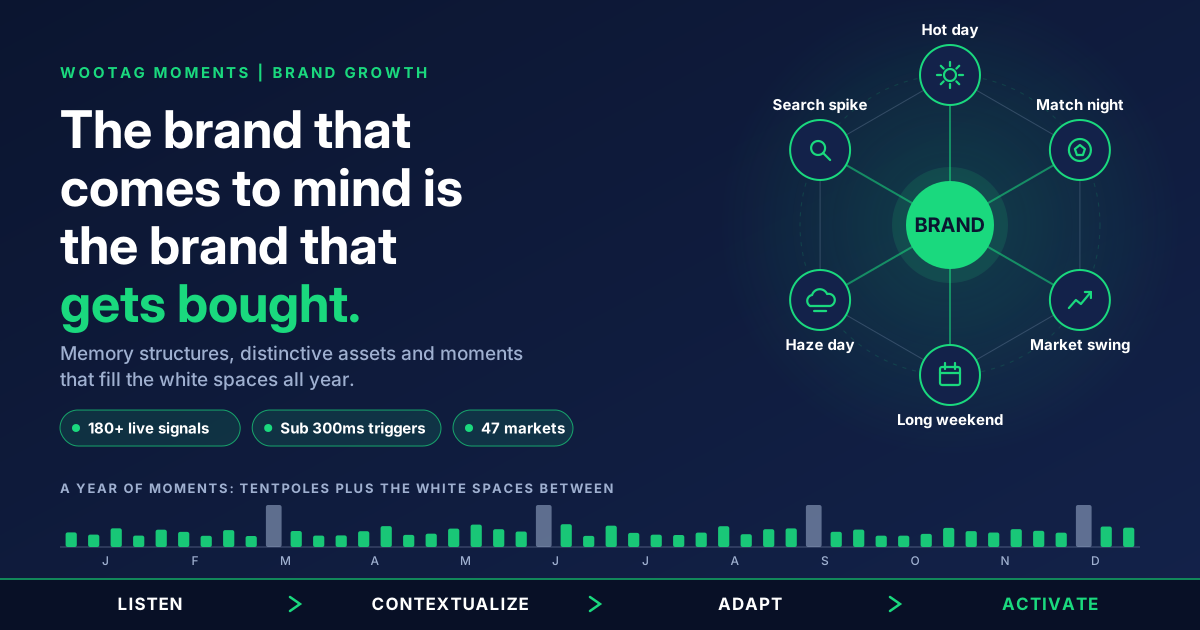
White spaces are where memory structures decay. But here is the twist: they are not quiet for your buyers. Life keeps happening. The weather turns. A local derby sells out. A heatwave hits three cities. Markets swing. A long weekend appears on the calendar. Haze rolls in. Search interest for a category spikes overnight. Every one of these is a live category entry point, a moment when somebody, somewhere, enters your category.
The gap persists for three reasons.
- Planning cycles are slow, moments are fast. By the time a brief is written, approved and trafficked, the hot afternoon is over.
- Signals are fragmented. Weather lives with one provider, sports data with another, market data with a third, retail stock in the brand’s own systems. Nobody on the marketing team is watching all of them at once.
- Always on usually means always the same. Many brands do keep a low level of activity running between peaks, but it is one generic message on loop. It holds reach, but it does not connect the brand to the specific situation the buyer is in, so it does little to build new entry point links.
The result is a brand that is loud at four or five moments a year and generic or absent for the rest, while its light buyers walk into the category on hundreds of ordinary days.
4. How Wootag Moments helps brands build memory structures
Wootag Moments is a signal orchestration platform. It connects real world signals to brand communication across channels, so a brand can show up in the right context, with the right message, at the moment the context occurs. Applied to memory structures, it does four things through its Listen, Contextualize, Adapt and Activate framework.
Listen: find the entry points as they happen. Moments ingests 180+ live signals across sports, weather, stocks, commodities, festivals, search trends and more, plus retail signals such as store stock and pricing for brands that connect them. Each signal is a proxy for a category entry point. A temperature crossing a threshold in a city is “hot and thirsty.” A goal in a live match is “watching with friends.” An index dropping is “worried about my money.” Because these signals are unified through the Moments Marketplace, a brand does not need to stitch providers together to see them.
Contextualize: decide what the moment means for the brand. Rules map each signal to a moment, and each moment to an approved message. The compute layer adds moments a single reading cannot, for example separating a sustained heat pattern from a one day spike, or a steady market climb from a volatile session. Just as importantly, brands configure moments to avoid. Franklin Templeton’s activation on Moments paused automatically whenever the Sensex moved within a narrow band, with no communication served. Silence is a design choice. Memory links can be built in the wrong context too, and suitability rules protect the structure you are trying to build.
Adapt: keep the brand’s assets constant while the context changes. This is where memory building and moment marketing meet. Brands upload their own approved creatives and messages by moment, and Moments pairs them automatically rather than inventing new creative. The context line changes (“This penalty calls for a Bud”). The distinctive assets do not. Same colours, same character, same sonic cue, same layout logic, reshaped across 9:16, 1:1, 16:9, display and CTV formats. Every activation becomes an act of asset building, not just asset using.
Activate: show up wherever the buyer is, sub 300 milliseconds after the signal. Moments activates across Meta, TikTok, CTV and OTT, programmatic and DV360, publisher sites, retail media, push notifications and shoppable surfaces, live in 47 markets.
The net effect is that the white spaces stop being white. Instead of five loud moments and long silence, a brand can run a steady rhythm of smaller, context matched, fully branded moments throughout the year. Each one refreshes memory before it corrodes, and each one links the brand to a real buying situation rather than a generic one.
Why this builds memory better than a generic always on line
Three reasons, all rooted in the research above.
- Recency is matched to the entry point. The brand is refreshed at the moment the buyer is actually in the situation, not on a random Tuesday.
- The entry point link is explicit. Seeing a cold drink brand on a scorching afternoon, with the brand’s own assets, creates a cleaner “hot day = this brand” link than seeing the same brand on loop in winter.
- Variety in context, consistency in assets. Romaniuk’s work says assets are built through repetition across contexts. Moments gives you many contexts and holds the assets steady across all of them.
Proof from the platform
The case studies below are Wootag’s own reported results. They measure engagement and efficiency, not mental availability directly, but they show that branded, moment matched communication earns attention, which is the first step in any memory being formed.
- Valvoline ran live FIFA moments on CTV (goal, halftime, penalty, team win), each with its own tailored message on the big screen in place of one spot on loop. Wootag reports a 99.03% average video completion rate, with the penalty as the top moment.
- Budweiser served Budweiser 0.0 display creative matched to live FIFA match events with live scorelines. Wootag reports a 3.2x engagement uplift, with pre-match as the top moment, a reminder that the build up is an entry point too.
- Everyuth used live city temperature to assemble matching image and video creative across Facebook and Instagram, reporting a 2.3x engagement uplift.
Notice what each example has in common: one brand identity, many contexts.
The channel is not the strategy
None of this depends on a particular platform. Memory structures are built wherever buyers spend attention: feeds, streams, big screens, inboxes, shelves. The principle is the same in every channel. Reach as many category buyers as you can, refresh them close to the moments they enter the category, and use the same distinctive assets every time so the memory lands on your brand. A moments layer should sit above channels and feed all of them from the same decision, rather than being one more channel tactic.
Mapping memory building moments across verticals
Below is an illustrative view of how a year’s white spaces can be filled with signal led moments. The CEPs are examples, not exhaustive.
| Vertical | Category entry point | Signal that detects it | Moment between tentpoles | What stays constant (DBAs) |
|---|---|---|---|---|
| Beverages | Hot, thirsty, out and about | City temperature crossing a threshold | Midweek heat spells across summer, not just the launch month | Brand colour, bottle shape, sonic cue |
| QSR and food delivery | Watching the match, feeding a group | Live match events, kick-off times | League fixtures every weekend, not only the final | Mascot, tagline, colour |
| Personal and home care | Sticky weather, haze, dust | Humidity, AQI, rainfall | Monsoon weeks, haze days, pollen spikes | Pack design, character, colour |
| Financial services | Market jitters, rate news | Index movement, central bank decisions | Volatile sessions and rate days through the year | Logo lockup, voice, reassurance line |
| Mobility and auto care | Long drives, rough conditions | Long weekend calendars, fuel prices, weather | Holiday weekends and first cold snaps | Sound, colour, product hero shot |
| Travel | Planning an escape | Search trends, forex, concerts and events | Off peak weekends and event driven demand | Logo, visual style, destination framing |
| Retail and apparel | Season change, need it now | Weather shifts plus own store stock | First cool week, rainy spells, local stock windows | Brand colour, font, model styling |
| B2B and SaaS | Budget cycles, disruption | Industry events, earnings, search trends | Conference weeks and quarter ends | Logo, colour, category line |
For B2B brands the outcome is awareness, site visits, leads and demo bookings rather than a shoppable click, but the memory logic is identical: the buyer who thinks of you first when the trigger hits is the one who calls.
What this does not replace
A moments layer is not a substitute for a strong brand platform, a recognisable creative idea or physical availability. If the product is not on the shelf, in the app or in stock, memory alone will not close the sale. And if a brand’s assets are weak or change every year, more exposures will not fix attribution. Moments works best for brands that already know what their distinctive assets are and want to put them in front of more buyers, in more real situations, more often.
We also recommend pairing moments activity with proper brand health measurement. Ehrenberg-Bass style CEP surveys track mental market share and mental penetration, which are the right yardsticks for memory building. Engagement metrics tell you attention was earned. Brand tracking tells you memory was built.
Sourcing and transparency
Wootag platform claims and results : platform specs (180+ real-time signals, sub 300ms trigger latency, 47 markets, channel coverage) are from wootag.com/moments. Case study metrics for Valvoline, Budweiser, Everyuth and Franklin Templeton are as reported by Wootag on wootag.com/moments/case-studies. These are not third-party audited and individual results will vary by category, market and execution. Wootag does not currently claim to measure mental availability directly.
Independent research cited:
- Romaniuk and Sharp’s definitions of salience, CEPs and mental availability, via PPC Land: Salience and Ehrenberg-Bass Institute: Identifying and prioritising CEPs
- Romaniuk’s definition of distinctive assets, via The Drum
- Fame and uniqueness, and asset using vs asset building, via Ehrenberg-Bass Institute: Brands of Distinction and Ehrenberg-Bass Institute: Mumbrella360 coverage
- Shopping decision times, via Nielsen: Make the Most of Your Brand’s 20-Second Window
- What happens when brands stop advertising, via Ehrenberg-Bass Institute Q&A
- Memory corrosion, via LinkedIn B2B Institute
- Light buyer data, recency and continuity, via Bizcommunity coverage of Dr Virginia Beal, Ehrenberg-Bass Institute
Your buyers enter your category hundreds of times a year. Your plan probably shows up for five of them. See how Wootag Moments can fill the white spaces with fully branded, signal led moments that keep your brand coming to mind. Book a demo at wootag.com/moments
The Brand That Comes to Mind Is the Brand That Gets Bought
