

A goal goes in. Eighty thousand people in the stadium erupt at the same instant, and millions more watching on connected TV feel the same jolt of adrenaline through their living room screens. For the next few seconds, attention on that screen is at its peak for the entire match.
And what does the ad break show them? The same 30 second spot that played during the goalless first half. The same spot that will play during the injury time replay. The moment came and went, and the creative never knew it happened.
This is the strange contradiction sitting at the center of connected TV right now. The channel has finally grown up. The way most brands use it has not.
CTV has stopped being an experiment
For years, connected TV sat in the same bucket as most emerging channels: a line item marked “test and learn,” funded out of innovation budgets, judged more on reach than on relevance. That phase is over. Recent industry commentary on CTV’s trajectory has made the point plainly: media planners have moved past asking whether to test the channel and are now focused on how to scale it, optimize it, and fold it fully into core media plans. CTV has been described as carrying a kind of hybrid identity, borrowing the creative ambition of television while inheriting the targeting and accountability of digital.
The audience numbers back this up. CTV reached 166 million monthly viewers in India in the first quarter of 2026, a jump of 23 percent over the same period a year earlier, according to Kantar’s Media Compass report. Sixty percent of that audience sits in the NCCS A bracket, and roughly one in three CTV viewers now comes from outside the metros. This is no longer a niche screen reserved for early adopters. It is a mainstream medium carrying premium audiences at real scale.
Here is where the contradiction shows up. The same industry analysis that celebrates CTV’s hybrid, digital grade DNA also points to dynamic creative optimization and addressable storytelling as the frontier capability that unlocks the channel’s real value, the thing that turns advertising from a broadcast interruption into something that feels personal, timely and effective. Scale has arrived. The moment level responsiveness that would justify calling CTV a digital channel at all is still, for most advertisers, missing.
The gap is not a CTV problem, it is a signal problem
Ask why most CTV campaigns still run a single static creative for the length of a match, a season, or a flight, and the honest answer usually comes down to plumbing, not ambition.
Audience level DCO on CTV is well understood. Brands can already swap creative based on who is watching, where they are, what device served the ad. What is much rarer is creative that responds to what is happening in the world at the exact second the ad fires. A goal. A penalty. A halftime whistle. A heatwave breaking over a city. A currency move. These are the moments audiences are actually reacting to in real time, and they sit completely outside the reach of a DCO engine built around static audience segments.
The reason is structural. Audience data lives in one system. Live event data lives somewhere else entirely, usually inside a broadcaster’s or league’s own infrastructure, and almost never wired into an advertiser’s ad server with the latency needed to matter. By the time a brand’s creative team notices a big moment happened, the moment is gone and the next one is already forming.
This is the white space that connected TV inherited from every other channel: the vast stretch of unaddressed real world moments sitting between planned campaign beats, now playing out on the biggest, most premium screen a brand owns.
Closing the gap requires a signal layer, not another DCO tool
This is precisely the problem Wootag Moments was built to solve, and it explains why the fix looks less like a creative platform and more like infrastructure sitting underneath one.
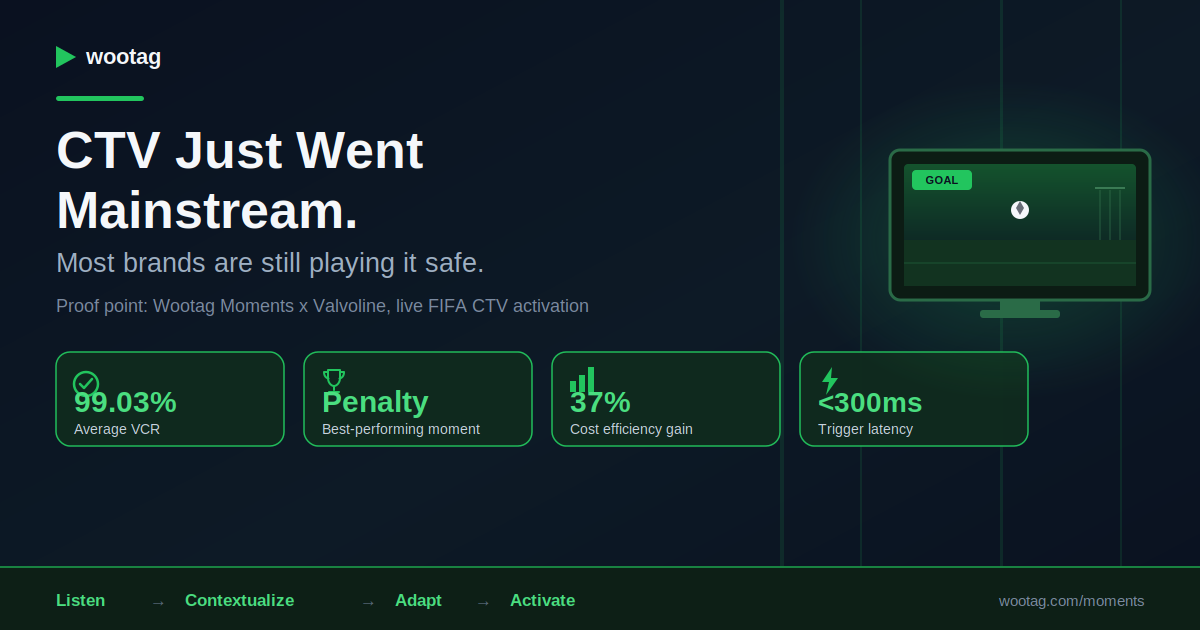
The architecture follows a simple loop: Listen, Contextualize, Adapt, Activate. Wootag listens across 180 plus live signal feeds spanning sport, weather, markets and commodities, detects the moments that matter to a brand’s audience, and triggers a contextually relevant creative response in under 300 milliseconds. That decision, what to say, to whom, in what tone, at what moment, is made once by the signal layer and then pushed out across every channel a brand runs, live in 47 markets today.
Connected TV is one of those channels, not a separate problem to be solved with a separate tool. The same signal that changes a brand’s message on social or push can just as easily swap the creative running on a CTV spot mid match, because the platform treats CTV as an activation surface, not as a walled garden with its own dynamic creative logic bolted on from scratch.
That is the argument in theory. Here is what it looks like when a brand actually ran it during a live tournament.
Proof point: Valvoline turned every FIFA match moment into a different CTV ad
During the FIFA World Cup, Valvoline used Wootag Moments to run a CTV campaign that changed its creative in response to what was actually happening on the pitch, rather than serving one spot for the length of the match.
The mechanics were straightforward. Wootag detected live FIFA match moments including goals, halftime, penalties and team wins as they happened, triggered the relevant creative instantly, and delivered the moment based ad on CTV in the right format, all within the same live broadcast window. A goal scored triggered one message. A penalty triggered another. A team win at full time triggered a third. Same campaign, same brand, three distinct creative moments matched to three distinct emotional states in the stadium and the living room.
The results are worth sitting with:
- 99.03 percent average video completion rate across every moment type, meaning viewers were not just served the ad, they watched it through
- Penalty moments delivered the highest completion rate of any trigger type, the single most tense seconds of a football match converting into the strongest ad attention of the campaign
- 37 percent improvement in cost efficiency, with spend concentrating against moments that were already earning outsized attention rather than spreading evenly across a match regardless of what was happening
- Impressions distributed meaningfully across moment types, with team win moments carrying the largest share at 30.3 percent, followed closely by halftime and goal moments at roughly a quarter each, and penalty moments at 13.4 percent despite delivering the strongest completion performance of the four
None of this required Valvoline to abandon CTV’s premium format or storytelling strength. It required matching that storytelling to what the viewer was actually feeling when the ad appeared. The screen stayed premium. The moment made it relevant.
Why this matters beyond one World Cup campaign
Sport is the easiest place to see moment marketing prove itself on CTV, because the emotional peaks are so visible and so widely shared. But the same logic extends to any live signal a brand’s audience reacts to: a heatwave pushing demand for cooling products, a rate cut changing the calculus for a loan campaign, a fuel price move shifting relevance for an auto or mobility brand exactly like Valvoline. The signal changes. The activation logic stays the same.
That is also why this is not a sports advertising story or a CTV story in isolation. It is a preview of where CTV buying is heading as the channel matures past the “premium video slot” phase and into something closer to what Wootag’s own Moments OS is built around: a layer that decides what a brand says and when, with the creative itself as one output among several, activated wherever the audience happens to be watching at that second, CTV included.
Sourcing transparency
The Valvoline campaign metrics referenced in this post, including video completion rate, cost efficiency improvement and impression share by moment type, are drawn directly from a Wootag Moments case study documenting the FIFA World Cup CTV activation. Platform specifications referenced, including the 180 plus live signal feeds, sub 300 millisecond trigger latency, 47 live markets and 2.1 billion monthly impressions, come from Wootag’s own product documentation. CTV audience figures for the Indian market, including the 166 million monthly viewer figure and the NCCS A composition, are drawn from Kantar’s Media Compass report and are cited as third party research, not Wootag or client data. Broader commentary on CTV’s shift from experimental to mainstream media planning draws on recent trade press analysis of the category. No unverifiable or low confidence statistics have been included.
Ready to make your CTV spend answer to the moment
Valvoline did not need a bigger media budget to win the penalty moment. It needed a signal layer that could see the penalty happening and act on it faster than the replay. That is what Wootag Moments does, on CTV and everywhere else a brand’s audience is paying attention.
Book a demo to see how the Listen, Contextualize, Adapt, Activate framework can turn your next live sporting moment, weather event, or market swing into a CTV creative that actually knows what just happened.
