

A hospitality association in Padua surveyed around 600 businesses in its city this summer and found more than 80 percent reporting turnover down roughly 20 percent during the recent heatwave. The reason was almost mundane. Aperitivo hour, the daily ritual that fills outdoor terraces across the city, simply started later once the heat made early evening unbearable, leaving those same terraces empty at the hour they usually earn the most. “A 20 percent decline wipes out your margin,” one hospitality leader put it plainly.
That is not a headline about climate change. It is a headline about timing. A signal shifted by a few hours, and an entire evening’s revenue moved with it.
This summer has made that kind of shift impossible to ignore anywhere in the world. The UK and Europe have logged some of the hottest weeks on record, wildfires have forced tens of thousands to evacuate towns in Canada, and heat-linked disruption has shown up everywhere from supply chains to insurance balance sheets. Verdant estimates the UK economy alone has lost at least £4.4 billion in output since May because of the heat, with losses potentially reaching £25.6 billion by 2030 if the pattern holds. Triodos Bank has separately warned the extreme weather could shave close to €180 billion off EU GDP, effectively wiping out a year of forecast growth. Moody’s puts last summer’s European heatwave losses at €43 billion in lost output against roughly €500 million in insured payouts, a protection gap wide enough to swallow entire sectors whole.
None of this is a once-a-decade anomaly anymore. It is a live, recurring signal, and most brand marketing still treats it like a mood board.
The gap: heat is planned like a season, but it behaves like a market
Walk into most marketing calendars in July and you will find a “summer campaign,” briefed months in advance, locked into a media plan, and built around an assumption of what a typical summer looks like. The problem is that summer 2026 did not behave typically. It arrived in spikes, cooled, spiked again, forced people indoors in some weeks and outdoors in others, and shifted spending in ways that had almost nothing to do with the seasonal creative brands had already shot and scheduled.
IGD’s ShopperVista research into this year’s heatwave found the shift was not simply “more sun, more barbecues.” Nearly half of shoppers surveyed said they actually did not enjoy the extreme heat, and more than half stayed home because of it. Food and drink choices changed sharply too, with the large majority of shoppers saying their usual choices were different in the heat, driven by lighter meals and a reluctance to cook. Convenience stores and quick commerce picked up last-minute demand for cold drinks and snacks as a result. That is a real shift in what people wanted, when they wanted it, and how they wanted to be reached, and it happened inside a single season that most calendars had already locked down as one undifferentiated “summer” flight.
The heat did not just change what people bought. It changed what they needed to hear, and from whom, at a specific hour, in a specific city.
Why the gap persists
Three structural reasons keep brands reacting to heat as a season rather than a signal.
The creative is seasonal, the trigger is not. A brand shoots a summer campaign once, in advance, and then runs it on a schedule regardless of whether a given week is mild or record breaking. There is no mechanism connecting the actual temperature curve to what goes out the door.
Compliance and creative approval move slower than the thermometer. Even when a marketing team spots a heat spike in real time, there is rarely a pre-cleared, ready-to-fire asset for that exact condition. By the time a new creative gets approved, the spike has passed and a different kind of week has begun.
Every channel team rebuilds the same detection logic separately. A retail media team, a CTV buyer, a CRM lead, and a social team each end up needing their own version of “is it hot right now in this city,” and each builds it, or ignores it, independently. The same heat signal gets detected five different ways, or not at all.
Channel independence is the real fix, not another weather ad network
It is tempting to solve this with a single-channel weather ad tool, and plenty exist. The trouble is that a weather-triggered DOOH vendor can only activate DOOH. A retail media network’s real-time bidding logic only fires inside that retailer’s own inventory. Each one is useful and each one is also a silo, meaning the same heat spike has to be re-detected, re-briefed, and re-created separately for every channel a brand touches.
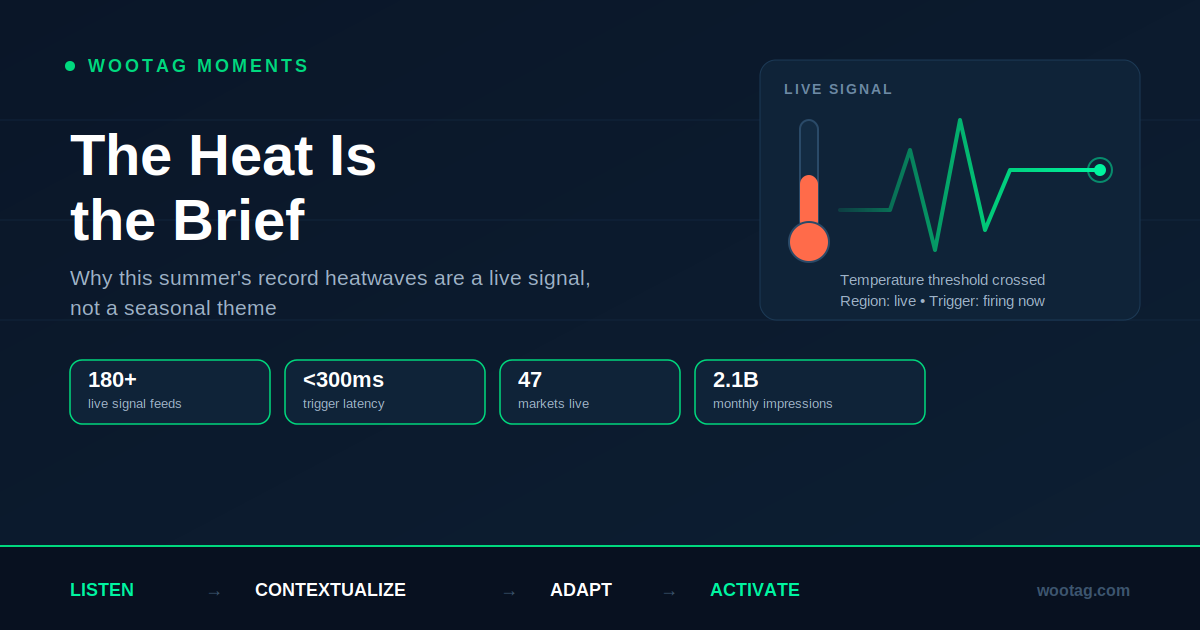
This is precisely why the signal layer needs to sit above the channel layer, not inside any one of them. Wootag’s Listen layer ingests 180 plus live signal categories, including weather, across 47 markets, and detects the moment worth acting on once, rather than leaving five different channel teams to spot it five different ways. Contextualize maps that signal to brand-safe messaging tuned to what the moment actually means for that audience. Adapt reshapes the same underlying decision into the right format for feed, story, CTV, or shoppable in under 300 milliseconds. Activate pushes it live across whichever channels a brand already buys or owns, whether that is a DSP, a retail media network, a CRM, or a CTV platform.
This is a communication decision before it is a creative decision
Here is the distinction worth sitting with. A heatwave does not just call for a cooler-looking ad. It calls for a different message, to a different segment, at a different hour, sometimes on a different channel entirely. A QSR chain in a heat spike is not just swapping in summery colors, it is deciding whether to push a cold beverage line to nearby foot traffic at 4pm or hold that message for a payday signal three days later. A travel brand is not just refreshing a beach banner, it is deciding whether to lead with rebooking flexibility because a heat-linked flight delay just hit a specific route.
That is a communication decision: what is said, to whom, in what tone, at what moment. The creative that comes out the other end is simply the visible, downstream output of that decision. Brands that only upgrade their creative for heat are optimizing the part of the problem that was never actually the bottleneck.
Where this shows up by industry
| Industry | What the heat signal changes | The communication decision, not just the creative |
|---|---|---|
| FMCG and CPG | Category demand shifts hour by hour, not week by week, as thresholds are crossed city by city | Which product line gets pushed, to which region, and whether the message leads with relief, refreshment, or convenience |
| F&B and QSR | Meal occasion and delivery demand spike or collapse depending on whether people are staying in or heading out | Whether to trigger a cold-beverage or light-meal push through the CEP, and to which segment, before the spike passes |
| Retail and e-commerce | Footfall moves from open-air to climate-controlled spaces, and back, within days | Whether messaging should pull shoppers toward indoor categories or toward outdoor and travel-adjacent ones that week |
| Travel and hospitality | Heat-linked disruption changes what travelers need to hear about flexibility, rebooking, or cooler alternative destinations | Whether the message is reassurance and utility, or a straightforward promotional push, based on how disrupted that specific route or city is |
| Fintech and insurance | Heat-linked losses expose a real protection gap for households and small businesses, not just headline risk | Whether communication centers on practical products like parametric cover or short-term liquidity support, versus general brand awareness, in a B2B or B2B2C context |
| Mobility and auto | Extreme heat affects EV range, tyre wear, and cooling-system demand in ways drivers notice immediately | Whether service and part messaging shifts toward heat-related maintenance in the exact week temperatures spike in a given region |
| Telecom | Network load and device usage patterns shift as more people stay indoors and rely on connectivity and streaming | Whether data or bundle offers are surfaced around at-home usage spikes instead of generic seasonal promotions |
| Consumer electronics and appliances | Cooling appliance demand and device thermal performance become genuinely top of mind, not just seasonally relevant | Whether the message leads with performance reassurance and availability, timed to the exact days a region is under heat advisory |
It is worth being direct about one thing here. None of the above should read as an invitation to treat a heatwave as a sales opportunity in the way a brand might treat a holiday. Extreme heat carries a real human cost. It strains vulnerable households the most, it is already showing up as lost wages and lost margin for small businesses like the hospitality operators in Padua, and it is a genuine strain on people rather than a backdrop for a clever campaign. The brands that get this right treat the moment as one where utility and empathy come first, whether that is practical guidance, flexible service, or a genuinely useful offer, and let commercial value follow from being useful at the right time rather than from being opportunistic about a hard week.
Sourcing transparency
The platform figures referenced in this post, including the 180 plus live signal categories, 47 markets, and sub-300ms activation window, are Wootag’s own published platform specifications. The economic and consumer research cited, including Verdant’s £4.4 billion UK estimate, Triodos Bank’s €180 billion EU GDP warning, Moody’s €43 billion European heatwave loss and protection gap figures, and IGD ShopperVista’s UK shopper behavior research, comes from independently published third-party sources and is cited as such rather than attributed to Wootag. Any brand-level scenario described in the vertical mapping table above is illustrative commentary intended to show how a signal-driven decision would differ from a standard seasonal campaign, and is not a claim of confirmed client work unless stated otherwise.
The real trend isn’t the heat. It’s the timing.
Every industry list above is really answering the same underlying question: not “how hot is it,” but “does this brand know, right now, in this city, that the answer has changed since yesterday.” That is what a Moments OS is built to sit underneath every channel a brand already uses and answer continuously, the same way it already does for a wicket falling, a market spike, or a payday. Heat is simply this summer’s clearest proof that the moment a brand needs to catch rarely waits for the next campaign cycle.
If your team is still briefing “summer” as a season rather than listening to it as a signal, that is exactly the gap worth closing before the next spike hits.
