

Anthropic’s Nasdaq debut won’t be one moment. It will be dozens of them, spread across weeks, and most brands that care will hear about them a day late.
In short
- Anthropic plans to price its IPO on November 18 and start trading on Nasdaq as ANT on November 19, with about 20% of shares set aside for retail investors. Interest is built in from the start.
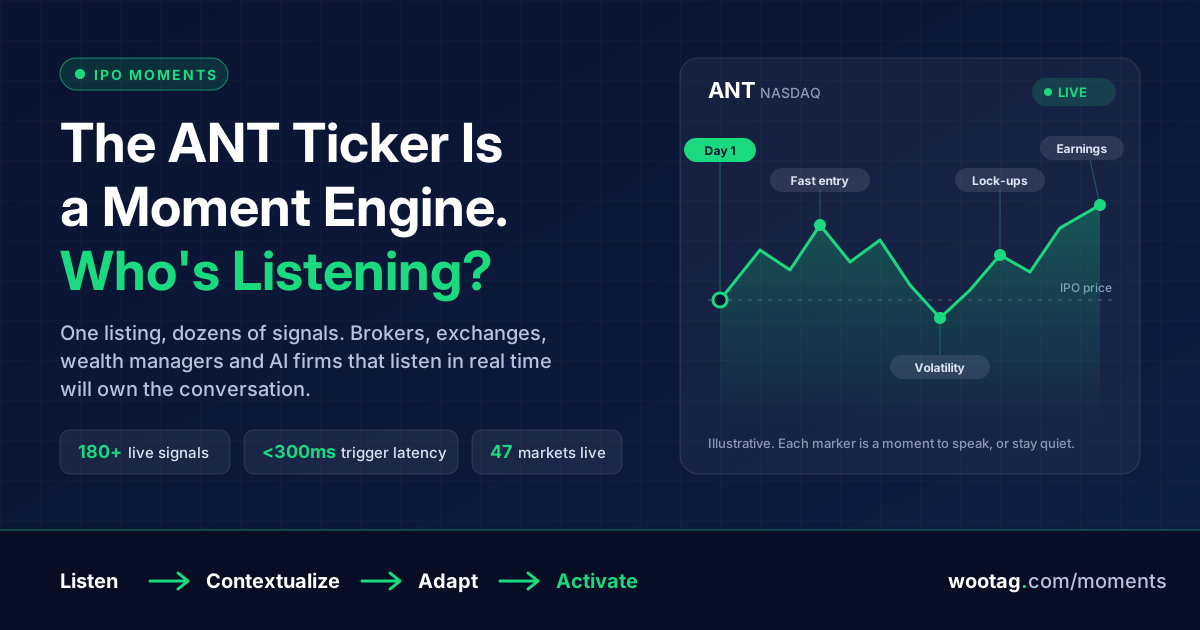
- The listing kicks off a chain of signals over the following weeks: first trade, price swings, Nasdaq-100 fast entry, lock-up expiries, first earnings. Each one is a separate moment for brokers, exchanges, wealth managers, AI firms and their marketers.
- Most of these brands will still communicate on a fixed calendar. The ones that listen to the live signal, read it in context and respond within compliance guardrails will own the conversation.
A market event that keeps happening
Every few years a listing comes along that people who don’t usually follow IPOs start talking about. In June it was SpaceX. In November it’s Anthropic.
The numbers are big. The company has filed to sell 825 million shares at $70 to $78 each, which puts its valuation at roughly $1.4 trillion at the top of the range. Trading is expected to start on November 19 under the ticker ANT. About a fifth of the offering is going to retail investors through Schwab, Fidelity, Robinhood, SoFi and E*Trade. For a lot of people this will be the first time they can own a piece of the company behind Claude.
We already know roughly what happens next, because SpaceX ran the same play five months ago. The stock closed its first day about 19% above its offering price. Robinhood recorded its highest trading volume ever and its app slowed under the load. Schwab took more than a million SpaceX orders in the first few hours. On Public, SpaceX traded more than Nvidia, Apple, Microsoft, Tesla, Meta and Alphabet combined.
All of that was attention, and nearly all of it went to whoever was standing closest to the live signal.
The gap: brands plan for the day and ignore the weeks
Most financial and tech marketers will treat November 19 as one date on the calendar. The emails go out on listing day, the social posts go up, and then everyone returns to the regular schedule.
In practice the IPO is a series of signals that keeps firing for months:
- Pricing night. The final price lands above, inside or below the range, and each outcome needs a different message.
- First trade and first close. A first day pop and a first day slide call for opposite tones.
- Daily movement against the IPO price. “Up 12% since listing” and “down 8% since listing” are two very different moments for the same audience.
- Volatility. Sharp intraday swings are a cue to talk about stability and discipline, not opportunity.
- Nasdaq-100 fast entry. Under rules Nasdaq adopted in May 2026, a new listing that ranks in the top 40 of the index by market value is tested on its seventh trading day and can be added after about 15 trading days. Every fund tracking the index then has to buy.
- Lock-up expiries. Anthropic’s filing lays out staggered lock-up releases at 27, 48, 62 and 76 days after listing. Each one brings a new group of employees and early investors who can sell.
- First earnings as a public company. Every quarter after that is another scheduled moment.
That’s at least ten distinct moments in the first quarter alone, each with a different mood and a different audience. A fixed calendar will catch one or two of them.
Why the gap persists
It isn’t for lack of data. Stock prices, index announcements and filing dates are public and easy to get. The trouble sits between the data and the message.
The signal and the message live in different systems. Market data sits with the trading desk or a data vendor. Messages sit in a CEP, a social scheduler or a programmatic platform. Nobody owns the link between them.
Compliance slows everything down. Financial brands can’t improvise. Each message needs approval, and nobody wants a hype-heavy post going out on the day a stock drops 15%. Teams end up approving one safe generic message and running it no matter what the market does.
One signal reading isn’t enough context. “ANT is up 4%” tells you very little. Up 4% after falling 10% the day before is one story. Up 4% on top of a 20% run is another. Growth over time, volatility and the move relative to the IPO price are what decide the right message.
Channel independence: the signal decides, the channel delivers
This holds for any brand, whatever it sells. The decision about what to say should be made before the decision about where to say it.
When a live signal fires, the same moment can be expressed as a push notification to app users, an in-feed post on Meta or TikTok, a LinkedIn message to B2B buyers, a programmatic video unit or a CTV spot. Each channel is a different surface for the same contextual decision. If the logic lives inside one channel, you have to rebuild it for every other channel you add. If it lives in a layer above the channels, adding a new one is just a matter of setup.
This matters most for events like an IPO, where the moments come fast, the tone changes from day to day, and the audience is spread across brokerage apps, social feeds and professional networks all at once.
Who should be listening, and what they should say
Below is a working map of the verticals with the most at stake once ANT starts trading. The brand types are illustrative; none of this describes confirmed client work.
| Vertical | Signals to listen to | Moments that matter | How communication adapts | Outcome to measure |
|---|---|---|---|---|
| Retail brokerages and trading apps | ANT price vs IPO price, intraday volatility, volume, allocation news | Pricing night, first trade, sharp up or down days | On calm days, education and watchlist prompts. On volatile days, risk and long-term messages. Hype stays off-limits. | App opens, watchlist adds, funded accounts |
| Exchanges, index providers and ETF issuers | Fast entry test date, inclusion announcement, index rebalance flows | Day 7 test, inclusion announcement, effective date | “You may already own it” messages for index fund holders, plus explainers on how inclusion works | Site visits, fund page traffic, inflows |
| Wealth managers and private banks | ANT move, Nasdaq composite move, volatility bands | Concentration risk moments, inclusion date, lock-up expiries | Portfolio review prompts, concentration and diversification content, advisor booking | Advisor meetings booked, leads |
| Cross-border investing apps and neobanks (Asia, Middle East, Europe) | ANT price in local market hours, FX moves | US open in local evening, overnight moves seen at local morning | Time-zone aware messages that reach users when they wake up, not at 3am | Sign-ups, first US trades |
| AI tech firms and the compute supply chain | ANT price as a read on AI sentiment, AI index moves, model launch news | Debut day, earnings, big AI sentiment swings | B2B messages that tie market attention to their own story: “the AI layer your enterprise actually runs on” | Demo bookings, site visits, awareness |
| B2B SaaS companies building on Claude | Debut, earnings, product launches | Debut week, earnings week | Customer stories and integration messages while search interest in Claude is at its peak | Leads, trial starts |
| Financial media and publishers | All of the above | Every moment | Live explainers, alerts and newsletter hooks, matched to the move | Subscriptions, time on site |
| Lifestyle and services for newly liquid employees (wealth, tax, real estate, premium travel) | Lock-up expiry dates, ANT price at expiry | Each of the four lock-up windows | Planning-led messages to Bay Area and tech-professional audiences around each release | Consultations booked, enquiries |
Two things stand out in this map.
First, most of the value sits after day one. Fast entry, the lock-ups and the first earnings report are all scheduled, all public and mostly ignored by marketers. For the brands in this table, those are free moments.
Second, the right message often runs against the hype. For a regulated financial brand, the most useful thing to say on a volatile day might be “here’s how to think about concentration risk,” not “trade now.” A good moment strategy includes moments where the brand stays quiet or chooses a calmer tone.
What this looks like on a moments platform
Here is how the four stages apply to a listing like ANT.
Listen. Take in the ANT price, the Nasdaq composite, an AI sector basket and the scheduled event dates (fast entry, lock-ups, earnings) from verified market data sources.
Contextualize. Compute more than the raw price. Look at growth over different windows (since IPO, past five days, intraday), volatility bands, and position against the IPO price. Wootag’s compute framework already does this for indices like the S&P 500, measuring positive and negative growth across durations and reading volatility to pick the right message. Running it on a new ticker is the same engine with a new input.
Adapt. Match each moment to a creative the brand has already approved. Financial brands upload their own approved messages by moment; nothing gets generated on the fly. Brands also decide which moments they want to talk about and which to avoid entirely.
Activate. Deliver through the channels the brand already uses: push through CEPs, Meta, TikTok, LinkedIn, programmatic and CTV. Guardrails keep it compliant: activations run only within set exchange time bands, end-of-day conditions or value ranges. A brokerage might, for example, choose to communicate only after the close, and only when the day’s move was within a set band.
Then measure by signal, by moment, by creative and by channel, so the next listing starts from real data.
This is already working in financial services
The approach isn’t new for financial brands. Franklin Templeton used a live Sensex signal to choose its message after the market closed. A gain of 0.3% or more triggered a growth-led film. A fall of 0.3% or more triggered a stability-led film. Smaller moves paused the activation, so no media was spent when there was nothing worth saying. Wootag reports an 8.3x CTR uplift, 24% budget saved and zero wasted impressions on that activation.
Swap the Sensex for ANT, add the IPO calendar, and the same logic carries over directly.
Beyond Anthropic
SpaceX went public in June and Anthropic follows in November. More mega listings are likely, and index providers are rewriting their rules to bring them into benchmarks faster. Each listing will produce its own sequence of moments in the weeks after it starts trading.
Brands that build the listening and compliance layer once can reuse it for every one of those listings. Brands that don’t will be writing a one-off post every time.
Sourcing and transparency
Wootag platform : 180+ real-time signals, 100+ signal categories, under 300ms trigger latency and 47 markets live are from wootag.com/moments. The Franklin Templeton results (8.3x CTR uplift, 24% budget saved, zero wasted impressions) are self-reported on wootag.com/moments/case-studies. Compute framework and financial compliance features reflect Wootag’s product capabilities as of November 2026.
Third-party reporting (independent):
- IPO terms, price range, share count, ticker, pricing and trading dates, retail allocation: CNBC, Yahoo Finance, TechCrunch
- Retail brokers allocated IPO shares: CNBC
- Lock-up schedule (27, 48, 62, 76 days): CNBC live coverage of the S-1
- Nasdaq-100 fast entry rule: Leverage Shares, Yahoo Finance
- SpaceX debut: first day gain (KSL / Reuters), Schwab order volume (Stockopedia / Reuters), Public trading data (JBiz News citing CNBC)
The vertical map is Wootag’s illustrative analysis and does not describe confirmed client deployments. Nothing in this post is investment advice.
Is your brand set up to hear the market when it moves? Wootag Moments listens to live market signals, reads them in context and activates pre-approved communication across your existing channels, all inside your compliance guardrails. Book a demo at wootag.com/moments
