

Twenty minutes that every security buyer just watched
On the evening of October 29, roughly $6.3 billion in digital assets left the wallets of one of the world’s largest crypto exchanges. Most of it moved in about 20 minutes, across ten blockchains. It is now the largest crypto theft on record, about four times the previous high set in early 2025.
The early findings read like a security vendor’s pitch deck. Investigators pointed to a compromised engineer’s laptop. That device gave the attacker a route into a service container, and from there into the systems that sign withdrawals. Trading paused, Bitcoin slid around 4 to 5 percent, and more than $3 billion of the stolen funds was frozen within a day.
We are not going to dwell on the exchange. It has said it will cover user losses, and its story belongs to its own teams. This post is about everyone else. Because for every company that sells endpoint security, secrets management, observability, cloud infrastructure, custody or wallets, October 29 was not just news. It was the clearest buying signal of the year, and most of those companies will answer it with silence or a generic blog post two weeks late.
The gap: brands either go quiet or go tasteless
When a breach this size lands, security and infrastructure brands tend to fall into one of two camps.
The first camp goes quiet. Legal worries about looking opportunistic, the content team has no approved angle, and the paid activations already in flight keep running the same evergreen creative they ran on October 28. The CISO scrolling LinkedIn that night sees an ad about “modernising your SOC” with no connection to what is on every screen.
The second camp goes loud in the wrong way. Fear headlines, the victim named in the copy, a dollar figure in 72 point type, a discount code. It gets attention and quietly costs trust, because buyers can tell the difference between a brand that helps them think and one that is cashing in.
There is a third option, and it is the one most teams never build for. Say something genuinely useful, tied to what actually happened, to the people who now have to answer their board’s question: could this happen to us? That is not a creative problem. It is a timing and context problem.
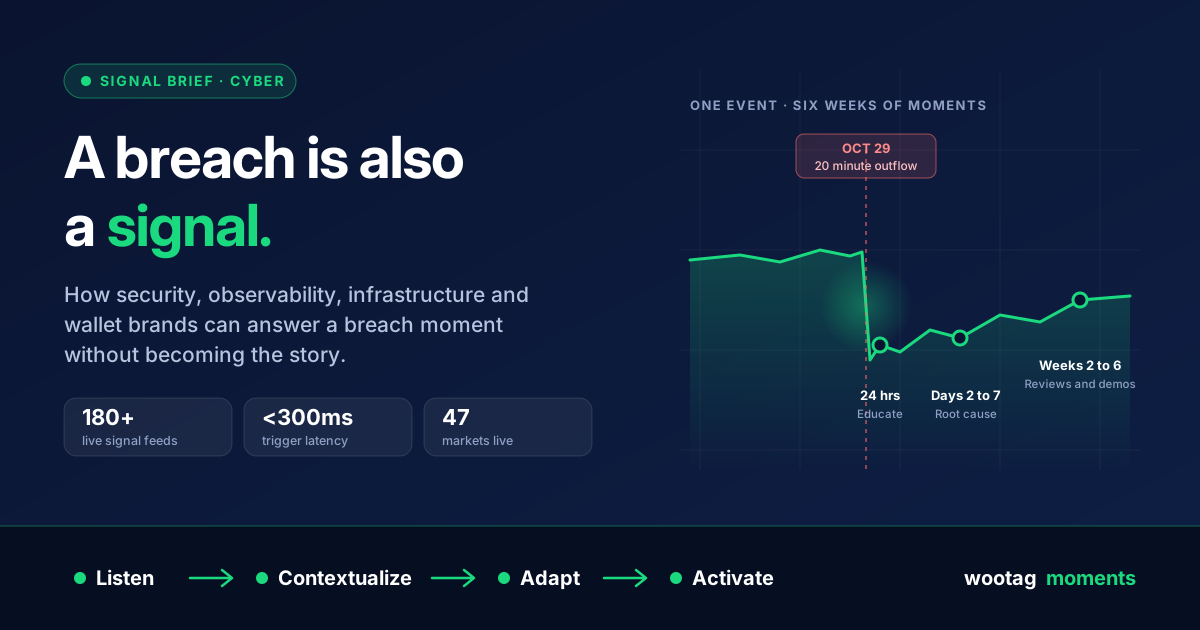
A breach is not one moment. It is six weeks of them.
Most marketers treat an event like this as a single news spike. In reality it unfolds as a chain of signals, each one changing what a buyer wants to hear.
- The first 24 hours: the shock. Withdrawals pause, prices drop, news volume explodes. Buyers want clarity, not a pitch. The right message is calm and educational: what is known, what is not, and the three questions every team should ask internally tonight.
- Days 2 to 7: the root cause. The details arrive. A developer’s laptop. A service container. Hot wallet signing infrastructure. Now the conversation gets specific, and so can you. An endpoint security brand can talk about engineer devices as production assets. A secrets management brand can talk about what a container should and should not be able to reach.
- Weeks 2 to 6: the trail. Blockchain analysts have observed that state linked groups often launder stolen funds in waves over roughly 45 days. Tracing, freezes and recoveries keep the story in the news. Regulators and boards start asking for reviews. This is when audits get commissioned, budgets get unfrozen and demo requests actually happen.
- The aftershocks. Market volatility, policy debates, insurance renewals, quarter end reviews. Each one is a smaller moment that a prepared brand can answer.
The point is that each phase deserves a different message, and the phase changes on the world’s schedule, not your content calendar.
Why most B2B teams miss it
It is not for lack of talent. Security marketers usually understand the threat better than anyone in the building. The gap is structural.
Activations are built weeks ahead. Creative, copy and targeting are locked before launch. Nothing in the stack is listening for a market drop, a news spike or a root cause disclosure, so nothing changes when one happens.
Approval cycles are slower than the news cycle. By the time a breach response post clears legal and brand review, the root cause phase is over and buyers have moved on to the next question.
Nobody has pre-agreed the rules. Which signals should change the message? What is the tone in hour one versus week three? When should paid media pause entirely? Without those decisions made in advance, every breach becomes an emergency meeting.
Signals live in different places. Crypto prices sit in one feed, threat intelligence in another, news velocity in a third. No one has stitched them into a single trigger that the activation can actually respond to.
This is a pattern, not a one off. Analysts at Chainalysis reported that the biggest crypto thefts in 2025 were around a thousand times larger than a typical incident, and that centralised services were losing more each year to compromised private keys. Big, sudden, newsworthy breaches are becoming the norm. The brands that win will be the ones that decided in advance how to show up.
The moment should not depend on the channel
A security buyer does not live in one place. The CISO reads LinkedIn on the way in, the platform lead watches a conference talk on YouTube, the head of treasury at a fintech checks a markets app, and the procurement team lands on your site from search. If the response to a breach only exists as one blog post or one LinkedIn ad, most of that committee never sees it.
The decision about what to say should sit above the channels, not inside each one. Decide once that a root cause disclosure involving developer endpoints triggers a specific message, in a specific tone, for a specific audience. Then let that decision flow into every surface you already pay for: paid social, programmatic display, video, push, your own site and your organic posts. The channel changes the format. It should never change whether you showed up.
This is the idea behind Wootag Moments. It works as a layer under the tools you already run, following four steps:
- Listen to live signals: market moves including crypto prices, news and industry events, and custom signals configured on request.
- Contextualize each signal against rules you agree in advance, including when not to speak.
- Adapt the approved creative to the right message, tone and format for each placement.
- Activate across LinkedIn, Meta, TikTok, programmatic, CTV and push, without rebuilding assets every time the story moves.
On LinkedIn specifically, a single trigger can update Single Image, Video, Lead Gen and Dynamic Personalized Ads as well as organic Page posts, so a lead form can carry the breach response checklist the same hour the root cause is confirmed.
What each category could say, and when
The examples below are illustrative. They show how one event becomes a different moment for each kind of company, and the B2B outcome each activation should aim for.
| Category | Signal to listen for | What to say | Where it runs | Outcome to aim for |
|---|---|---|---|---|
| Endpoint and identity security | Root cause disclosure naming a compromised engineer device | Developer laptops are now production infrastructure. Here is a 10 point hardening checklist. | LinkedIn Lead Gen, programmatic display to security titles | Checklist downloads, demo bookings |
| Secrets and privileged access | Reports of access to a service container and signing systems | What can your containers reach, and who approves a withdrawal? A blast radius self assessment. | LinkedIn Dynamic Personalized Ads, organic Page posts | Assessment completions, meetings |
| Observability and SIEM | The 20 minute outflow window | Would your team have seen it in minute two? A time to detect benchmark by industry. | LinkedIn Video, YouTube, CTV for brand reach | Benchmark requests, site visits |
| Cloud and signing infrastructure, HSM and MPC | Hot wallet signing infrastructure named as the target | How we separate signing keys from developer access, explained in plain language. | Programmatic display, publisher content, LinkedIn | Architecture review requests |
| Blockchain analytics and compliance | Freezes, tracing updates, the laundering window | Live tracing explained: what happens to stolen funds over the next six weeks. | LinkedIn, newsletters, publisher feeds | Briefing sign ups, awareness |
| Wallets and self custody | Withdrawal pauses and crypto price drops | Calm education on custody choices and security habits, no fear and no trading prompts. | Meta, TikTok, push to existing users | App engagement, feature adoption |
| Cyber insurance and fintech | Board level coverage, market volatility | Three questions to ask your insurer or provider this quarter. | LinkedIn, display to finance and risk titles | Consultation requests |
Notice what changes from row to row. Not just the creative, but the audience, the tone and the success metric. A wallet brand speaking to consumers needs a very different register from an HSM vendor speaking to a platform architect, even though the trigger is the same event.
Rules for answering a breach without becoming the story
A breach moment is not a goal in a football final. Real people lost access to their money for a while, and real teams are working through the night. The brands that earn trust here are the ones with clear rules agreed before anything happens.
- Never name the victim. The story is the pattern, not the company. Your buyers know what happened.
- No dollar figures as a hook. Use the facts to explain, not to frighten.
- Match the phase. Education in the first 24 hours. Specifics once the root cause is public. Offers and demos only once buyers are actively reviewing.
- Build in a pause. If the news turns darker, or attribution and facts are still disputed, the right move is to stop serving. Silence can be a rule, not a failure.
- Respect financial promotion rules. Wallet and fintech brands should keep breach moments educational and avoid anything that reads like trading advice.
That pause logic is something Wootag has already run in a regulated category. For Franklin Templeton, Moments watched a live stock index and served a growth led film when it rose 0.3 percent or more, a stability led film when it fell 0.3 percent or more, and paused delivery entirely inside that band. Wootag reports 8.3x CTR uplift and 24 percent budget saved from that activation. The same mechanism applies here: a breach signal can switch the message, change the tone, or switch the activation off.
The broader principle shows up across Wootag’s sports work too. For Budweiser 0.0 and Valvoline during FIFA, Moments served a different creative for each match event instead of one creative on loop, and Wootag reports 3.2x engagement uplift for Budweiser and 99.03 percent average video completion for Valvoline. A breach is a very different kind of event, but the discipline is the same: decide in advance what each moment deserves.
Where these numbers come from
We keep independent research and Wootag’s own figures separate so you can weigh each on its own terms.
Independent reporting on the October 29 event
- Value moved, the 20 minute window, ten blockchains and attribution: TRM Labs incident analysis
- Compromised engineer laptop, service container access, price moves and funds frozen: CNBC market report and Axios
Independent research on the wider pattern
- 2025 theft totals and the shift to fewer, larger attacks: The Record, summarising Chainalysis
- Largest attacks around 1,000 times the typical incident, and rising private key losses at centralised services: Crowdfund Insider, summarising Chainalysis
- The roughly 45 day laundering pattern: Asia News Network, citing Chainalysis
Wootag platform claims and self reported results
- Platform scope (180+ live signal feeds, under 300ms trigger latency, 47 markets, custom signals on request): wootag.com/moments
- LinkedIn formats and organic Page support: wootag.com/moments/linkedin
- Franklin Templeton, Budweiser and Valvoline results: wootag.com/moments/case-studies. These are Wootag reported figures, not independent audits.
Build for the next one now
There will be another breach. The only question is whether your brand meets it with a week old ad and a hurried blog post, or with a calm, specific message that lands in front of the right buying committee within the hour.
If you sell security, observability, infrastructure, custody or wallets, the work to do this week is simple. List the signals that matter to your buyers. Agree what each one should trigger, and when you should say nothing at all. Then put a layer in place that can act on those decisions across every channel you already use.
That is what Wootag Moments is built for. Book a demo and we will map the signals behind your category and show you a live moment built on your brand.
A $6 Billion Breach Is Also a Signal
