

A penalty is awarded in the 78th minute. The S&P breaks resistance at 11:47am. A heatwave alert fires for a major city at 38°C. Three signals, three industries, one shared problem: by the time most marketing stacks notice, the moment is already over.
Every marketing team now runs a genuinely impressive stack — a CRM for identity, a CDP for unified profiles, an automation platform for journeys, a CMS for content, an analytics suite for measurement. Most of it is composable, API-connected, increasingly AI-assisted. And almost none of it can see the world outside the customer record.
That’s the gap this post is about. Not a new channel. Not another point solution. A layer that sits underneath the stack you already run — the way an operating system sits underneath the applications on a laptop — sensing what’s happening in the real world and making that context available to everything above it. We call this layer Moments OS, and this post lays out why the category exists, how it’s architected, and how growth and marketing teams across functions can put it to work.
The stack manages who. Nothing in it senses when.
Look at any 2026 martech reference architecture and the layers are remarkably consistent: a data layer (CRM, CDP) that answers “who is this person,” an execution layer (automation, CMS, ad platforms) that answers “what do we show them,” and a measurement layer (analytics, attribution) that answers “did it work.” A new category — often called a Marketing Operating System — has emerged specifically to unify these layers, replacing fragmented point tools with a single orchestrated system for data, execution and optimization.
That consolidation is real progress. Vendors from Adobe to Salesforce to HubSpot are racing to become the orchestration layer marketing teams run on, and industry coverage now frames the martech stack itself as, in effect, the operating system for a company’s marketing operations. But read the architecture closely and a pattern shows up everywhere: every layer, every vendor, every “OS” claim is describing how to act faster on data the business already owns. None of it is built to answer a different question — what is happening right now, outside the four walls of the stack, that makes this the moment to act at all?
That second question is what Moments OS exists to answer. Not who the customer is. Not what to send them. But when — the live signal, external to any CRM record, that makes an otherwise generic message suddenly relevant: a match moment, a rate cut, a heatwave, a payday, a commodity spike.
Why this gap persists
It’s not for lack of trying. Most marketing and growth teams already attempt real-time relevance — a war room during a cricket final, a manually triggered push during a market swing, a scramble to get creative live before a trending moment cools. It’s expensive, it doesn’t scale past two or three flagship events a year, and it depends entirely on someone being awake and watching the right feed at the right second.
The structural reason is that sensing the outside world at brand-safe, activation-ready speed is a fundamentally different engineering problem from anything else in the stack. It means ingesting dozens of live data categories simultaneously, filtering signal from noise, mapping each one to creative and offer logic, and firing across channels before the emotional window closes — all in under a second, at a scale no campaign team can staff for manually. CDPs are built to persist and unify known customer data, not to ingest an external, constantly-changing world. Automation platforms are built to sequence journeys against triggers a business defines, not against a rate hike nobody scheduled. That’s precisely why this has to live below the stack, as shared infrastructure, rather than as one more workflow bolted onto the top of it.
Channel-independence: this is not a media-buying decision
It’s worth being explicit here: nothing about this framework is tied to a particular channel, platform, or ad format. A signal layer is channel-agnostic by design — its job is to detect and interpret a real-world event, not to decide whether that event gets expressed as a paid social unit, a CTV spot, a CRM push, or a sales enablement alert. The same underlying signal — a market move, a weather event, a live sports moment — can and should activate differently depending on where a brand’s audience actually is: programmatic and CTV for reach, owned app and CRM channels for retention, social for organic amplification, in some cases sales or field teams for relationship-led categories.
This matters because it reframes the investment decision. Teams aren’t being asked to pick a new channel to fund. They’re being asked to fund a layer that makes every channel they already use more contextually relevant, simultaneously, from one signal.
Inside the kernel: Listen → Contextualize → Adapt → Activate
The useful way to think about an operating system is in terms of what it has to do, in order: sense input, decide what it means, translate it into something applications can use, and execute. Moments OS is architected around exactly that sequence.
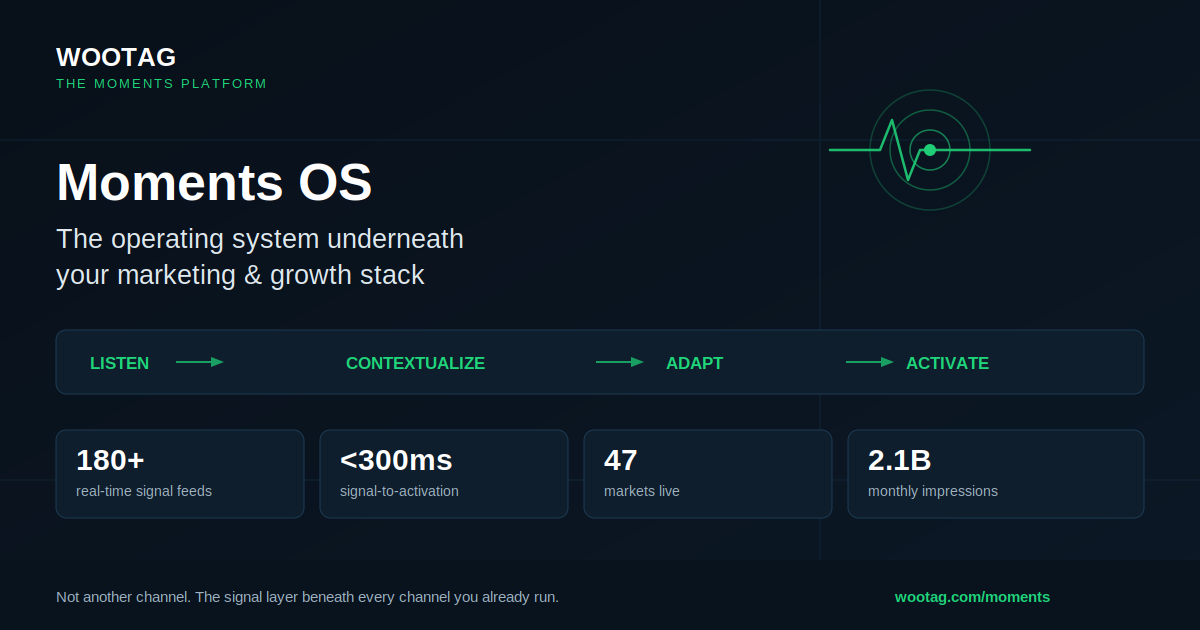
Listen — the sensing layer. Wootag’s Moments Platform ingests 180+ live signal feeds across sports, weather, stocks and commodities, live in 47 markets, continuously scanning for high-impact moments as they happen — the equivalent of an OS kernel reading hardware interrupts. This is the layer nothing else in the stack has, because nothing else in the stack was built to have it.
Contextualize — the decisioning layer. A raw signal isn’t a moment until it’s mapped to something usable: brand-safe creative logic, an offer, a hyperlocal trigger, tuned to audience sentiment. This is the scheduler — deciding which process (which brand response) gets priority, and what it should look like, the instant the signal fires.
Adapt — the compilation layer. The same underlying moment has to render correctly whether it’s landing in a social feed, a CTV spot, or a display unit. Assets are reshaped to the format and context of wherever they’ll actually live — the same way an OS renders the same instruction differently across a phone screen, a laptop display, and a printer.
Activate — the system call. The response fires across CTV, social, programmatic, retail screens, and owned channels, in the moment reported latency is sub-300ms from signal to activation. That speed is the entire point: it’s fast enough that the activation still lands inside the emotional window the signal created, not after it’s closed.
Run continuously, this loop is what makes it infrastructure rather than a campaign. A campaign has a start and end date. An operating system doesn’t switch off between briefs.
How it sits under the stack you already run
This is the positioning point worth being precise about, because “operating system” language is being used loosely across martech right now — Adobe, Salesforce, HubSpot, and a wave of AI-native challengers are all describing their own orchestration layers as some version of a marketing OS. Current thinking on that category increasingly favors a hybrid model: keep core systems like the CDP, DAM and CRM independently owned and replaceable, and layer new orchestration capability on top through open, standards-based integration rather than a rip-and-replace of the existing stack.
Moments OS follows that same logic, but at a different layer. It isn’t trying to replace the CDP, the CRM, or the automation platform your team already depends on — it’s trying to feed all of them a category of input none of them currently have: live, external, real-world context. A CDP still owns the unified customer profile. Automation still owns the journey logic. Moments OS supplies the trigger — the why now — that makes the next send, the next bid, the next creative variant contextually true rather than generically scheduled.
Mapping Moments OS across the marketing and growth org
| Function | What they already run | What Moments OS adds underneath | What changes |
|---|---|---|---|
| Growth / Performance Marketing | DSPs, programmatic, paid social bid logic | Signal-synced bid triggers so spend concentrates in the exact window attention peaks | Media dollars stop chasing average attention and start chasing peak attention |
| Brand & Creative | DAM, CMS, creative production pipelines | A live feed of contextually true creative moments to build against, instead of a fixed campaign calendar | Creative becomes always-on and reactive, not locked to a quarterly brief |
| Lifecycle / CRM & Retention | Automation platforms, push/CEP tools | External signals as a new trigger type alongside behavioral and lifecycle triggers | Retention messages fire on real-world relevance, not just internal event logic |
| Social & Community | Native scheduling and social listening tools | Sub-second detection of the live moments worth showing up for, before the conversation moves on | Social teams stop reacting late to trends they only saw after the fact |
| PR & Comms | Media monitoring, newsroom workflows | The same signal layer feeding a shared view of what’s happening, so brand and comms respond in the same beat | Fewer moments where brand and comms tell two different stories about the same event |
| RevOps / Revenue teams | CRM, sales enablement content libraries | Signal-aware prompts for relationship-led outreach — the kind of context a rep would want before a call, not a consumer-facing send | Field and relationship teams get timing intelligence, not just contact records |
The common thread: none of these functions need to adopt a new tool to benefit. They need the stack they already run to receive a real-time input it currently doesn’t get.
What this looks like activated: sports as the clearest proof point
Sports remains the sharpest illustration of the model because the signal-to-emotion link is so direct. Wootag’s sports moments framework tracks discrete triggers within live play — wicket falls and hat-tricks, century celebrations, powerplay overs, match-winning catches, final-over finishes in cricket, with equivalent moment types mapped across football, F1, NBA, tennis and NFL — and fires brand activation the instant each one happens, across CTV, display, and every major social platform from one platform.
The clearest self-reported proof point on the sports side is UltraTech Cement’s IPL activation, where real-time shoppable overlays were triggered during boundaries, wickets and powerplay milestones, pairing product messaging with peak in-match excitement across CTV and social. Wootag reports that campaign delivered a 3.2x engagement lift and a 42% increase in brand recall. FedEx (via its CSK sponsorship), Castrol, Franklin Templeton and Clear are also cited by Wootag as brands that have run moment-triggered activation on the platform; where this post doesn’t have independently reported metrics for a specific execution, we’re naming it as a partner brand, not attaching an unverified number to it.
The mechanism generalizes past sports. A rate move is a fintech brand’s version of a wicket falling. A heatwave alert is a QSR brand’s version of a powerplay over. Different vertical, same kernel: Listen, Contextualize, Adapt, Activate.
Sourcing transparency
In the interest of keeping this series’ standards consistent: the platform specifications cited above — 180+ live signal feeds, live in 47 markets, sub-300ms signal-to-activation latency, 2.1B monthly impressions — are Wootag’s own self-reported platform figures, not independently audited third-party benchmarks. The campaign metrics (3.2x engagement lift, 42% brand recall increase) are Wootag-reported results from that specific activation. The framing of martech consolidation, composable architecture, and the emerging “Marketing Operating System” category draws on independent 2026 industry coverage tracking that shift, including analysis of the hybrid consolidation-versus-lock-in debate now playing out among enterprise buyers. We’ve excluded several third-party statistics found during research for this piece — including some widely circulated CAC-reduction figures — because their underlying methodology couldn’t be independently verified to the standard this series holds itself to.
The infrastructure question, not the campaign question
The honest framing is this: no team needs Moments OS to run one good campaign. War rooms and manual scrambles can still pull off a single flagship activation a few times a year. What they can’t do is sustain that responsiveness continuously, across every live signal a brand’s category actually cares about, without a dedicated sensing-and-activation layer doing the work underneath.
That’s the question worth asking of any marketing or growth stack in 2026: it almost certainly already knows who your customer is and what you want to say to them. Does it know when the world just made that message true?
See how the Listen → Contextualize → Adapt → Activate loop works across every signal category →
Explore how the same kernel activates specifically around live sports moments →
