

A city is under a heat emergency. Hospitals are asking people to stay indoors. And somewhere, a cold drink ad is cheerfully telling the same city to “beat the heat.”
Nobody meant it to land that way. The signal was right and the timing was right. The tone was wrong, and nobody was there to catch it.
This is the fear sitting behind almost every conversation about real-time marketing. Marketers love the idea of answering the world as it happens. They are less sure about letting a system do it unsupervised.
The gap: relevance without control
Most brands today sit in one of two places. Some keep moments manual: someone spots the event, a brief goes around, creative gets approved, and the activation goes live after the moment has passed. Others automate the trigger but not the judgment, so a signal fires and creative goes out whether or not the situation calls for it.
The first loses the window. The second risks the brand.
Consumers are not forgiving about this. In a study of more than 2,000 people, a key takeaway was that consumers believe brands intentionally place their ads, so when the context is negative, they question the brand’s motives. People rarely assume it was a glitch. They assume you meant it. marketingdive
Why the gap persists
Because control is usually imagined as a delay. We picture a human reviewing each moment before it goes out, and that is exactly what makes real-time impossible. A moment that needs a three-day approval cycle is not a moment anymore.
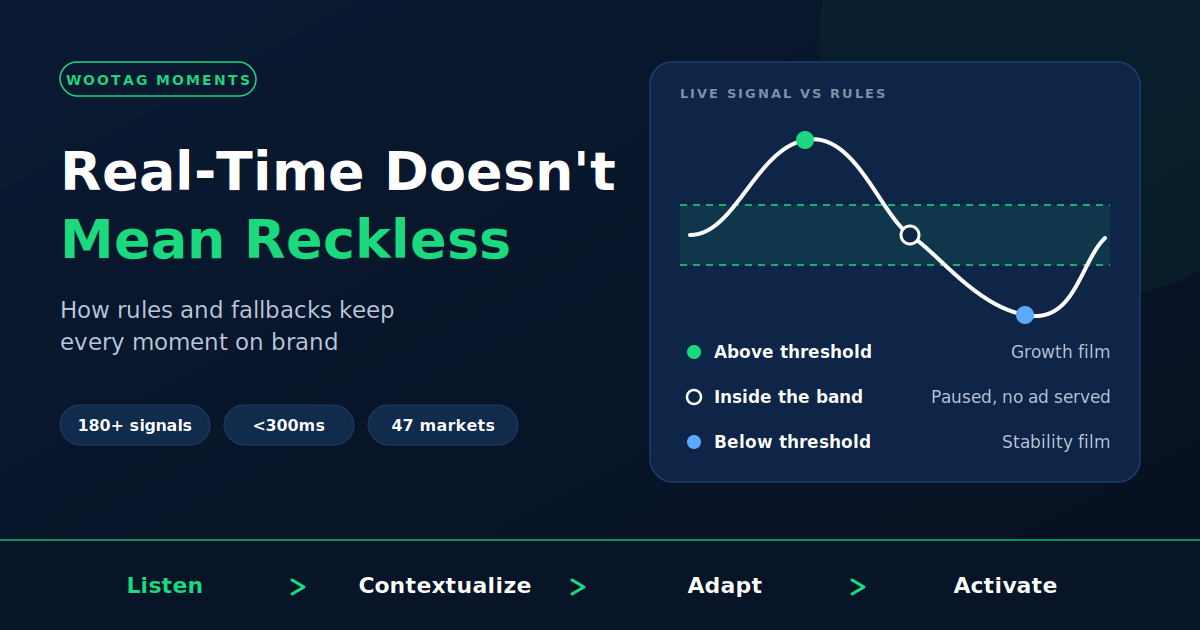
The mistake is treating control as something that happens after the signal fires. In an orchestrated system, control is decided before it. The judgment is made once, in advance, as a set of rules. Then it runs at machine speed, every time.
What on-brand automation actually looks like
Wootag Moments works across four stages: Listen, Contextualize, Adapt, Activate. The guardrails live in the middle two, and they come down to three questions every moment has to answer.
1. When should this fire at all? A signal is not automatically a moment. Conditions and thresholds decide whether something qualifies. Franklin Templeton’s activation is the clearest example. A move of +0.3% or more in a stock index triggered a growth led film. A drop of 0.3% or more triggered a stability led film. Inside a tiny band around flat, the activation paused automatically. No ad served, no budget spent. The result was 0 wasted impressions and 24% of budget saved, alongside an 8.3x CTR uplift.
2. What should it say in this state? The same signal can carry different meanings. A rising market and a falling market need different messages, and the right creative for a goal is not the right creative for a penalty. Valvoline mapped separate creatives to Goal, Halftime, Penalty and Team Win. Everyuth’s creative changed with each viewer’s live city temperature. The brand never improvises. It decides, in advance, what it says in each state.
3. What happens when there is no clear moment? Signals go quiet. Feeds drop. A match has not started. A reading sits in the dull middle. A fallback rule answers this: run the default brand creative, or pause entirely. Either way, the brand is never left saying something it did not choose to say.
Together these three questions turn “what if the machine says the wrong thing?” into something you can answer in a rules screen. Every state is defined. Every edge has an instruction.
Control belongs to the layer, not the channel
None of this depends on where the activation runs. The rules sit in the orchestration layer, above any single platform. The same conditions, creative mapping and fallbacks apply whether the moment lands on Meta, TikTok, push notifications, connected TV or programmatic display. Change the channel and the guardrails come with you. That is why governance has to live in the signal layer. If it lives in each channel separately, you end up maintaining ten rulebooks that slowly drift apart.
Where guardrails matter most
| Vertical | Signal | Where it can go wrong | The guardrail |
|---|---|---|---|
| Fintech | Market index movement | Upbeat message on a falling day, missing compliance line | Threshold bands, separate creative per direction, pause in the flat zone, disclaimers built into the creative |
| Travel | Weather, events, disruptions | “Escape to the beach” during a storm warning | Severe condition rules that swap or suppress creative |
| FMCG and home care | Heat, rain, air quality | Cheerful tone during a health alert | Tone mapped to signal severity, with a default fallback |
| Sports sponsors | Live match events | Celebratory message after a loss | Separate creative for Goal, Penalty, Win and Pre-Match states |
| Retail and apparel | Weather plus local stock | Promoting a product the nearest store has run out of | Stock aware rules that route demand elsewhere |
A note on sourcing
We keep the platform’s own claims and independent research separate.
From Wootag: The platform listens to 180+ live signals, triggers in under 300ms and operates in 47 markets. The Franklin Templeton, Everyuth and Valvoline figures come from the Wootag case studies page and are self reported results.
From independent research: The consumer perception finding comes from “The Brand Safety Effect,” a study by CHEQ, IPG Mediabrands and BMW, based on more than 2,000 consumers and published in 2018. It measured ads placed next to unsafe content, not real-time messaging, so we use it as a parallel about how audiences read brand intent, not as a direct measure of moments.
The takeaway
Speed and safety are not a trade. The brands that win real-time moments will not be the ones that move fastest without rules, or the ones that review everything by hand. They will be the ones that decide, once and carefully, what every state of the world should trigger, and then let the system run.
If you want to see how that looks on your own category, we will build a live moment on your brand in 20 minutes. Book a demo.
