
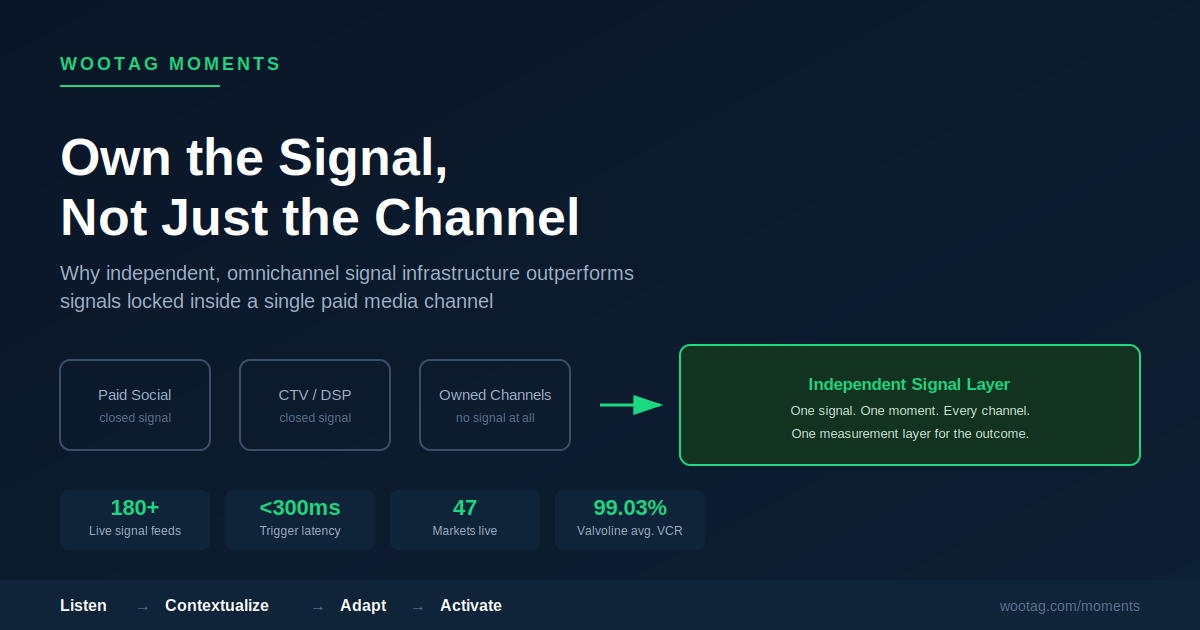

A goal goes in during a FIFA match. Inside Meta, that moment triggers one kind of read. Inside a DSP running Connected TV, it triggers another. Inside the brand’s own app, it barely registers at all, because the app was never wired to know a goal just happened.
Same moment. Three different signals, three different definitions of what just occurred, and no single system deciding what the brand should say about it. This is the daily reality for most growth teams today, and it is the reason so many real-world moments, a weather spike, a stock swing, a match-defining play, go completely unclaimed.
The instinct is to blame the channels. But the channels are doing exactly what they were built to do. The real gap is upstream of the channel: most marketing organizations do not own an independent signal layer. They rent fragments of one, one fragment per platform, and call it a strategy.
The gap: signal by channel vs. signal as infrastructure
Every major media channel today offers some version of “signal-aware” advertising. Meta can trigger on engagement events. A DSP can trigger on contextual page content. A retail media network can trigger on basket data. Each of these is real and each of these works, inside that one channel.
The problem is structural, not a matter of any one platform falling short. A signal captured inside a walled garden was built to optimize that garden’s own inventory, using that garden’s own definitions, reported through that garden’s own dashboard. It was never designed to travel to your owned channels, to your other paid channels, or into a single measurement view that shows what actually happened across all of them.
Three things compound this:
Signal scope is narrow and inconsistent. A channel only sees the signals relevant to its own environment. A social platform sees engagement and audience signals. A DSP sees inventory and bid signals. Neither sees the weather in the viewer’s city, the live score of the match the viewer is watching, or the inventory level of the product on the shelf nearest them. Real-world context, the thing that actually creates urgency and relevance, sits outside every channel’s walls.
Every channel is a closed loop. Walled gardens became one of the defining structures of digital advertising because platforms control user data, advertising inventory, and measurement and optimization rules inside a closed environment. Marketers can see their Meta performance inside Meta and their Google performance inside Google, but neither platform hands over raw data that lets the two be compared on equal terms. A signal that triggers inside one of these gardens dies at the garden wall. It cannot be reused to trigger a push notification, a CTV spot, or an update to your own site.
The category has already reorganized around this closed structure, and it is getting more closed, not less. Walled gardens are projected to control 83% of digital ad revenue by 2027, and 90% of consumer online time now happens inside these environments, which means the vast majority of the signal a brand needs to react to is generated in places a single-channel tool was never built to read.
Why the gap persists
If the problem is this visible, why hasn’t the market already solved it channel by channel? Three forces keep it in place.
Marketing teams have papered over the gap with more tools, not more integration. The average marketing stack ran 121 tools in 2026, up from 91 in 2022, and only about a third of those tools are actively used in any given month. Adding a signal tool per channel does not close the gap between channels. It adds another silo, another login, and another definition of “conversion” to reconcile.
Measurement confidence is falling as channel count rises, not improving. Forrester expects marketers’ confidence in accurately measuring marketing impact to fall by 7% in 2026, leaving only 72% of B2C marketing leaders able to demonstrate business outcomes with confidence. The IAB’s State of Data 2026 report found three in four marketers say their attribution, incrementality testing, and marketing mix modeling are not delivering the speed, accuracy, or trust they need to make confident decisions, and that the core issue is the data infrastructure underneath those methods, not the methods themselves. Marketers point to siloed and incomplete data, cross-channel deduplication issues, and walled-garden reporting limits as their top barriers to accurate measurement.
Creative and asset production has not kept pace with channel-specific signal demands, so most teams simply narrow what they attempt. Producing every creative variation a modern multi-channel, multi-format program requires can run into the millions of dollars at typical per-variation production costs, and the largest catalogs would need production volumes that make manual output impossible. Two-thirds of marketers say a lack of creative resources is preventing them from truly scaling dynamically optimized creative, and 58% report insufficient operational resources to execute it at all. Faced with that math, teams quietly shrink their ambitions to whatever one channel’s native tools can adapt for them, which means the signal never reaches the other channels the audience is actually in.
None of this is a failure of any single platform. It is the predictable outcome of trying to run real-time, cross-channel relevance on top of infrastructure that was built one closed channel at a time.
The case for an independent signal layer
An independent signal layer flips the architecture. Instead of a brand assembling relevance channel by channel, it sits above every channel: a marketplace of real-world signals (sports, weather, stocks, commodities, retail and location data), a way to turn any of those signals into a defined moment, a system that adapts brand-approved assets to whatever format each channel needs, and a single activation layer that fires the right version everywhere at once, in real time.
This is the same four-stage discipline behind Wootag Moments: Listen, Contextualize, Adapt, Activate. It works because each stage is channel-agnostic by design, which is what makes it possible to compare the independent model against the channel-locked model on hard economics rather than on preference.
Economics of scale. A channel-specific signal tool has to be bought, configured, and maintained separately for every channel it serves, and the creative behind it has to be produced separately too. Automated creative versioning built for reuse across formats has been shown to cut creative production costs by an average of 89% through cloud-based versioning, and give teams back up to 80% of the time they were spending on manual campaign management, because one signal and one asset master drive every channel’s version instead of a separate build for each. The independent model’s marginal cost of adding a new channel is close to zero, since the signal, the moment logic, and the asset adaptation already exist. The channel-locked model’s marginal cost of adding a new channel is a new integration, a new dashboard, and a new production run.
Ease of enablement. A channel-locked signal has to be re-learned and re-built inside every new platform a brand wants to activate on. An independent signal, defined once in a marketplace, is enabled across Meta, TikTok, LinkedIn, CTV, programmatic, retail screens, and owned push in the same configuration step. Wootag’s own live network runs 180+ real-time signal feeds across 47 markets with sub-300ms trigger latency, and every one of those signals is enabled the same way regardless of which channel eventually fires it.
Measurement. This is where the case is strongest, because the failure mode is so well documented. In a March 2026 survey of senior brand and agency marketers, 91% said platform-reported results are overstated, and four in five admitted they optimize without verified data to check those numbers against. The same survey found marketers estimate at least 11% of media budget is lost to the disconnect between what platforms report and what actually happened, with a third of respondents putting that loss above a quarter of spend. A signal owned outside any single channel is measured once, against one definition of the outcome, before it ever gets split into per-platform reporting. That single measurement layer is what makes an honest read of total performance possible in the first place.
Single source of optimization and outcomes. Over 66% of marketers running 16 or more martech tools report that the resulting data silos make audience identification across touchpoints inefficient and personalization ineffective. When every channel optimizes against its own walled definition of success, the brand is left holding a stack of reports that cannot be reconciled, not a decision. An independent signal layer optimizes the moment once, at the signal level, and pushes that single decision out to every channel, so the win or the pause happens everywhere at once instead of channel by channel.
The two models, side by side
| Parameter | Channel-locked signals | Independent signal layer |
|---|---|---|
| Economics of scale | New integration, new dashboard, new creative build for every channel added | One signal and one asset master reused across every channel, marginal cost near zero |
| Ease of enablement | Signal logic re-learned and rebuilt inside each platform | Signal defined once in a marketplace, activated the same way everywhere |
| Measurement | Each channel grades its own performance, no shared definition of the outcome | One measurement layer, one definition of the outcome, before any per-channel split |
| Optimization and outcomes | A stack of per-platform reports that rarely reconcile | One decision at the signal level, pushed out to every channel at once |
What this looks like in market
Valvoline ran the same live FIFA signal, goal, halftime, penalty, team win, into Connected TV and programmatic OTT instead of looping one static spot, and saw a 99.03% average video completion rate alongside a 37% improvement in cost efficiency. Budweiser 0.0 ran the identical signal set into display and DCO for the FIFA World Cup and posted a 3.2x engagement uplift and 39% cost efficiency gain. Same signal category, two different channels, two different formats, one signal layer deciding what fired and when.
Neither result came from a smarter Meta account or a better DSP setting. It came from a signal that did not belong to either channel, adapted into each channel’s native format, and measured against one outcome definition rather than two separate platform reports.
Where the numbers come from
The platform figures in this piece, 180+ live signal feeds, sub-300ms trigger latency, 47 markets, and the Valvoline and Budweiser results, are Wootag’s own published platform specs and case study metrics from wootag.com/moments and wootag.com/moments/case-studies. Every other statistic, on walled garden revenue share, martech stack size and utilization, measurement confidence, attribution barriers, and creative production costs, comes from independent third-party research: AI Digital, Visionary Marketing’s 2026 MarTech Stack Study, Forrester, the IAB’s State of Data 2026 report, MarTech.org’s measurement survey, Okoone, and Jivox’s DCO benchmarking. None of the third-party figures are Wootag-sponsored research, and they are cited here to show the gap exists independent of any vendor’s claims about how to close it.
The takeaway for growth teams
Every channel will keep improving its own native signal handling, and that is a good thing. But no channel is incentivized to build the layer that sits above all of them, because that layer, by definition, is not theirs to own. If your signal strategy is really a collection of per-channel signal features, you are optimizing the economics, the enablement, and the measurement of each channel separately, and paying the reconciliation cost of that separation every single month.
An independent signal layer is not a rejection of your paid channels. It is what makes every one of them, and every owned channel alongside them, answer to the same real-world moment at the same time.
Wootag Moments can show you what that looks like on your own brand in about 20 minutes. Book a demo and bring the signal that matters most to your category.
Own the Signal, Not Just the Channel
