

Look closely at how Budweiser activated its FIFA World Cup 2026 moments and you will notice something that most vendor decks quietly skip over. DCO shows up in that activation. It is listed right alongside Display and Programmatic Display, as one execution surface among several. Not the strategy. Not the system that decided a goal had just been scored, that BRA was leading 2-0, or that the next best message was “This calls for a Bud.” DCO was simply where one version of that decision got rendered.
That distinction is the whole story of this post. Dynamic Creative Optimization has become shorthand in marketing conversations for “real-time personalization,” and vendors are happy to let that shorthand stand because DCO is a mature, well-understood, easy-to-sell category. But DCO answers one question only: given a set of pre-built creative components, which combination should this particular viewer see right now. It does not answer where that viewer should see it, what should trigger the message in the first place, whether the offer should include live retail stock, or whether the brand should even be spending money in this moment at all. Those are orchestration questions, and they sit a full layer above creative assembly.
The gap: DCO personalizes people, not moments
Every major definition of DCO circles the same inputs: audience segment, device, location, time of day, retargeting status, browsing history. These are viewer attributes. They describe who is looking at the screen and what that person has done before. Industry estimates put the DCO market at roughly 4.1 billion dollars, and the headline benefit, close to three times higher click through rate than static creative, is well documented. That is a real gain, and no one building a modern media plan should ignore it.
But notice what is missing from that list of inputs. None of it is the world outside the browser. A DCO engine has no native way to know that a heatwave just hit a city, that a stock index swung two points in the last hour, or that a match just went to penalties. It can react to who you are. It cannot react to what is happening right now, because it was never built to listen to anything beyond the ad request.
Even the vendors who write honestly about DCO admit this boundary exists. Independent guides on the category describe DCO as sitting “in the middle”: it builds and serves creative, but it does not decide the signal that should trigger a change, and it rarely explains which specific element actually moved the outcome. That insight gap is not a bug engineers forgot to fix. It is the natural edge of what creative assembly technology was designed to do.
Why the gap persists
DCO lives inside the ad server or the DSP because that is the only surface its vendors control. A platform that owns bid requests can rearrange headlines and images at serve time. It cannot ingest a live sports API, a weather feed, or a stock ticker, because those signals do not arrive through an ad exchange. It also cannot check whether a store fifteen minutes from the viewer still has stock, because that data lives inside a retailer’s POS system, not inside programmatic infrastructure.
So the ad tech industry solved the problem it could reach. Creative assembly got automated. The upstream question, what real-world event should decide that a message needs to change at all, stayed unsolved, because solving it means listening to signals no single ad platform owns, then deciding what to do about them before any creative gets touched.
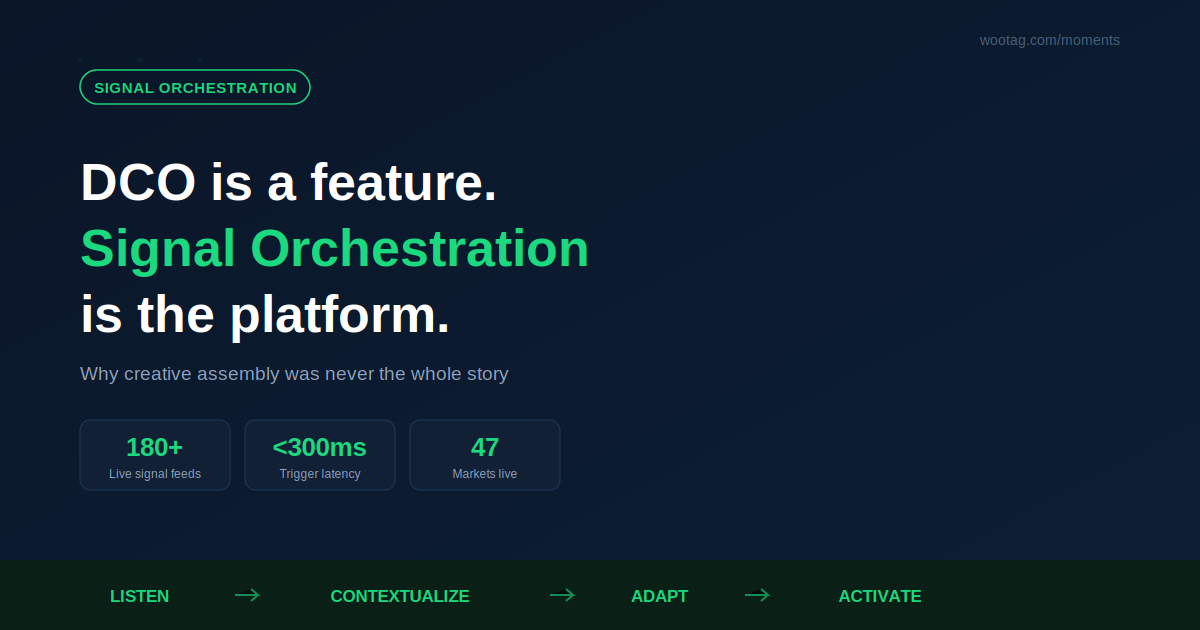
This is exactly the layer Wootag Moments was built to occupy. The platform ingests over 180 live signal feeds across sports, weather, stocks and commodities, watches for the moments that matter inside them, and only then decides what a brand should say, in what tone, through what format, and where. Listen, Contextualize, Adapt, Activate. Creative assembly, including DCO where it is the right execution surface, is one output of that fourth step. It is not the system making the decision.
The difference shows up clearly across the case studies already running on the platform:
Everyuth did not just swap creative by audience segment. Wootag Moments read each viewer’s live city temperature and assembled the matching image and video from that signal, before any creative decision was made, delivering a 2.3x engagement uplift across Meta.
Valvoline did not run a single CTV spot with a personalized end card. Wootag Moments detected live FIFA match events, Goal, Halftime, Penalty, Team Win, and triggered an entirely different spot for each one in real time, holding a 99.03 percent average view completion rate across the tournament.
Franklin Templeton shows the part DCO structurally cannot do. When the Sensex moved less than 0.3 percent in either direction, Wootag Moments paused the activation entirely. No creative was served, because no signal justified spending the budget. DCO always serves a variant. It has no concept of serving nothing. That single decision saved 24 percent of budget and produced zero wasted impressions.
Budweiser, again, used DCO as one of several execution channels once the signal orchestration layer had already decided a goal, a halftime, or a penalty was the moment worth activating.
None of these are stories about better creative assembly. They are stories about a system that listens to the world first and only reaches for creative tools, DCO among them, once it knows a moment is real.
Channel independence: the same decision, wherever the audience is
None of this logic is tied to one channel. The signal is the same whether the resulting activation lands as a Meta carousel, a TikTok native unit, a push notification, a programmatic display banner, a CTV spot, or a shoppable overlay on a retail screen. Signal orchestration decides what should happen and why. The channel is simply where that decision gets delivered, and the format adapts to wherever the audience already is scrolling, watching or searching.
This matters because it means the platform question and the channel question are not the same question. A brand does not need to choose CTV over social, or programmatic over push, to benefit from signal orchestration. It needs one layer that listens to the signals relevant to its category, decides the message and the moment, and then reshapes that decision for every surface it already runs activations on. DCO can remain part of that stack wherever it is the right creative engine for a channel. It simply stops being asked to do the one job it was never equipped to do, deciding that a moment exists in the first place.
Where the distinction shows up by vertical
| Vertical | What DCO alone delivers | What Signal Orchestration adds |
|---|---|---|
| Personal care / FMCG | Creative variants by audience segment or device | Live local temperature or weather condition triggers the exact product message, before any variant is chosen |
| Automotive / lubricants | A rotation of pre-built CTV end cards | Real-time match events decide which spot fires, second by second, without a media planner touching the schedule |
| Financial services | Segment-based messaging by risk profile | Live index movement decides whether to run a growth message, a stability message, or pause spend entirely |
| Logistics / delivery | Personalized display units by retargeting status | Live scoreboard events decide the exact interactive unit and the moment it should appear, synced to peak attention |
| Beverages / QSR | Creative swapped by daypart or location | Match state, weather or footfall data decide which offer, format and channel combination activates, with retail stock folded in where a brand has physical presence |
The retail signal layer is modular. Brands without physical stores use the public signal set, weather, sports, stocks, commodities, exactly as shown above. Brands with retail infrastructure add POS, footfall or inventory signals through the same orchestration layer, on top of the same Listen, Contextualize, Adapt, Activate logic. Neither path requires the other.
What this is built on
To keep this comparison honest, the specifics above come from two different places. Wootag’s own platform specifications, the 180-plus live signal feeds, sub-300ms trigger latency, and 47 live markets, along with every case study metric cited here (Everyuth, Valvoline, Franklin Templeton and Budweiser), are self-reported figures from Wootag’s published case studies. They are included because they describe what the platform does, not as independent validation.
The industry context on DCO, the roughly 4.1 billion dollar market size, the commonly cited 3x click through rate lift over static creative, and the observation that DCO structurally sits “in the middle,” building and serving creative without deciding what should trigger a change or explaining which element drove a result, comes from independent industry research and guides on dynamic creative optimization, not from Wootag.
The takeaway
DCO is a genuinely useful piece of technology, and it is not going anywhere. But it was designed to answer a narrower question than most marketing conversations give it credit for: given creative that already exists, which combination should this viewer see. It was never built to listen to a heatwave, a market swing, or a goal. It was never built to decide that the right call, this hour, is to spend nothing at all.
That is the layer Wootag Moments sits on. Not a replacement for the creative tools already in a media stack, a signal layer underneath them, deciding what should happen before any creative engine, DCO included, gets asked to build it.
Tell us the signal that matters most to your category. Wootag will show you a live moment built on your brand in twenty minutes, benchmarked against results already running for brands like Everyuth, Valvoline and FedEx.
DCO Is a Feature. Signal Orchestration Is the Platform.
