

Most sports marketing plans are built around the calendar. Opening ceremony, closing ceremony, a few hero moments in between. Then the Games begin, and the real story starts writing itself in ways no calendar predicted.
We spent a week enabling Asian Games Moments, and the audience told us clearly where attention actually lives.
The numbers that stood out
Two patterns showed up again and again:
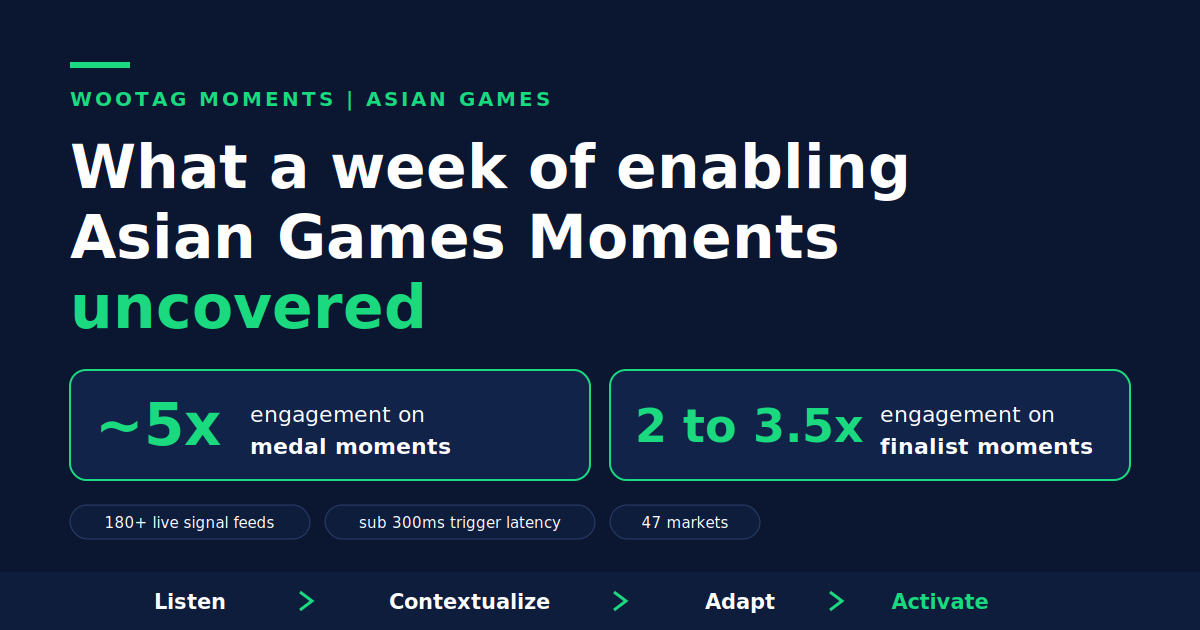
- Medal moments drove audience engagement close to 5x the average.
- Country moments, when a country’s player reached the final, drove 2x to 3.5x uplift over the average.
Neither of these is a surprise in hindsight. People care most when something is won, and when someone they identify with is one match away from winning. What surprised us was how sharp the spike was, and how short the window to use it.
Why the average hides the story
An average engagement number across a multi-week event blends quiet hours with defining minutes. It tells you the Games are interesting. It does not tell you when.
Once we split engagement by moment type, the picture changed. A default state, where nothing notable is happening, performs like a default state. A Games event like an opening ceremony lifts attention in a predictable way. But a medal or a finalist is where audiences lean in, and the lift is several times higher.
That means the same budget, the same audience and the same channels can produce very different results depending on whether the message meets the moment or arrives after it.
The moments that mattered
Our rules framework for the Games was deliberately simple, and it held up:
- Default and fallback: the always-on message that runs when no key signal is live, so nothing ever goes dark.
- Games events: opening and closing ceremonies, the planned anchors of the event.
- Country events: medal tally updates and a country’s player qualifying for a final.
The country events did the heavy lifting. The planned anchors gave us a baseline. The unplanned, signal-driven moments gave us the peaks.
It was not just timing, it was the change in communication
Here is the part that is easy to miss. Reaching the right moment was necessary, but it was not enough. What made the peaks worth having was that the communication itself changed when the moment did.
A default message speaks to a general fan. A finalist message speaks to someone whose country is playing for a medal in the next few hours, in the tone of anticipation. A medal message speaks to someone who just watched a win, in the tone of celebration. Same brand, same audience, three different conversations.
If you only swap the creative, you get a nicer looking version of the same message. If you change what you say, to whom, in what tone and at what moment, the audience responds like the moment is actually happening. Because it is.
The recipe we would repeat
Looking back at the week, the playbook came down to four steps, the same ones we build every Moments activation around:
- Listen to the real-time signal: a medal awarded, a finalist confirmed, a tally updated.
- Contextualize it: which country, which event, which audience cares.
- Adapt the communication to what that moment means.
- Activate it across the channels where your audience already is, while the moment is still live.
The value is in the sequence running without a manual handoff. When a medal is confirmed, the window for a relevant message is short. Anything that depends on someone noticing, briefing a team and approving new creative arrives after the peak, when the audience has already moved on.
What this means for sports marketing
Sports marketing has long rewarded whoever secured the biggest sponsorship or the most visible placement. Those still matter. But the week showed us a second lever, and it is available to every brand, sponsor or not: being present and relevant inside the moments that carry the most attention.
The future of sports marketing is not a bigger plan. It is infrastructure that recognizes a moment as it happens and responds with the right message. Brands that build that layer will not need to guess which minutes matter. They will be ready for all of them.
| Moment type | What the signal is | What the communication does |
|---|---|---|
| Default | No key event live | Keeps the brand present and on message |
| Games event | Opening or closing ceremony | Marks the occasion with a planned anchor message |
| Country event | Player reaches a final | Builds anticipation for the next few hours |
| Country event | Medal won or tally updated | Celebrates the win while attention is at its peak |
How to read these numbers
The uplift figures above are engagement observed by Wootag across activations enabled on Asian Games Moments during the first week, measured against the average engagement of the same activations. They are our own platform observations, not third-party benchmarks, and results will vary by brand, market and creative. We share them as a pattern to test, not a guarantee.
Build your moments before the next one starts
If you are planning sports activations for the next tournament, the question is not which day to run them. It is whether your marketing can recognize a medal or a finalist the moment it happens and say the right thing. See how Wootag Moments works at wootag.com/sports and talk to us about setting up your own signal-led activations.
What a Week of Enabling Asian Games Moments Uncovered
