

It is the 89th minute of a World Cup knockout. The score is level, a penalty has just been awarded, and hundreds of millions of people are holding their breath at the same time.
If you run a beer, spirits or wine brand, this is the moment your category was built for. Friends in one room, a screen on the wall, a shared reaction that happens once.
And on most digital channels, your brand has nothing to say.
That is not a creative problem. It is a gap, and it is one most alcohol brands have quietly accepted.
The gap: the most moment-rich category is the most silent one
Think about when alcohol actually gets talked about, planned for and bought. Match nights. Long weekends. Festival seasons. A heatwave that arrives two days before a barbecue. The Friday a big tournament final lands. Almost every purchase occasion in the category is tied to something happening in the real world at a specific time.
Now look at what most alcohol brands run online during those same windows: the same brand film, the same approved visual, the same line, all year. Age-gated, carefully reviewed, and completely unaware of what is happening on the screen next to it.
The result is a category that is present everywhere and relevant almost nowhere. When the moment peaks, the brand is either absent or saying something generic that could have run on any day.
Why the gap persists
It is not laziness. There are real reasons, and they are worth stating plainly.
The rules are genuinely complicated. Alcohol advertising is regulated market by market, and platforms add their own layer on top. Meta’s policy requires that alcohol ads follow local laws and industry codes, include age and country targeting, and never be shown to anyone under 18, with some countries not permitted at all. Google only allows alcohol sale ads in countries on its approved list. In India and Indonesia, only 0% alcohol products can be advertised through its platforms. YouTube expects age gating on brand channels and videos. Google also rewrote its alcohol advertising policy, effective 30 September 2026, with a single country table and new disclosure rules.
Compliance teams respond by shrinking the surface area. When every message needs review in every market, the safest path is one approved asset and one approved message. That is a sensible reaction to risk. It is also exactly what makes a brand irrelevant to a live moment.
Manual real-time cannot keep up. A reactive post written after the penalty, sent for legal review, approved the next morning, is a post about yesterday. The moment has already passed. So most teams decide not to try.
Put together, the restrictions end up treated as a reason to stay out of the moment, rather than a brief to design inside of.
The reframe: restrictions govern what you say and who sees it, not whether you show up
Read the rules again and notice what they actually control. Who can be shown the message. Which markets it can run in. What claims and imagery are allowed. Google, for example, explicitly calls out prohibited claims about alcohol’s benefits.
None of them say a brand must be absent from the moment.
A moment is a decision: what a brand says, to whom, in what tone, at what time. Creative is one output of that decision, not the whole of it. Once you see it that way, restrictions stop being a wall and become inputs to the decision. Market, age gate, allowed claims, approved assets, fallback behaviour. These are rules you can define once and have applied every single time a signal fires.
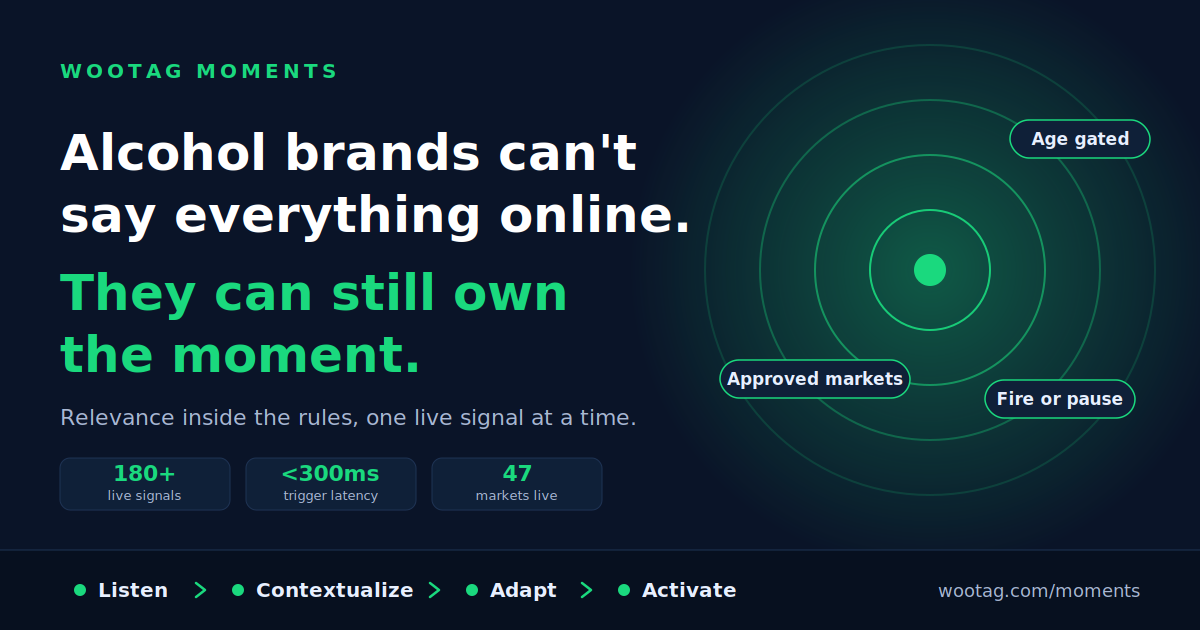
That is what a Moments OS does. It listens to real-world signals, contextualizes them against your rules, adapts the approved assets to the format and channel, and activates only where it is allowed to.
What owning a moment looks like when you cannot sell the drink
The answer is not to find clever ways around the rules. It is to be genuinely relevant inside them. The strongest alcohol communication in a live moment tends to be about the occasion, not the product.
Here is what that can look like in practice. These are illustrative ideas, not confirmed client work.
Match night. When a signal says kick-off is an hour away, the message is about the gathering: the room, the rivalry, the ritual of the pre-match. When a goal goes in, the brand reacts with the mood of the moment in its own voice. No claims about performance, no suggestion that drinking improves the night. Just a brand that clearly knows what is happening right now.
Heatwave and long weekend. A temperature signal for a city can shift the communication toward hosting, gatherings and summer plans, tuned to the local forecast. Where local rules and platform policy allow it, availability and store information can follow. Where they do not, the brand stays at the occasion level.
Responsible moments. Some of the most brand-safe and genuinely useful moments are the ones that come after the whistle. A late finish, a big weekend, a festival night. A moment-triggered message about planning a safe way home is relevant, welcome and fully aligned with responsible advertising expectations. Most alcohol brands already fund responsibility messaging. It rarely arrives at the moment it matters most.
Rules that pause as well as fire. The same rule engine that triggers a message should also stop one. If a signal fires in a market where the activation is not permitted, or the audience cannot be age-verified, nothing runs. This is the opposite of risky. Franklin Templeton’s Sensex activation is a useful parallel from another regulated category: the rules decided what to say when the market moved, and paused the activation entirely when it did not, so no impression was wasted.
The shift is simple. Instead of one approved message playing all year, you get a library of approved messages, each tied to the moment it fits, each governed by rules that your compliance team defines up front.
Where Wootag Moments fits in the picture
Wootag Moments listens to 180+ live signal feeds across sports, weather, stocks and commodities, and detects high impact moments in real time. Its Contextualize and Adapt layers map each signal to brand-safe creative and the right format for where it will appear. Activate then fires across social, CTV, programmatic, retail screens and more, with trigger latency under 300ms.
The point for an alcohol brand is not speed for its own sake. It is that approved creative can meet the right moment without a human relaying a message at 1am.
The moment is bigger than any one channel
A moment does not belong to a platform. A penalty, a heatwave or a public holiday is not a Meta event or a TikTok event or a CTV event. It is a real-world event that happens to reach people through many screens.
That matters because the decision about what to say should be made once, at the moment layer, and then expressed through whichever channels are right. Rules and permissions can differ by channel and by market. The signal, the logic and the approved assets stay the same.
When a channel changes its policy, you change a rule, not your strategy. When you add a new market, you add its constraints, not a new set of manual workflows. The moment layer sits beneath the channels, so no single platform decides whether your brand can be relevant.
Mapping the opportunity across the category
Here is how the moments might map across different parts of the alcohol category. This is illustrative, and every activation is subject to local law, platform policy and your own compliance review.
| Category | Signals worth listening to | Communication angle | Guardrails to build into rules |
|---|---|---|---|
| Beer | Live sports events, kick-off and final whistle, heatwaves | Shared occasions, rivalry, hosting | Age gate by market, no consumption or performance claims |
| Spirits | Tournament finals, festival calendar, long weekends | Gifting, celebration, craft and occasion | Approved markets only, age verified audiences |
| Wine | Seasonal weather, holidays, dinner occasions | Food pairings, hosting, seasonal moods | Local rules on tone and claims, age gate |
| Ready to drink and mixers | Weather, weekends, summer peaks | Easy gatherings, outdoor moments | Mixers allowed only when targeting above legal purchase age |
| 0.0 and alcohol free | Match events, commute and workday moments, wellness peaks | Full contextual activation, including in markets that restrict alcohol | Platform application may be required in some markets |
| All categories | Late night and big weekend moments | Responsible drinking messaging | Fire only where permitted, pause otherwise |
What the proof does and does not tell us
Wootag’s case studies show how brands have turned live signals into measurable results.
Valvoline used live FIFA match events such as goals, halftime, penalties and team wins to trigger matching connected TV creatives. It reported a 99.03% average view completion rate and 37% cost efficiency.
Budweiser 0.0 used the same type of live FIFA signals on display, serving the right creative for kick-off, goal, halftime, penalty and win. It reported a 3.2x engagement uplift and 39% cost efficiency, with the pre-match moment performing best.
An honest note on that second one. Budweiser 0.0 is a non-alcoholic beer. It shows a beer family brand answering a live sports moment with relevant, contextual communication, and it shows that the moment layer works in a category most people associate with restrictions. It is not proof for alcoholic products. We do not have an alcohol product case study to share, and we would rather say so than stretch the evidence.
What to do next
If you work on an alcohol brand, you do not need to start with a big idea. Start with three questions.
- Which five or six moments in your calendar already drive your category? Be specific: the matches, the weekends, the weather patterns.
- For each one, what would you be comfortable saying, and to whom, in each market? Write it down as a rule.
- What would your brand say in a moment that is not about the product at all? That is usually where relevance starts.
Then build the rules once and let the moments do the work.
Sourcing and transparency
Wootag platform claims. Signal coverage (180+ live feeds), trigger latency (under 300ms), market reach (47 markets) and the four stage framework come from wootag.com/moments. Case study results for Valvoline and Budweiser 0.0 are self reported by Wootag and come from wootag.com/moments/case-studies. The Franklin Templeton example is from the same page.
Third party sources on alcohol advertising rules. Meta’s alcohol advertising policy is from Meta’s Transparency Center. Google’s alcohol advertising requirements, including the approved country list, age gating on YouTube, the 0% alcohol requirement in India and Indonesia, and the policy update effective 30 September 2026, come from Google’s Ads policy documentation and trade reporting by PPC Land and Relevant Audience.
Illustrative content. The match night, heatwave, responsible moments and category mapping examples are illustrative ideas, not confirmed client work. This article is not legal advice. Alcohol advertising rules differ by market and change often, so confirm every activation with your legal and compliance teams.
Own the moment, within the rules
The next big match, long weekend or heatwave is already on the calendar. The question is whether your brand has something relevant to say when it arrives, to the right audience, in the right market, inside rules your team has already approved.
Tell us the signal that matters to your category. We will show you a live moment, built on your brand, in 20 minutes.
Alcohol Brands Can't Say Everything Online. They Can Still Own the Moment.
