

Most brands react to what happens in the world. Few react to what’s happening on their own shelves.
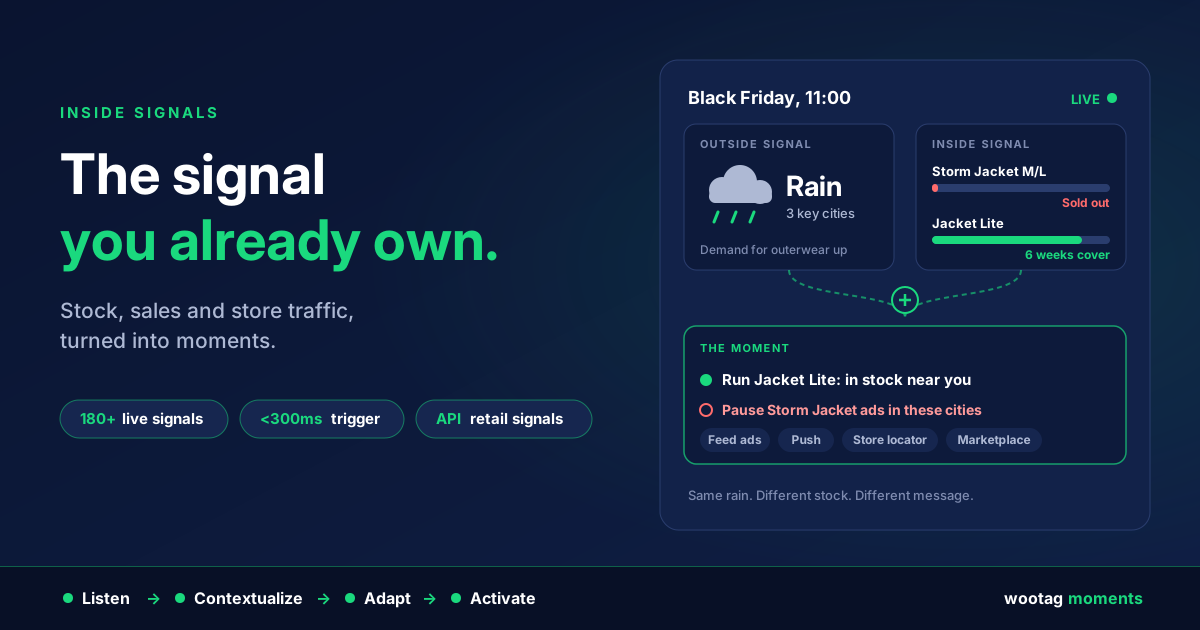
It’s 11am on Black Friday. The waterproof jacket in your hero ad sold out in medium and large an hour ago. It’s raining in three of your biggest cities, and the ad is still running there, at full budget, sending people to a product page that says “notify me when available.”
Meanwhile a near-identical jacket is sitting in your warehouse with weeks of cover, and the ad isn’t mentioning it.
No one did anything wrong. The media plan was signed off in October. The creative was approved in early November. The stock system and the ad account just never talk to each other.
That’s the gap this post is about. Real-world signals like weather, sport and markets tell you when people are paying attention. Your own signals (stock, sales, store traffic, prices) tell you what you can actually deliver at that moment. The strongest moments use both.
Your ads don’t know what’s on the shelf
The cost of that gap is large. IHL Group estimates that inventory distortion, its term for the combined cost of out-of-stocks and overstocks, costs retailers around $1.73 trillion a year, or 6.5% of global retail sales.
Shoppers aren’t patient about it, either. In AlixPartners’ 2024 Holiday Survey, two-thirds of consumers said they would leave a store, online or physical, and buy elsewhere if an item was out of stock. When something was unavailable in store, 34% said they would order it online from a different retailer, and 31% would try another store.
So a stock-out doesn’t just cost you that one sale. If your ad created the demand, you’ve paid to send a customer to a competitor.
The overstock side is quieter but just as costly. Products sitting in the wrong place get discounted at the end of the season, often while the ads that could have moved them earlier were promoting something else.
Why the gap persists
Media and merchandising run on different clocks. Merchandising teams see stock by store and by hour. Media teams see audiences and budgets by week. Neither one changes what the other does in real time.
Catalogs sync. They don’t decide. Product feeds do update availability, but a feed only takes an out-of-stock item out of a carousel. It doesn’t change the message, move budget to a substitute, or switch the call to action from “buy now” to “order for delivery.”
Promotions are planned weeks ahead. The 20% off line in your Black Friday creative was fixed long before anyone knew which products would sell through first.
Store-level detail gets lost. National creative can’t show that one city’s stores are full of stock and another’s are almost empty.
Two kinds of signal, one decision
The way we think about it at Wootag is simple. A moment is the point where an outside signal and an inside signal agree.
Outside signals tell you that people are paying attention or that their needs have changed: a heatwave, a rainstorm, poor air quality, a team winning, a market move, a spike in search interest.
Inside signals tell you what you can do about it: stock by store or warehouse, sell-through rate, footfall, current price and deals, delivery capacity.
Put the two together and the decision gets sharper:
- Heatwave in a city, and plenty of portable fans in nearby stores → run the fan, with “in stock near you” and store directions.
- Heatwave, and the nearest stores are almost out → switch to the next best model, or route demand to delivery or a marketplace listing that can still fulfil.
- The home team wins, and jersey stock is healthy → run the celebration offer straight away.
- The home team wins, and jerseys are running low → run a pre-order message instead, so the moment isn’t wasted.
- Rain is driving footfall down → shift budget from store visits to delivery and click-and-collect.
- A product line is overstocked in one region → push it harder whenever an outside signal makes it relevant there.
Same signal, different stock position, different message. That’s what makes a moment useful rather than merely timely.
You don’t need a store to use this
This isn’t only for brands with physical retail. The inside signal is whatever your business can actually fulfil.
For a D2C brand it’s warehouse stock and delivery capacity. For a QSR it’s kitchen load and delivery time. For a travel brand it’s seat or room availability. For a marketplace seller it’s listing stock and the current price. And for brands like fintech or insurance, outside signals alone are often enough. You can use one kind of signal or both.
In Wootag, outside signals come from more than 180 live feeds. Inside signals like POS, inventory and footfall are connected per brand through API, because every retailer’s systems are different. Both feed the same set of rules.
Silence counts as a decision too
One of the most useful inside-signal rules is the one that stops spend. If a product can’t be fulfilled in a location, the activation pauses there or moves to something that can.
We saw how much this matters with financial signals. Franklin Templeton’s activation paused automatically whenever the index move was too small to matter. The result was 24% budget saved and zero wasted impressions. Inventory works the same way: not advertising what you can’t sell is a real saving.
The moment should land wherever the customer is
Once the decision is made, it shouldn’t be stuck in one channel. The same rule can update a Meta or TikTok ad, change the product shown in a catalog ad, send a push notification to customers near a store with stock, swap a CTV spot, change what a retail screen shows, or send demand to a marketplace or quick commerce listing when your own stock is low.
Your ecommerce platform, POS, CDP and media buying stay as they are. The orchestration layer reads from them and decides what to say, to whom, in what tone, at what moment, and with which product.
How it maps by vertical
| Vertical | Outside signal | Inside signal | What the rule decides |
|---|---|---|---|
| Apparel and footwear | Rain, cold snap, team win | Size-level stock by store and warehouse | Hero product, substitute, or pre-order message |
| Consumer electronics | Heatwave, launch day, big shopping days | Store stock, price, delivery slots | Product shown, “in stock near you” or delivery offer |
| Personal and home care | Temperature, humidity, air quality | Distributor and quick commerce stock | Which product, and whether to route to a marketplace |
| QSR and food delivery | Rain, match night, kick-off time | Kitchen load, delivery time | Delivery push, bundle, or pause in overloaded zones |
| Grocery and quick commerce | Weather, festivals, sports nights | Dark store stock, sell-through | Which basket to push, where, and when to stop |
| Sports goods | Team results, tournament stages | Jersey and merchandise stock | Celebration offer, pre-order, or substitute |
| Travel and hospitality | Destination weather, events, forex moves | Seat and room availability, price | Which destination and offer, and which markets to stop pushing |
Sources and transparency
Wootag platform claims (self-reported): 180+ live signal feeds and sub-300ms trigger latency are from wootag.com/moments. The Franklin Templeton results (24% budget saved, zero wasted impressions) are self-reported on wootag.com/moments/case-studies. Retail signal integrations such as POS, inventory and footfall are built per brand through API. We don’t yet have a published case study on inventory-linked moments, so the examples above are illustrative.
Third-party research: The $1.73 trillion inventory distortion figure (6.5% of global retail sales) is from IHL Group’s 2025 research. The 66%, 34% and 31% figures on out-of-stock behaviour are from AlixPartners’ 2024 Holiday Survey, as reported by SGB Executive.
Before peak season starts
Black Friday is on 27 November. Your creative is probably done. Your stock position on the day isn’t known yet, and that’s what decides whether the creative pays off.
Tell us the outside signals that drive your category and the inside signals you can share, and we’ll show you a live moment built on your brand in 20 minutes.
