

The November 2026 Microsoft 365 outage was one of the biggest shared moments of the year for office workers. It was never going to sit on anyone’s campaign calendar, and that is exactly the point.
In short
- A global outage is a real-world signal with a start, a spread, a duration and a recovery. Each of those stages is a separate moment a brand can respond to, in a different tone.
- F&B, sports, cloud software, infrastructure and a long list of other categories had something useful, warm or reassuring to say. Only the brands that had the response ready before the outage began could say it while it mattered.
- Moments like this never make the planning deck. They need a signal layer that listens, decides and activates in minutes, with suitability rules that also know when to stay quiet.
Thursday afternoon, the inbox stopped
On Thursday, 12 November 2026, millions of people across the Americas tried to open Outlook and got nothing. Within a few hours the problem had spread to Teams, SharePoint, OneDrive, Copilot and parts of Azure, and reports were coming in from multiple regions. Microsoft said affected servers were failing automated health checks, tied the start of the disruption to a recent network configuration change it began rolling back, and stated there was no indication of a cyberattack.
By Friday morning the outage had run for more than 18 hours. Services were mostly back by Friday evening in the US, though some features stayed slow for a while longer.
For IT teams it was a long night. For everyone else it was something rarer: a shared, global, slightly absurd pause in the working week. Meetings were cancelled. People wandered out for coffee. Group chats filled up with “is it just me?” messages. Sales teams couldn’t send proposals. Students couldn’t submit assignments.
That is a moment. A big one. And almost no brand outside the tech press said anything useful about it while it was happening.
An outage is a signal, not just a headline
Most marketers read an event like this as news. It is more helpful to read it as a signal, with structure you can act on.
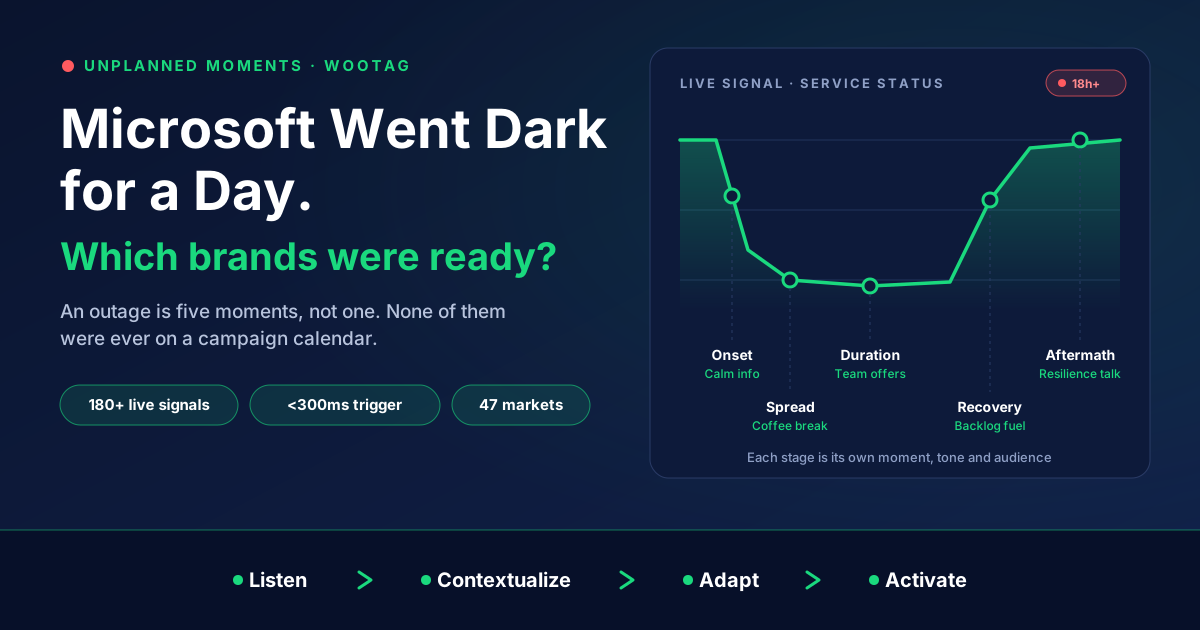
A large outage moves through stages that are fairly predictable even when the outage itself isn’t:
- Onset. Reports spike, status pages change, social conversation jumps. People are confused and looking for confirmation.
- Spread. More services and more regions are affected. Confusion turns into acceptance. “Nothing works, so I’ll do something else.”
- Duration. The two hour mark, the six hour mark, the overnight mark. Each threshold changes how people feel and what they need.
- Recovery. Services come back. Relief, plus a huge backlog of email and meetings.
- Aftermath. The next morning and the next week. Leadership asks “what’s our backup plan?” and budgets for resilience open up.
Each stage carries a different mood, a different audience and a different window. A coffee brand belongs in stage two. A backup software company belongs in stage five. A bank needs to be careful in stage one.
The data to detect all of this exists in public. Provider status pages publish incident updates. Outage tracking services show report spikes by service and region. Social conversation volume shows how widely people feel it. And for many software companies, their own product telemetry shows the moment a Microsoft integration starts failing. The signal is there. What’s usually missing is a system that listens to it and knows what to do next.
Why moments like this will never be in a campaign calendar
Here is the uncomfortable truth for annual planning: some of the most engaging moments of the year are, by nature, unschedulable.
- Nobody knows when. Outages don’t publish a date. This one started on a Thursday afternoon in the Americas. The next could be a Monday morning in Asia.
- Nobody knows how long. A 40 minute blip and an 18 hour outage are completely different moments. The right response depends on duration, which is only known as it unfolds.
- The window closes fast. The emotional peak of an outage lasts hours, not weeks. A typical creative and approval cycle is longer than the moment itself.
- It is not one moment. As shown above, an outage is five or more moments in sequence. Treating it as a single “react on social” opportunity misses most of the value.
Real-time marketing’s most famous example proves the point. When the lights went out at the 2013 Super Bowl, Oreo’s “You can still dunk in the dark” post went live within minutes and was shared tens of thousands of times. But it was only possible because Oreo had built a dedicated command room with agency and brand decision makers sitting together for that one evening. Few brands can staff a war room every day of the year, waiting for something that might not happen.
That’s the gap. The opportunity is real, but the operating model most brands run on is built for planned moments. Unplanned moments need infrastructure, not heroics.
How different categories could have used the outage
What follows is illustrative. None of these are client activations. They show how the same signal turns into very different moments depending on who is listening.
F&B and QSR: “Your inbox is down. The coffee isn’t.”
Food and beverage brands had the most natural, low risk role in this moment. People suddenly had unplanned free time during working hours, and the outage concentrated it in office-heavy areas.
- Spread moment, business districts, working hours. A coffee chain or QSR app could switch its Meta, TikTok and push communication in office-dense locations to a light, friendly break message: “Teams isn’t working. Neither should you, for ten minutes.” Pair it with a single item offer to drive store visits.
- Duration moment, two hours plus. As the outage stretches toward the end of the work day, shift to team-sized offers: “Meeting cancelled? Bring the whole team.” Group orders and delivery bundles fit well here.
- Recovery moment, next morning. Friday morning meant a mountain of unread email. A breakfast or coffee message built around “backlog fuel” lands at exactly the right time.
If the brand has store-level stock and pricing connected, each message can point to what’s actually available at the nearest store, rather than a generic offer.
Sports: a pause in the week, and an evening with nothing to do
Sports brands, leagues, broadcasters and sports apps didn’t have to talk about Microsoft at all. They only needed to recognise that a large share of their audience had an unexpected gap in the day.
- Spread moment. A sports streaming service or league app could push highlights, classic match replays or short form content framed around the pause: “Your Teams is down. Ours isn’t.” It is playful without mocking anyone.
- Stacked signals. The outage ran into Thursday evening and Friday. If a live fixture falls inside the window, the outage signal and the match signal stack. People who logged off work early are more likely to be watching from the start, so pre-match and kick-off moments deserve more weight that day.
- Sports retail. For sportswear and equipment brands, “go for a run while the servers reboot” is an easy, positive message, paired with in-stock running gear near the user.
Cloud software: be helpful first, and the leads follow
For SaaS companies, especially in collaboration, email, file sharing and productivity, this is the most tempting moment and the easiest to get wrong. Gloating over a competitor’s outage reads badly with IT buyers, who know that every provider has bad days.
The better play is utility. The outcomes here are B2B outcomes: site visits, content downloads, demo bookings and leads, not instant conversions.
- Onset and spread. If your product integrates with Microsoft 365, your first moment is not a marketing message at all. It’s a clear service status communication to your own customers: what works, what doesn’t, and what to do in the meantime.
- Duration moment. For products that genuinely help teams keep working (offline-capable tools, alternate communication channels, backup email), a calm “how to keep your team moving during a Microsoft 365 outage” guide, promoted on LinkedIn and programmatic channels to IT and operations decision makers in affected regions, is useful content, not opportunism.
- Aftermath, the following week. This is where most of the commercial value sits. Leadership teams ask about continuity plans after every big outage. A resilience checklist, a short webinar, or a “what we learned” piece earns attention from buyers who are actively thinking about the problem.
Infrastructure platforms: the aftermath is the main event
Multi-cloud and hybrid cloud providers, observability platforms, backup and disaster recovery vendors, managed service providers and connectivity companies all sell resilience. An outage is the moment the whole market is reminded why resilience matters, and the cost is significant. Research from Splunk and Oxford Economics puts the cost of downtime for Global 2000 companies at around $400 billion a year, roughly 9% of profits.
- During the outage, mostly quiet. An infrastructure brand pushing promotional messages while a peer’s customers are still offline looks predatory. The right moment during the outage is help: status communication and practical guidance for customers.
- Recovery moment. Once services are restored, start with an educational, neutral tone: what happens in a large outage, and how architecture choices affect blast radius.
- Aftermath moments. The next week and the next month. Resilience assessments, architecture reviews and executive briefings, targeted to the industries and regions where the outage was felt most.
- A rule that protects you. Infrastructure providers often depend on the same hyperscalers. If your own status signal shows any degradation, every outage related message should switch off automatically.
And many others
- Telecom and mobile data. When work moves to phones, hotspots and messaging, mobile data packs and “stay connected” messages fit naturally.
- Coworking and hospitality. Day passes and lobby cafés for people who decide to work somewhere else for the afternoon.
- Stationery and notebooks. “Pen and paper never needed a server” is a gentle, charming line that almost writes itself.
- Education. Learning platforms and institutions can communicate deadline extensions and alternate submission routes to students who couldn’t upload work.
- Banks and fintech. Reassurance messaging, such as “payments and transfers are unaffected”, when customers who rely on email for statements or OTPs start to worry. Sometimes the right communication is information, not promotion.
- Wellbeing and fitness apps. A short guided break or walk, timed to the moment people step away from their screens.
The moments that should stay quiet
Not every brand should respond to every outage, and not every stage is fair game. An outage is an annoyance for most people but a serious problem for some: a small business that couldn’t invoice, a hospital team that lost a scheduling tool, an IT lead who didn’t sleep.
Good suitability rules for outage moments look like this:
- Never mock the provider. Humour should be about the shared situation, not about Microsoft or its engineers.
- Never imply a security incident. Microsoft said there was no indication of malicious activity. Fear-based messaging built on speculation is both inaccurate and damaging.
- Check your own dependencies. If your own services run on the affected platform, switch off playful messages and switch on service communication.
- Watch severity. If the outage starts affecting emergency services, healthcare or critical public services, playful and promotional responses should pause automatically.
- Know when it’s over. Relief humour the next morning can work. A “lol remember the outage” message a week later doesn’t.
Silence is a designed outcome, not a failure. A system that knows when not to activate is as valuable as one that knows when to activate.
This is not a channel problem
It’s tempting to think of moments like this as “social media stuff”. They aren’t. The decision about what to say, to whom, in which tone and at which point in the outage is the same whether the output is a Meta or TikTok post, a push notification, a programmatic display unit, a connected TV spot, an email or an in-app message. Channels are where the decision lands. The decision itself has to happen upstream, consistently, and in minutes. A brand that solves this for one channel and not the others ends up with a clever social post and a promotional push notification that contradicts it.
Mapping the outage to moments
| Outage stage | Example trigger | Tone | Who it fits |
|---|---|---|---|
| Onset | Status page incident plus spike in outage reports | Calm, informative | Software with Microsoft integrations, banks and fintech (service reassurance) |
| Spread | Multiple services and regions affected | Light, friendly | F&B and QSR, sports apps and streaming, wellbeing, stationery |
| Duration (2h, 6h, overnight) | Outage still active past each threshold | Practical, team-oriented | QSR group offers, coworking day passes, telecom data packs, productivity tools |
| Recovery | Status page shows services restored | Relief, warmth | Breakfast and coffee, sports highlights, everyday retail |
| Aftermath (next week) | Incident closed, post-incident review published | Educational, advisory | Cloud software, infrastructure, MSPs, observability, backup and DR |
| Suppression | Own service degraded, critical services affected | Silent or service-only | Every brand |
Where Wootag comes in
Wootag Moments is built for exactly this kind of moment: one that matters to your audience, can’t be scheduled, and changes shape while it unfolds.
- Listen. Wootag ingests real-world signals across more than 180 live feeds and over 47 markets. An outage signal (provider status, report spikes, your own service health) is the kind of custom signal the Wootag team maps with a brand, alongside sports, weather, markets and other signals already running.
- Contextualize. Rules turn a raw signal into specific moments: onset, spread, each duration threshold, recovery, aftermath. Each moment is paired with a pre-approved communication, tone and offer. Suitability rules decide where to stay quiet.
- Adapt. The same decision is shaped for every format and placement, so the push message, the Meta post and the programmatic unit say the same thing in a way that fits each channel.
- Activate. The moment fires across channels with trigger latency under 300 milliseconds, while the moment is still live.
The result is that a brand doesn’t need a war room on standby. The response is built once, approved once, and then waits for the signal.
The same approach is already working with signals brands can see coming but can’t time precisely. Valvoline’s activations on live FIFA match events achieved 99.03% average video completion on connected TV with 37% cost efficiency, and the Penalty moment performed best. Budweiser’s match-event activations delivered 3.2x engagement uplift and 39% cost efficiency. Franklin Templeton’s market-signal activations showed the other side: by pausing when the signal didn’t justify a message, they saved 24% of budget with zero wasted impressions. Outage moments use the same logic. Respond when the moment is right, hold back when it isn’t.
Sourcing and transparency
Third-party sources
- Outage timeline, scope, Microsoft’s stated cause and the “no malicious activity” statement: SecurityWeek, Windows Central, BleepingComputer and XDA Developers reporting, 12 to 13 November 2026.
- Cost of downtime ($400 billion a year for Global 2000 companies, around 9% of profits): Splunk and Oxford Economics, The Hidden Costs of Downtime, 2024.
- Oreo 2013 Super Bowl blackout response: Digiday, The Drum and the Cannes Lions archive.
Wootag platform and case study figures
- Platform specs (180+ live signal feeds, 47 markets, under 300 ms trigger latency) are from wootag.com/moments.
- Valvoline, Budweiser and Franklin Templeton results are self-reported by Wootag on wootag.com/moments/case-studies.
The next outage is already coming
Nobody knows when the next big outage, blackout, storm or upset result will happen. You do know it will. The brands that win those moments won’t be the ones with the fastest social team. They’ll be the ones that decided in advance what each moment means for them, and connected that decision to a system that acts on it.
If you want to see how outage, sports, weather and market signals could become moments for your brand, talk to the Wootag team.
Sources
- Microsoft 365 Outage Disrupts Outlook, Exchange Online and Teams (SecurityWeek)
- Microsoft outage drags on as Outlook, Teams, and Microsoft 365 show signs of recovery (Windows Central)
- Massive Microsoft 365 outage disrupts Outlook, Teams, Copilot worldwide (BleepingComputer)
- Microsoft’s major Outlook, Teams, and OneDrive outage seems to be mostly over (XDA Developers)
- Uncovering Downtime’s $400B Impact (Splunk)
- The definitive oral history of the Oreo “You can still dunk in the dark” tweet (Digiday)
- The Oreo Blackout Tweet (Cannes Lions archive)
- Wootag Moments
- Wootag Moments case studies
Microsoft Went Dark for a Day. Which Brands Were Ready for It?
