
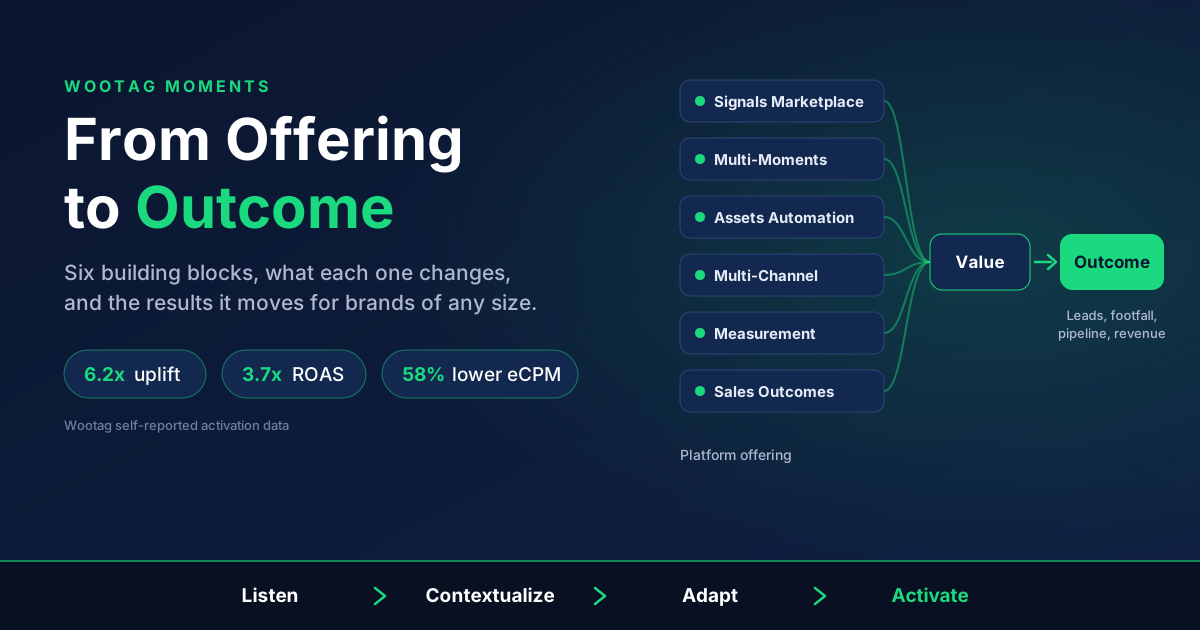

A plain map of the six building blocks of Moments, what each one changes for your team, and the marketing and sales results it is built to move
In short
- Wootag Moments is six connected pieces: a Signals Marketplace, a Multi-Moments library and rules engine, Assets Automation, Multi-Channel activation, Measurement and Sales Outcomes.
- Each one is there to remove a specific cost or delay that stops brands acting on real-world moments, from data builds and production bottlenecks to fragmented channel budgets.
- Marketing outcomes (relevance, reach, engagement) and business outcomes (leads, footfall, account openings, pipeline, repeat purchase) are tracked separately, so you can tell which moments made money and not just noise. And none of it needs enterprise scale to start.
Most marketing teams we speak to are not short of moments. It rains in twenty cities at once. A market index jumps two percent before lunch. A national team wins gold on a Tuesday afternoon. A search term spikes overnight because of a news story nobody planned for.
What teams are short of is a way to act on those moments without stopping everything else. Someone has to notice the signal. Someone has to decide if it matters for the brand. Someone has to brief a variant, get it approved, traffic it to the right channel and then, two weeks later, try to work out whether it did anything.
By the time all of that happens, the moment has passed.
That is the problem Wootag Moments was built to solve. Not with another dashboard, and not by replacing the plan your agency already runs, but by sitting beneath it as an always-on layer that listens, decides and activates on its own rules.
This post lays out exactly what that layer is made of, and for each piece, the value it gives your team and the outcomes it is designed to move.
The gap between a moment and a result
When we map how brands handle real-world moments today, the same pattern keeps showing up. Planned bursts are well funded and well produced. Festive season, a product launch, a sponsorship property. In between those bursts sits a long stretch of white space where the brand is either silent or running the same communication it ran last month.
The white space is not empty. It is full of moments where your audience’s context has changed: the weather turned, their portfolio moved, their team won, their industry announced something. Those are the moments where relevance is cheapest to earn, because almost nobody else is showing up with something that fits.
So why do brands leave it on the table?
Why the gap persists
Three things get in the way, and none of them is a lack of ideas.
Data is fragmented. Weather comes from one provider, sports results from another, market data from a third, search trends from somewhere else. Stitching those together means contracts, pipelines and engineering time that marketing rarely has.
Production cannot keep up. A single moment can need dozens of variants by city, format and product. Multiply that across a year and the creative team becomes the bottleneck.
Proof is hard to get. Even when a brand does act on a moment, the reporting usually rolls it into the wider activation. Nobody can say whether the rain moment beat the regular flight, so nobody gets the budget to do it again.
Each of the six pillars below exists to remove one of these blockers.
Pillar 1: Signals Marketplace
What it is: A library of 100+ public signals across weather, sports results, market movements, search trends, festive and cultural calendars, news and social sentiment. Signals can be stacked with AND/OR logic and thresholds, for example rain plus temperature plus city, or an index move plus a spike in searches for a fund. Brands can also plug in their own feeds: broadcast and show events, conference calendars, forex or commodity prices.
What it means for you: Always-on listening with no data build. There are no pipelines or vendor contracts to set up, and because the data is strictly public, it stays privacy safe. Stacked signals give you precise context, so fewer impressions go to people for whom the moment does not apply. Custom signals give you triggers your competitors simply cannot copy, because they are tied to your sponsorships and your category.
Marketing outcome: Relevance at the moment of intent, and share of voice in moments your competitors miss.
Business outcome: Lower cost to acquire and faster speed to market, without adding headcount.
Proof: When it started raining in each Starbucks location during a pilot, 40% of the activation’s reach was delivered right as the rain began. Standard Chartered’s stock-computed signals drove a 3.2x uplift in outcomes.
Pillar 2: Multi-Moments
What it is: A ready-made library of moments across Sports, Financial, Weather, Festive and Cultural, Events and B2B. These run through a rules engine (Map, Rule, Trigger) where you set the trigger logic, thresholds and guardrails per product line, audience or market. The whole thing can be planned as an Annual Moments Framework: a 12-month calendar of planned and reactive moments on one license and one credit pool.
What it means for you: The white space between your planned bursts finally gets filled, and it gets filled as a layer beneath your agency-led plan, not as a replacement for it. The rules engine keeps automation brand safe and compliant. A jewellery brand and an investment brand might both react to a gold price move, but each product line gets its own logic. And the annual framework means one predictable budget line across the financial year instead of a string of one-off activations.
For B2B brands, the moments are different but the idea is the same: reach buyers when their world changes, such as an industry event, a market move or a category shift, rather than on a fixed flight schedule.
Marketing outcome: Continuous, compliant brand presence across the year.
Business outcome: Sustained demand and pipeline year round, higher lifetime value and a clear path from pilot to scale.
Proof: Workday’s activations across F1, Asian Games and financial moments delivered a 6.2x uplift. Budweiser’s FIFA World Cup moments delivered a 3.2x engagement uplift and 39% better cost efficiency, with no product depiction at all, which matters in categories where compliance limits what you can show.
Pillar 3: Assets Automation
What it is: One master set of communication is automatically versioned by moment, location and channel format. Each asset is mapped to the moment, rule and channel it belongs to, and swaps on its own when the signal changes. A chat-based setup for configuring moments, rules, assets and activation is currently in beta.
What it means for you: No production bottleneck and no manual trafficking. One brief becomes hundreds of relevant variants, and the right communication shows up without anyone on the brand or agency side having to switch it over at 7am because it started raining.
Marketing outcome: Locally relevant communication at scale, where the message always matches the context.
Business outcome: Lower production and operations cost, and faster time from trigger to live.
Proof: Zydus Everyuth served 2.7x more video moments through automated adaptation. In the Starbucks pilot, communication adapted live across 20 locations the moment it rained.
Pillar 4: Multi-Channel
What it is: One license that activates moments across social (Facebook, Instagram, LinkedIn and TikTok), the open internet and premium screens (programmatic, CTV, DOOH and retail media), and owned channels through customer engagement platform partners.
What it means for you: Moments go wherever your audience is, with serving credits included. You are not tied to a single platform or a single activation, and you do not pay separate serving fees for every new channel you add.
Marketing outcome: Efficient reach in high-attention placements.
Business outcome: One budget line across channels, and lower cost per reach.
Proof: Starbucks saw an eCPM 58% lower than its average, with around 73% of its activation running on Instagram Stories and Reels, two of the highest-attention placements on the platform.
Pillar 5: Measurement
What it is: Reporting at the level of the moment, not the flight. Reach, impressions and engagement by moment, signal, location and channel. Cost efficiency benchmarked against your own business-as-usual numbers. Speed-to-moment analytics that show how fast you went live and how much reach you captured in the first window. And a structured 60 to 90 day pilot in two or three markets with agreed KPIs and a BAU comparison.
What it means for you: You know which moments work and where to move credits next. More importantly, you get the validation data that finance and leadership ask for before they approve scaling to more brands or markets.
Marketing outcome: Budget shifts to the best-performing moments.
Business outcome: Better marketing ROI and a de-risked decision to scale.
Proof: Zydus Everyuth recorded a 2.3x engagement uplift and 37% better cost efficiency against BAU. Across Everyuth, Budweiser and Starbucks, cost efficiency gains ranged from 37% to 58%.
Pillar 6: Sales Outcomes
What it is: Moments designed from the start to move revenue, not just attention. That covers demand capture when intent spikes, location-aware store and footfall moments, financial product acquisition when markets move, B2B pipeline and account expansion, and retention through owned channels.
What it means for you: Every moment is tied to a business result you already report on. For a travel brand that is bookings. For a coffee chain it is store visits. For a bank it is account openings. For a B2B software company it is pipeline.
Marketing outcome: Higher CTR and landing traffic at the moments when intent peaks.
Business outcome: Leads, footfall, account openings, pipeline and repeat purchase.
Proof: Airbnb India’s moments, built on weather, search trends and events, delivered a 3.7x ROAS. Standard Chartered’s market-movement moments drove a 3.2x uplift in outcomes.
Why none of this depends on one channel
It is worth saying plainly: the value here does not come from any single platform. Channels change their formats, their pricing and their algorithms all the time. What stays constant is the decision underneath: what to say, to whom, in what tone, at which moment.
That decision is the asset. When it lives in a signal layer that sits beneath your stack, every channel you plug in gets smarter, and none of them becomes a single point of failure. If a placement gets expensive, the same moment can shift to another channel without rebuilding the logic. If a new channel arrives, it inherits every moment you have already configured.
This is also why Moments works alongside the tools you already have. Your CDP, CRM and automation platforms keep doing their jobs. Moments adds the real-world context they were never designed to listen to.
The full map at a glance
| Pillar | Value to you | Marketing outcome | Business outcome | KPIs to track |
|---|---|---|---|---|
| Signals Marketplace | Always-on listening, no data build, privacy safe | Relevance at the moment of intent | Lower cost to acquire, faster speed to market | Signal-to-activation time, % reach in first window, CTR vs BAU |
| Multi-Moments | Fills the white space beneath agency-led plans | Continuous, compliant brand presence | Year-round demand, higher lifetime value | Active moments, days with live activations, credit burn vs plan |
| Assets Automation | No production bottleneck, no manual trafficking | Locally relevant communication at scale | Lower production and ops cost | Variants served, trigger-to-live time, cost per variant |
| Multi-Channel | Moments go wherever the audience is | Efficient reach in high-attention placements | One budget line across channels | Reach, eCPM, incremental reach |
| Measurement | Know which moments work, evidence to scale | Budget shifts to best-performing moments | Better ROI, de-risked scale-up | Engagement uplift vs BAU, cost per outcome |
| Sales Outcomes | Moments tied to revenue, not just awareness | Higher CTR and traffic at intent moments | Leads, footfall, account openings, pipeline, repeat purchase | ROAS, bookings, CPL, store visits, MQLs and SQLs |
Not just for big brands
Look at the names in the proof points above and it would be easy to assume Moments is an enterprise tool. It is worth unpacking why that assumption no longer holds.
Big brands have always been able to act on real-world moments. Not because they had better ideas, but because they could afford the machinery behind them: data partnerships to source signals, studios to produce variants on demand, trading desks to push communication across channels, and analysts to prove it worked. Smaller businesses had the same moments happening around their customers. They just did not have the machinery.
Moments puts that machinery inside the platform.
You do not need a data team. The 100+ public signals are ready to use from day one. A café chain with ten outlets listens to the same weather feed as a global coffee brand, with no contracts and no engineering.
You do not need a production studio. One master set of creative is versioned automatically by moment, location and format. A business with a single designer can run as many relevant variants as a brand with a full creative team.
You do not need a trading desk. One license covers social, programmatic, CTV and more, with serving credits included. Adding a channel does not mean adding a vendor.
You do not need to go big to start. A pilot can be one moment, in one city, on one channel. Prove it against your own numbers, then add the next.
A few illustrative examples of what that looks like in practice:
- A regional café chain switches its Instagram communication to hot drinks and a nearest-outlet prompt the moment it starts raining in each neighbourhood, and back again when it clears.
- A sports bar group goes live with matchday communication the minute the local team qualifies for a final, in the cities where that team’s fans actually are.
- A D2C electrolyte or skincare brand activates heat and humidity moments on TikTok and Meta only in the cities crossing a temperature threshold, instead of spending nationally on a heatwave that is only happening in three places.
None of these needs a big budget. Each needs the right signal, a clear rule and communication that changes when the moment does. That is exactly what the platform handles.
Size used to decide who could be relevant in the moment. Now it is just a matter of how many moments you choose to run.
How to read this if you are evaluating Moments
If you are a smaller or growing business, start with one moment that clearly matters to your customers, in one location you know well. Weather, a local sporting fixture or a seasonal search trend are usually the easiest places to begin.
If you are a brand marketer, start with the white space. Look at your calendar for the last twelve months and mark the weeks where the brand had nothing contextual to say. That is the opportunity Multi-Moments is built for.
If you lead performance or growth, start with Measurement and Sales Outcomes. The question is not whether moments get engagement, it is whether they beat your BAU cost per outcome. A 60 to 90 day pilot in two or three markets will answer that with your own numbers.
If you run a regulated or compliance-heavy category, start with the rules engine. Budweiser’s results came without showing the product at all, and financial brands can configure exactly which moments to speak on and which to stay silent through.
Wherever you start, the sequence is the same: Listen to the signals that matter to your audience, Contextualize them against your brand and products, Adapt the communication automatically, and Activate it across every channel you already use.
Want to see what your white space looks like? Talk to the Wootag team about a Moments pilot built around your signals, your markets and your BAU benchmarks. Visit wootag.com/moments to get started.
From Offering to Outcome: What Wootag Moments Actually Delivers for Brands
