

Why sporting goods, apparel, and activity brands don’t need a team badge to own a sports moment
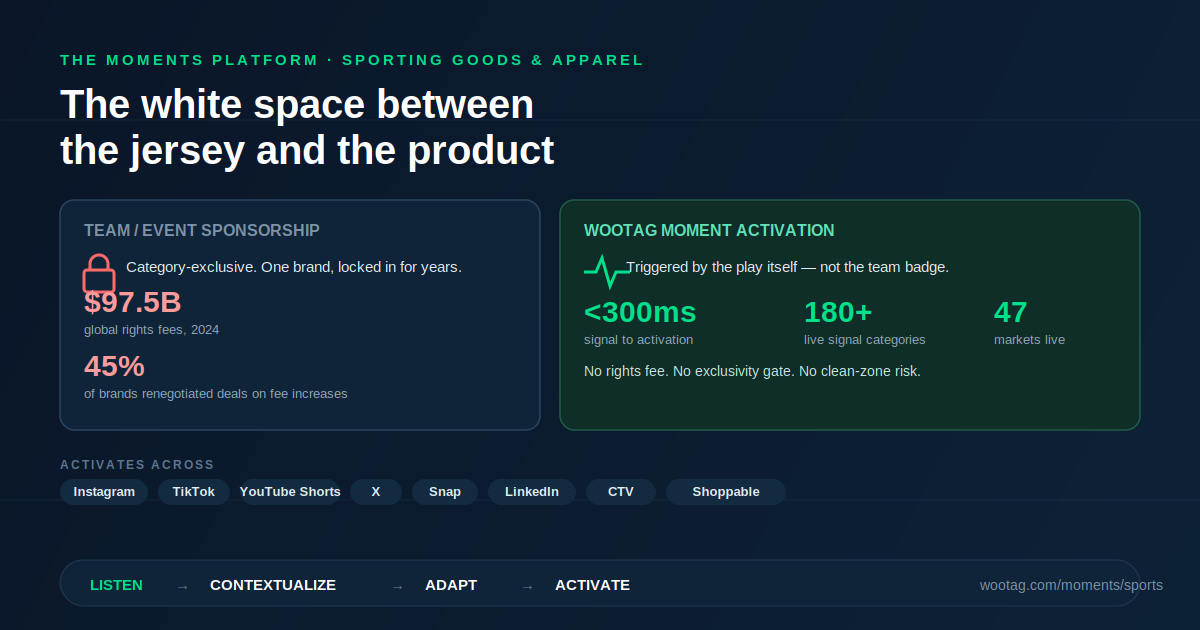
Every major sports calendar year, the same headline repeats: rights fees are up again. Global sponsorship rights fees reached roughly $97.5 billion in 2024, and by 2026 the broader sports sponsorship market is valued at $74.59 billion and climbing toward $96.45 billion by 2030. Brands are paying more for the same logo placements — and a large share of them are quietly unhappy about it. Nielsen-backed research cited in recent sponsorship trend reporting found that 45% of brands renegotiated deals last cycle — exiting, shrinking scope, or shortening terms — because fee increases had outpaced the value delivered.
Meanwhile, a second, much larger market has been growing in plain sight. Sporting goods alone is worth $112.52 billion in 2026, on its way to $151.43 billion by 2031. Global sportswear is valued at $437.4 billion in 2026 and is forecast to nearly double to $890.4 billion by 2033 — a 10.7% CAGR. Sports apparel, footwear, equipment, fitness wearables, outdoor gear: this is the category that actually sells product when a fan feels something during play. And yet almost none of the marketing playbook built for this category depends on owning a team or league relationship at all.
That’s the white space. Brands that make the shoes, the rackets, the leggings, the recovery tools, and the fitness apps don’t need a jersey badge to be present at the moment a sport creates emotion. They need to be present for the play itself — the wicket, the personal best, the match point, the summit — not the team that happens to be on the field when it happens.
The team-sponsorship trap
Official sponsorship isn’t just expensive; it’s structurally exclusive. Category exclusivity is a standard term in most tournament and league deals — once a competitor signs as the official kit or equipment partner, every other brand in that category is locked out for the life of the contract, regardless of budget. Brands that don’t win the category then face a second, riskier option: ambush marketing. Legal analysis of the FIFA World Cup 2026 and other major events confirms that “clean-zone” and “clean-stadium” policies actively require organizers to cover or remove non-sponsor branding, and that trademark law creates genuine infringement exposure for any brand that references protected event marks or suggests an official affiliation it doesn’t have. The IOC’s Rule 40, born from decades of ambush-marketing disputes, exists for exactly this reason.
In short: if a sporting goods or apparel brand wants to be part of a Wimbledon final, a World Cup knockout match, or an Olympic final, it either pays escalating rights fees for a shrinking pool of exclusive category slots, or it takes on legal risk trying to associate with the event’s name and marks without paying for the privilege.
There’s a third option most brands haven’t fully exploited: stop marketing to the event, and start marketing to the moment.
Listen to the play, not the property
Wootag’s Moments Platform is built around a simple distinction that solves the exclusivity problem structurally, not just legally: it listens to live signals — a wicket falling, a goal, a personal-best split, a match point, a heatwave — rather than to protected event trademarks or team IP. A brand activating off “a century is scored” or “a marathon PB is logged” isn’t claiming official affiliation with a tournament, a league, or a franchise. It’s responding to the sporting action itself, in its own paid and owned channels, adapted through Wootag’s four-stage framework:
- Listen — 180+ live signal categories across sport, weather, and 47 markets are ingested in real time.
- Contextualize — AI maps the signal to brand-safe creative, offers, and messaging tuned to the emotional state the moment creates.
- Adapt — Smart-adapt reshapes the same creative asset for feed, story, banner, CTV, or shoppable formats in under 300ms.
- Activate — The brand experience fires across every channel the platform reaches — no venue, no broadcast package, no team logo required.
Because the trigger is the play — not the property — a running shoe brand can activate the instant a marathon world record falls; a racquet brand can activate on every match point of a Grand Slam final; an equipment brand can activate on every century, without ever being a tournament sponsor, standing in a clean zone, or touching a protected mark.
Where it actually shows up
The reason moment activation works for a product category rather than a single sponsorship slot is that it’s genuinely omnichannel — the same signal-triggered creative reshapes itself for wherever the audience already is:
- Social — Instagram, TikTok, YouTube Shorts, X, Snap, and LinkedIn, each with native creative tuned to that feed’s behavior. TikTok and Shorts in particular map well onto the highlight-clip consumption habit noted below; LinkedIn is the natural home for the B2B side of a campaign — the trade and retail-partner story behind a consumer moment.
- Content & feeds — publisher sites, news apps, and sports apps, where context wraps around the story a fan is already reading.
- Digital advertising — programmatic display, DSPs, search, and retail media, with bid logic synced to the live signal.
- CTV & streaming — connected TV and OTT spots swapped dynamically based on what’s unfolding on screen.
- Shoppable & commerce — marketplace tiles, D2C sites, and QR-driven retail screens that turn the moment directly into a transaction.
For a sporting goods or apparel brand, that spread matters more than it does for a single-event sponsor: a shoe brand’s marathon-PB moment can run as a TikTok native clip, a LinkedIn post aimed at retail partners, a CTV spot during the race broadcast, and a shoppable tile on a marketplace — all from one signal, without buying rights to any of those placements individually.
Where this maps for sporting goods, apparel, and activity brands
| Vertical | Signal that matters | Moment example | Activation |
|---|---|---|---|
| Running & marathon gear | Personal-best splits, world records, race completions | A qualifying-time PB is logged mid-race | Push/social creative congratulating the achievement, tied to the shoe or wearable that supported it |
| Team-sport equipment (bats, boots, balls, rackets) | In-play moments: wickets, goals, aces, match points | A wicket falls in a powerplay over | Shoppable overlay on the equipment category — not the team — during peak emotion |
| Fitness & activewear | Workout completions, streaks, activity-level thresholds tied to weather | A heatwave alert coincides with indoor-workout search spikes | Contextual creative for breathable, cooling, or indoor-activity product lines |
| Outdoor & adventure gear | Weather signals (heat, snow, monsoon), seasonal activity windows | First snowfall alert in a target market | Dynamic creative for gear suited to the specific condition, hyperlocal |
| Golf & precision sports | Milestone shots: holes-in-one, birdie streaks, tournament leaderboard shifts | A player shoots under par in a major | Equipment-brand creative tied to the shot type, not the tournament name |
Team sponsorship vs. moment activation, side by side
| Team / event sponsorship | Wootag moment activation | |
|---|---|---|
| Cost structure | Multi-year rights fees, often seven figures+; inflating faster than broader marketing budgets | Platform subscription plus creative adaptation; no rights fee |
| Exclusivity | Category-exclusive; one brand per category, others locked out entirely | Not exclusivity-gated — any brand can activate on a signal category |
| Legal exposure | Low if you’re the official sponsor; high if you’re not and try to associate anyway | Minimal — activation is triggered by the live signal, not by referencing protected marks |
| Speed to activate | Locked in months or years ahead via contract | Sub-300ms from signal to creative, activated per moment |
| Channel reach | Typically limited to what the sponsorship package covers (stadium, broadcast) | Omnichannel: Instagram, TikTok, YouTube Shorts, X, Snap, LinkedIn, OTT/CTV, programmatic, display, DOOH, email, push |
| Measurement | Broad reach/impression metrics, harder to tie to a specific in-play moment | Per-moment engagement, recall, and incremental-reach tracking |
A note on scale and receptivity
This isn’t a niche behavioral bet. GWI’s 2026 sports fan research found that sports fans are 42% more likely to buy something with positive social proof attached, and that 61% of sports fans now consume highlights and short clips rather than full broadcasts — the exact moment-sized content unit that moment-based creative is built for. Nielsen’s global sport marketing research separately found sports sponsorship activity drives measurable purchase-intent lift when it’s genuinely tied to the audience’s emotional state, not just brand-adjacent placement. Moment activation is built to capture that same lift without requiring the rights fee that traditionally comes with it.
On the data in this post
The market-size, rights-fee, ambush-marketing, and fan-behavior figures above come from independent third-party sources — Research and Markets, Mordor Intelligence, Fortune Business Insights, Grand View Research, GWI, Nielsen, and legal analysis from Morgan Lewis and the International Trademark Association — and are cited inline. Platform capability figures (180+ signal categories, sub-300ms latency, 47 markets) are drawn directly from Wootag’s own product pages. Case studies referenced on wootag.com/sports, including the UltraTech IPL campaign, involve brands that held tournament-level partnerships; they’re included here only to illustrate how moment-triggered creative mechanics work in practice, not as evidence that non-sponsor sporting goods brands have already run identical campaigns on Wootag. The sporting-goods, apparel, and activity-brand application described in this post is a strategic proposal, not a confirmed client engagement.
The takeaway
Sporting goods, apparel, and activity brands have spent a decade watching sponsorship inventory get more expensive and more exclusive, while the market they actually sell into — equipment, apparel, footwear, fitness product — has kept compounding at 6–10% a year regardless of who’s wearing the team crest. The opportunity isn’t to outbid competitors for a shrinking pool of official partnerships. It’s to build the infrastructure that lets a brand show up the instant the sport itself creates the moment worth showing up for.
Book a demo → to see how Wootag’s Moments Platform can map signal categories to your product line.
