
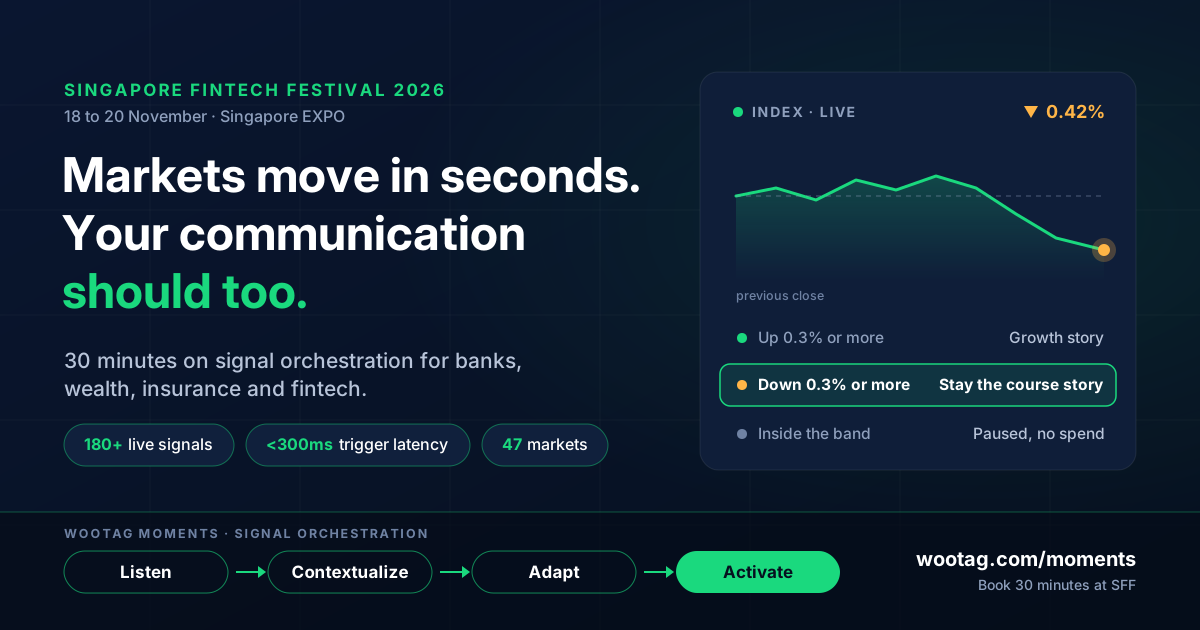

For banks, wealth managers, insurers and fintechs at Singapore FinTech Festival, 18 to 20 November 2026, Singapore EXPO.
In short
- Your customers react to rate decisions, market swings, FX moves and live events the moment they happen. Most financial brands still talk to them on a media plan approved weeks earlier.
- Wootag Moments is a signal orchestration platform. It listens to 180+ live signal feeds and changes what your activations say, to whom and when, across the channels you already buy.
- In 30 minutes we map two or three signals to your products, show you a live moment built on your brand, and sketch the marketing, sales and CFO case together.
The market moved at 9:31. Your communication said what it said yesterday.
Picture a morning when the S&P 500 opens two percent down. Millions of people open their banking or brokerage app before they open their email. Some are anxious, some see a buying opportunity, and a few start wondering whether their savings belong somewhere safer.
Now look at the bank and fintech marketing activations running that same morning. Almost all of it is identical to the day before. Same headline, same offer, same tone, approved weeks ago and locked into a flight that runs until the end of the month.
Your customers changed their state of mind in a minute. Your communication did not change at all. That gap is what a 30 minute conversation with us at SFF is about, and it is a gap that costs you on three lines at once: marketing efficiency, sales conversion and return on spend.
Finance runs on live signals. Its marketing mostly does not.
Few industries sit closer to real-time data than financial services. Your treasury desk sees a rate move in milliseconds. Your customers feel it within the hour. These are the signals that change what people want to hear from you:
- Index moves and volatility spikes. A record high invites confidence messaging. A sharp dip calls for reassurance, not a hard sell.
- Central bank rate decisions. Deposit, fixed deposit, mortgage and refinancing interest moves the same day the decision lands.
- FX swings. A stronger home currency is a remittance, travel card and cross-border payments moment.
- Gold, crude and crypto milestones. Wealth, gold savings and digital asset audiences pay closest attention exactly when prices cross a psychological level.
- IPO listing days and earnings. Retail investors are most curious when a listing pops or a result surprises.
- Live sports and weather. Card spend, travel insurance and sponsorship assets all carry more weight in the minutes around a big match or a storm warning.
Why the gap persists
The data already exists. What is missing is a layer that connects it to communication. Three things usually stand in the way.
- Signals are fragmented. Market feeds, weather, sports and FX sit with different providers, in different formats, owned by different teams.
- Approvals are slow, so teams make one safe version. BCG found that more than half of financial institutions need at least 14 weeks to launch a digital marketing activation. When every version needs its own review, nobody writes five.
- Media runs on flights, not triggers. Nothing in a standard buy tells your marketing activation to change when the world does. So it does not.
The same BCG research describes real martech spend fatigue in banks after long, costly platform builds. Which is why the answer here is not another platform to replace what you have. It is a signal layer that makes what you already own respond in real time.
What signal orchestration actually does
Wootag Moments decides what your brand says, to whom, in what tone and at what moment. Creative is one output of that decision, not the product itself. It works in four stages.
- Listen. Moments ingests 180+ live data feeds across markets, FX, commodities, crypto, weather and sports, unified through the Moments Marketplace. Custom signals, such as your own rate card, can be added on request.
- Contextualize. Rules map each signal to a message. A market up beyond a threshold gets one story, a market down gets another, and a flat market can pause spend entirely.
- Adapt. Pre-approved creative variants are assembled in the right format for each channel: feed, story, banner, video, CTV or push. Your compliance team reviews the full set of variants once, rather than signing off on a new asset every time the market moves.
- Activate. The right variant goes live across Meta, TikTok, LinkedIn, programmatic display and video, CTV and push notifications through your engagement platform, with trigger latency under 300 milliseconds.
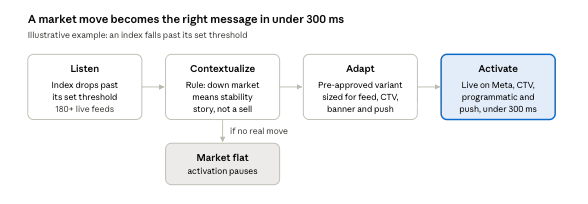
Once rules and variants are approved, every stage runs on its own. A flat market triggers nothing and spends nothing.
On top of single readings, a compute layer looks at growth across different durations and at volatility on indices to pick the message. That creates moments a single data point cannot. A market that is down today but up over the quarter is a different conversation from one that has fallen for five sessions in a row.
A real example from financial services
For Franklin Templeton, Moments watched the Sensex live. A rise of 0.3% or more served a growth-led film. A fall of 0.3% or more served a stability-led film. Anything in between paused the activation, so no budget was spent on a moment that did not exist. Wootag reports an 8.3x CTR uplift, 24% budget saved and zero wasted impressions. The same logic works on the STI, the S&P 500, the Hang Seng or any index your customers watch.
Marketing outcomes: relevance you can measure
For a CMO or head of digital, signal orchestration changes four things.
- Attention earned, not bought. A message that matches what just happened to someone’s money gets read. That is where the Franklin Templeton CTR lift came from: the same audience, a more relevant story.
- Less waste by design. When the signal says nothing worth saying, the activation pauses. Spend concentrates on the moments that carry intent.
- Many more moments from one brief. Wootag’s view is that thousands of moments a year go unclaimed. Once the rules and variants are approved, every rate decision, market swing and match day becomes an activation without a new creative cycle.
- Brand trust when it matters most. A calm, stability-led message on a bad market day reads as service, not selling. Customers remember which brand spoke to them like that.
Independent research points the same way. BCG’s work with financial institutions shows an achievable 20% to 30% revenue lift from addressable marketing through data-driven personalization, yet only 15% of FI CMOs rate their own capability above basic. Real-world signals are one of the fastest ways to close that gap, because they need no new customer data to work.
Sales outcomes: intent that arrives with context
In financial services, sales looks different by business line. It might be account opens, deposit inflows, card activations, AUM, loan applications, first trades or, for B2B fintechs, qualified leads and demo bookings. Signal orchestration helps on each because it changes when the ask is made.
- The ask lands when the need is real. A refinance message on the afternoon rates are cut, or a remittance nudge when the exchange rate turns in your customer’s favour, meets demand that already exists. You are not creating intent, you are catching it.
- Clicks tell you why. Someone who responds to a stability message on a down day is telling you something different from someone who responds to an all-time high. That context can flow into your CRM or engagement platform, so relationship managers and call teams know which conversation to have first.
- Owned channels do more work. Push notifications through your existing engagement platform can fire on the same signal as paid media, turning app users into the first audience for every moment, at almost no extra media cost.
- B2B pipeline, not just consumer demand. For transaction banking, treasury and B2B payments, LinkedIn activations that respond to FX volatility or commodity swings reach CFOs and treasurers while the problem is on their desk. The outcome there is meetings and demos, not clicks.
The common thread is timing. Most of the funnel work your sales teams already do gets easier when the first touch arrived at the right moment.
CFO ROI: why finance signs off
A CFO does not need to love the creative. They need to see where the money goes and what comes back. Signal orchestration makes that case on five points.
- It rides on media you already buy. Moments does not add a channel to fund. It makes existing Meta, programmatic, CTV and push budgets work harder.
- It spends only when the moment is worth it. Pause logic is a cost control. Franklin Templeton’s 24% budget saving came from pausing the activation on days the market gave no reason to communicate.
- Every moment is its own line item. Because each signal triggers its own variant, performance can be read per moment: which rate decision, which market move, which match minute paid back. That is cleaner attribution than one creative on loop.
- Cost is known up front. Moments runs on an annual license with usage credits, so finance can model it before a single activation goes live.
- No rip and replace. It plugs into your current stack, which is exactly the kind of integration-first investment BCG recommends for banks over building yet another platform.
Sketch the business case in the meeting
The table below is how we build a first estimate together. Assume a bank already spends S$2M a year on digital media. Moments does not replace that spend; it makes it work harder. The figures below are the value added on top, to compare against the Moments license. They are illustrative assumptions, not benchmarks or client results. In the meeting, your numbers replace ours.
| Value line | How to estimate it | Illustrative annual value added (S$) |
|---|---|---|
| Media efficiency | Share of spend no longer served into flat or irrelevant moments. Assume 10%, the low end of the 10% to 30% marketing spend efficiency range McKinsey reports for personalization leaders | 200,000 |
| Incremental conversions | Extra conversions from signal-led activations × value per conversion. Assume 1,500 extra account opens × S$150 first-year value | 225,000 |
| Production and approval time | Variant sets approved once instead of new assets per moment | Your agency and review costs |
| Annual value to compare against license cost | Sum of the lines above | 425,000+ |
If the conservative version of your own numbers clears the license cost comfortably, the pilot is an easy decision. If it does not, we will tell you that in the meeting too.If the conservative version of your own numbers clears the license cost comfortably, the pilot is an easy decision. If it does not, we will tell you that in the meeting too.
It sits under your stack, not on top of it
Channels come and go. The feed that works this year may not be the one that works next year, and the engagement platform you run today may be replaced in three. What lasts is the decision logic: when this happens in the world, say this, to these people, in this tone.
That logic should not live inside any single channel or vendor. Signal orchestration keeps it in one place and sends the answer to wherever your audience is: paid social, programmatic, CTV, your app, your site, or a CRM workflow. Your CDP still owns the customer. Your ad platforms still own the buy. The signal layer decides the moment and the message, and hands off.
For regulated businesses this matters twice. Rules and approved variants are written down and auditable, which is easier to govern than a stream of ad hoc reactive posts.
What this looks like for your business
These are illustrative starting points we would test in the meeting, not descriptions of existing client work.
| Business | Signal | Moment | Outcome to measure |
|---|---|---|---|
| Retail banking | Central bank rate decision | Deposit or fixed deposit message the hour rates move | Account opens, deposit inflows |
| Wealth and asset management | Index up or down past a threshold, volatility spike | Growth story on up days, stay-the-course story on down days, pause when flat | AUM inflows, advisor bookings |
| Cards and payments | Live sports moments, travel season, FX | Card offers tied to match moments, FX-aware travel card messages | Card activations, spend |
| Remittance and cross-border fintech | FX swings | Push and social nudges when the rate favours the sender | Transfers, app opens |
| Insurance | Severe weather alerts, haze, market volatility | Travel, home or protection cover messages as conditions change | Quote starts, policies issued |
| Digital brokers and crypto platforms | All-time highs, IPO listing days, BTC and ETH milestones | Celebratory or cautious creative matched to the move | Account opens, first trades |
| B2B fintech and transaction banking | FX volatility, commodity moves | LinkedIn activations to CFOs and treasurers | Leads, demo bookings |
What you get from 30 minutes
SFF week is full of 30 minute meetings that end with “let’s stay in touch”. We would rather you walk away with something you can take to your team on Monday. Here is how we use the time.
- The first 5 minutes: your priorities. Which products, which markets and which number you are measured on this year.
- The next 10 minutes: your signal map. We pick two or three live signals that matter most to your customers and map each one to a message and a channel.
- The next 10 minutes: a live moment on your brand. We show you how one of those signals would change your creative in real time, on the channels you already run.
- The last 5 minutes: the business case. We rough out the marketing, sales and CFO numbers using the framework above, and agree whether a pilot is worth scoping.
You leave with a signal map, a sample moment and a first-pass ROI sketch. If it is not a fit, you will know that within the half hour, and so will we.
Sources and transparency
We keep our own numbers separate from independent research so you can weigh each for what it is.
Wootag platform specs and self-reported results
- 180+ live signal feeds, trigger latency under 300 milliseconds, live in 47 markets: Wootag Moments
- Market signals tracked (all-time highs, IPO listings, earnings, crypto, FX, volatility): Stocks and Markets Moments
- Franklin Templeton: 8.3x CTR uplift, 24% budget saved, zero wasted impressions: Wootag case studies
Independent research
- More than half of financial institutions need at least 14 weeks to launch a digital marketing activation; 15% of FI CMOs rate their personalization above basic; 20% to 30% achievable revenue lift; martech spend fatigue in banks: BCG, How Bank CMOs Can Do More with Less
- 5% to 15% revenue lift and 10% to 30% marketing spend efficiency for personalization leaders, as reported from McKinsey research: ClickZ
- Singapore FinTech Festival 2026 dates and venue: The Fintech Times
The business case table and the vertical mapping are illustrative and are labelled as such.
Book your 30 minutes at SFF
We will be at Singapore EXPO from 18 to 20 November, and Singapore is one of our home offices, so a coffee before or after the festival works just as well.
Tell us the signal that matters most to your customers, whether that is a rate decision, a market swing, an exchange rate or a big match. We will bring a live moment built around it.
Book a 30 minute conversation or simply reply to the message that brought you here with a time that suits you.
The next market move is already on its way. The only question is whether your brand has something to say when it arrives.
Why 30 Minutes With Wootag at SFF 2026 Is Worth It
