
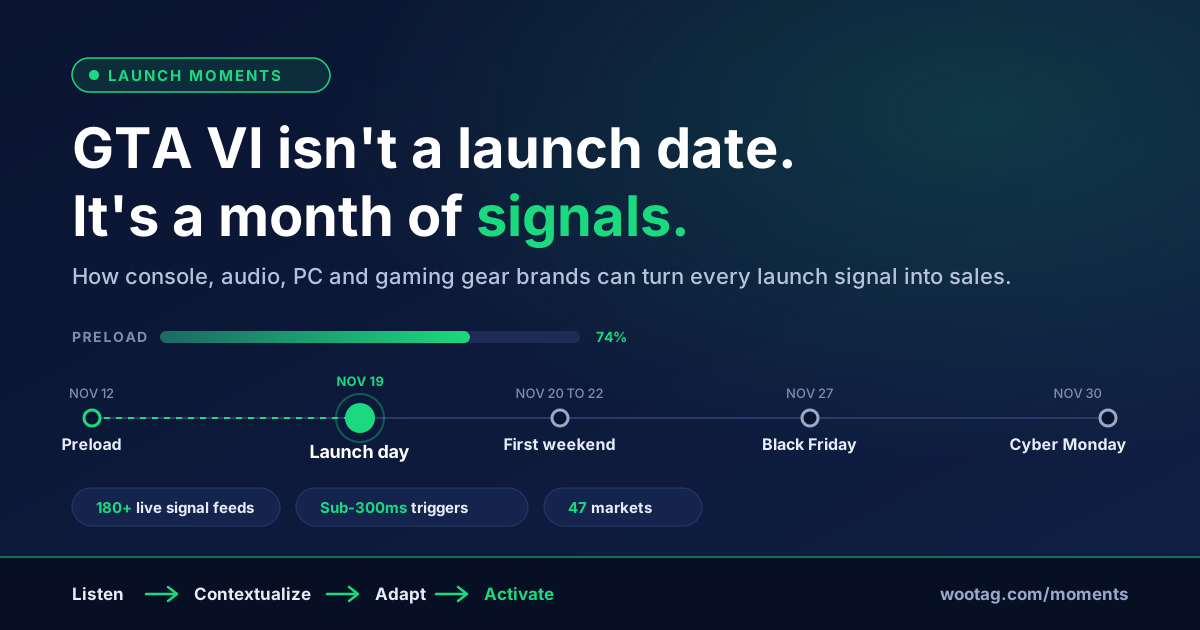

GTA VI Isn’t a Launch Date. It’s a Month of Signals Your Brand Can Answer.
Why the biggest entertainment release of the decade matters to every console, headset, PC, chair and gaming gear brand, and how to turn its signals into marketing and sales outcomes.
In short
- GTA VI lands on November 19, but the opportunity started today with preloads and runs straight through Black Friday, the first weekend of play and weeks of post launch news.
- Most adjacent brands will plan one hero burst around launch day. Demand will actually move hour by hour, by market, by platform and by what is still in stock.
- Brands that listen to each signal, change what they say and route intent to products people can actually buy will capture far more of this moment than brands that simply show up on the date.
The download bar is the first signal
At local midnight today, November 12, millions of PS5 and Xbox Series X|S owners started downloading a game they can’t play for another seven days. Rockstar opened GTA VI preloads exactly one week before its November 19 launch. Across living rooms everywhere, a progress bar is creeping forward.
That progress bar tells you more about your customer than most media plans do. It tells you this person owns a current generation console. It tells you they paid around $80 for the standard edition. It tells you they have cleared their schedule for next Thursday night. And it tells you that in the next seven days they will think hard about their headset, their storage, their controller, their chair and whether their TV is good enough.
We have seen this movie before. When GTA V launched in September 2013, it made $800 million on day one and passed $1 billion in three days, faster than any entertainment release before it, film included. Thirteen years and two delays later, the sequel arrives with more anticipation, not less. Rockstar’s Extended Look on Netflix drew more than 30 million viewers, and UK sales of PS5 and Xbox Series consoles jumped by roughly a third in the week that followed. One analyst expects at least 38 million copies sold in the first 12 months.
For anyone who sells something a gamer touches, plugs in or sits on, this is not a pop culture headline. It’s a demand event. The question is whether your brand treats it as a date on the calendar or as what it actually is: a stream of live signals.
A launch is a signal stream, not a date
November 19 is the headline, but it’s only one point in a run of signals that started today and lasts well into December. Each one tells you something different about the person on the other side of the screen.
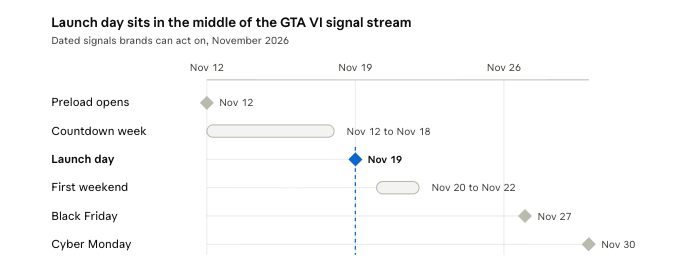
- Preload opens (today). The buyer is committed and counting down. This is the window for anything they need before they play: storage, headsets, controllers, a faster connection.
- Countdown week. Search interest climbs, creators post predictions and late deciders realise they still don’t own a console. Stock and bundles matter most here.
- Launch day. Attention peaks and plays out market by market. People are playing, not shopping, so the message should be short, timely and useful.
- First weekend. The long sessions begin. Comfort, sound and setup move from “nice to have” to “why didn’t I buy this already.”
- Black Friday and Cyber Monday. Launch excitement collides with the biggest discount week of the year, one week later. Anyone who held off on hardware now has a second reason to buy.
- After launch. Reviews, sales milestones, online updates and any PC announcement each restart the conversation. Every one is a fresh signal, not a reason to rerun launch week creative.
Where adjacent brands lose the moment
Most brands around a launch like this do the same thing. They brief one creative, lock one flight around launch week, attach one offer and hope the timing lines up. It looks like participation. In practice it leaks value in four places.
Wrong time. Launch doesn’t happen at one moment. The same date plays out across time zones, so launch night in Sydney is a working morning in London and the middle of the night in Los Angeles. A message scheduled for “launch day” in one market lands while players in another are already hours into the game, or still asleep.
Wrong message. The player who preloaded today doesn’t need to hear “get ready for GTA VI.” They are ready. What they need is a better headset, more storage or a second controller. The person who still hasn’t bought a console needs something else entirely: stock, a bundle and a reason to buy this week instead of waiting.
Wrong product. Hot items sell out. When the PS5 Pro or a popular headset goes out of stock at a local retailer, a fixed activation keeps pushing it anyway. Every click after that point is paid frustration.
Wrong audience promise. GTA VI launches on PS5 and Xbox Series X|S only. Rockstar hasn’t announced a PC version. A gaming laptop brand telling people to “play GTA VI on our machine” next week is making a promise it can’t keep. The PC moment around this launch is real, but it is a different moment: streaming, content creation and the long wait for a PC release.
Why the gap persists
None of this is a creativity problem. Gaming and electronics marketers know their audience better than almost anyone. The gap is structural.
Plans are built on dates, and dates move. GTA VI was first expected in 2025, then set for May 26, 2026, then moved to November 19, 2026. Every brand that locked media around the May date had to unpick it. A plan built on a signal fires when the signal fires, whatever the calendar says.
The signals live in different places. Preload and launch timing come from the publisher. Stock and pricing sit in retailer and brand systems. Search interest, social chatter and stream viewership sit with other providers again. No single team watches all of them, so no single decision connects them.
There is no layer that decides what to say, and when. Most stacks can deliver a message brilliantly once someone decides what it is. Very few can decide, in the moment, that the console stock story should give way to the headset story because the console just sold out in Jakarta. That decision is usually a meeting. By the time the meeting ends, the moment has passed.
The moment doesn’t belong to a channel
A launch moment is not a social moment or a CTV moment or a push moment. It is a change in what a person is thinking about, and it travels with them across every screen they touch that day.
That is why the decision about what to say has to sit above the channels, not inside each one. When the signal fires, the same decision should shape the story on Meta and TikTok, the push notification in a retail app, the programmatic placement, the CTV break and the screen in a store. Each channel gets the format it needs. None of them should have to work out the moment on its own.
Brands that get this right stop asking “what should our launch creative be?” and start asking “what should we say when this happens, to whom, and what should they be able to buy right now?”
What this looks like by category
The mapping below is illustrative. It shows how brands in each category could read the GTA VI signals, not what any named brand is doing.
| Category | Signals to listen for | The moment | What changes in the communication | Outcome to track |
|---|---|---|---|---|
| Consoles (PlayStation, Xbox) | Preload opens, countdown days, local retailer stock, search interest in console plus GTA VI, Black Friday | The last week buyer who still doesn’t own a current console | Lead with whichever model and bundle is in stock nearby; when it sells out, switch to storage, controllers and accessories | Console sell through, accessory attach rate |
| Headphones and headsets | Preload, launch night, first weekend play sessions, late night local time | The first long session, when sound suddenly matters | Immersion and comfort for long sessions; console compatibility called out clearly; late night tone | Product page visits, conversion, basket size |
| Gaming laptops and PCs | Stream and creator viewership peaks, search interest in a GTA VI PC version, any PC news from Rockstar | Creators and streamers covering the launch, and PC players waiting their turn | Talk to streaming and capture setups now; prepare a separate “ready when it lands” story for if and when a PC version is announced | Consideration, notify me sign ups, creator bundle sales |
| Gaming chairs and desks | First weekend (Nov 20 to 22), Black Friday, weekend weather | The marathon weekend, when hours on the couch start to add up | Comfort and posture for long sessions; delivery promises that land before the weekend | Sales, delivery cut off conversions |
| Storage, controllers and TVs | Install size chatter, preload, launch week reviews of performance modes | “My console is full” and “my TV isn’t doing this justice” | Expansion storage and second controllers before launch; display upgrades around Black Friday | Attach rate, average order value |
The same logic stretches well beyond hardware. Broadband and telco brands have a download moment today. Food delivery and quick commerce have a launch night moment next Thursday. Energy drinks and snacks have a first weekend moment. None of them need to be official partners to show up with something useful.
How Wootag Moments runs a launch like this
Wootag Moments is built for exactly this kind of moving target. It works as a signal layer that sits under the tools a brand already uses, deciding what to say, to whom and when, and then handing that decision to every channel.
Listen. Moments pulls in launch milestones alongside live signals like search trends, weather and local time, from a marketplace of 180+ live feeds. With Retail Signals, brands can also connect their own stores, stock and pricing through an API, so the system knows what is actually available in each location.
Contextualize. Each signal is mapped to an audience state. Preloaded and waiting. No console yet. Deep into the first weekend. PC player watching from the sidelines. The Compute Framework adds another layer, reading whether a search trend is accelerating or cooling over the last few hours, so a brand pushes harder when interest is climbing and eases off when it peaks.
Adapt. Brands upload their own approved messages and creatives for each moment. Moments pairs the right one to the signal and reshapes it for the format each channel needs. Nothing goes out that the brand hasn’t signed off.
Activate. The chosen message goes live across Meta, TikTok, push notifications, programmatic and CTV, with sub-300ms trigger latency. When local stock runs out, the activation can switch to the next best product or route demand to a marketplace that still has it.
One more thing matters with a title like this. GTA has always been a mature-rated franchise, and not every brand wants to sit next to every scene. Suitability rules let a brand decide which moments to claim, which imagery to avoid and which audiences to exclude, so the energy of the launch is used without borrowing its content.
The pattern is already proven in live sports, which behave a lot like a big launch: huge, emotional and impossible to schedule to the minute. Budweiser used live FIFA match signals across display and DCO and reported a 3.2x engagement uplift with 39% cost efficiency. Its top performing moment was not a goal. It was pre-match, the anticipation window. Valvoline used live match events on CTV and OTT and reported a 99.03% average view completion rate and 37% cost efficiency. GTA VI is all anticipation right now, and the week between preload and launch is its pre-match.
A note on sources
Wootag platform claims and case study results are self-reported by Wootag and published at wootag.com/moments and wootag.com/moments/case-studies. That covers the 180+ signal feeds, sub-300ms trigger latency, and the Budweiser and Valvoline results. The case study page doesn’t publish baselines or measurement periods.
Third party facts:
- GTA VI release date of November 19, 2026, on PS5 and Xbox Series X|S, and the earlier May 26, 2026 date: TechRadar, Variety.
- Preloads opening November 12 and the $79.99 standard edition price: TechRadar.
- GTA V’s $800 million first day and $1 billion in three days: GameSpot.
- 30 million+ Extended Look viewers and the 33% (PS5) and 34% (Xbox Series) UK sales lift, from NielsenIQ data via The Game Business: VGC.
- The forecast of at least 38 million copies in the first 12 months, from Joost van Dreunen of Aldora: GamesIndustry.biz via GameDev.net.
The category mapping is illustrative and doesn’t describe the plans of any named brand.
Seven days is enough
The preload bar will finish long before November 19. The question is whether your brand’s plan will be ready to listen, change its message and point people to something they can buy, every time the signal shifts.
If you sell anything a gamer plugs in, puts on or sits in, talk to the Wootag team about setting up your launch Moments this week. GTA VI won’t be the last big release. The brands that build the muscle now will be ready for the next one.
GTA VI Launch Moments
