

The moment we’re living through
This summer hasn’t been a normal one. Europe has gone through consecutive, record-breaking heatwaves since late May, with temperatures crossing 40°C in France, Germany, Spain, Italy, and beyond, and heat-related deaths climbing into the thousands across the continent. Across the Atlantic, roughly 150 million Americans have sat under heat alerts at once, with cities like Washington DC, New York, Philadelphia, and Boston flirting with or breaking all-time July records.
This isn’t a footnote in the weather app. It’s a live, evolving signal that is reshaping how millions of people move, shop, work, and make decisions — in real time, every single day the heat persists.
And that raises an uncomfortable question for most marketing teams: if your audience’s entire day is being reorganized around the temperature outside, why is your brand still running the campaign you planned three weeks ago?
Real-world signals don’t wait for your content calendar
A heatwave is not a single event — it’s a rolling series of micro-moments. The first “red alert” notification. The first person searching “cooling center near me.” The first office that quietly switches to a half-day. The first parent checking whether the kids’ football match got cancelled. Each of these moments carries a spike in attention, urgency, and intent — and each one closes within hours, sometimes minutes.
This is precisely the gap that platforms like Wootag are built to close. Wootag’s Moments Platform is designed to listen to over 180 live signal categories — sports, weather, stocks, commodities — and turn each one into a brand-ready moment in under a second, from detection to a live creative on someone’s screen. When a city crosses a heatwave threshold, that signal can trigger cold-drink, air conditioning, sunscreen, or hydration messaging instantly and hyperlocally, down to the postal code, rather than days later when the moment — and the emotional relevance — has already passed.
That speed matters because attention during a heatwave isn’t generic; it’s specific and time-boxed. A brand that shows up with “beat the heat” messaging while a genuine 40°C heat dome is sitting over a region isn’t intruding — it’s meeting people exactly where their head already is.
What “responding well” actually looks like
Resonating with a heatwave in real time isn’t just about slapping a sun emoji on a banner ad. The brands that get this right tend to combine several tools at once:
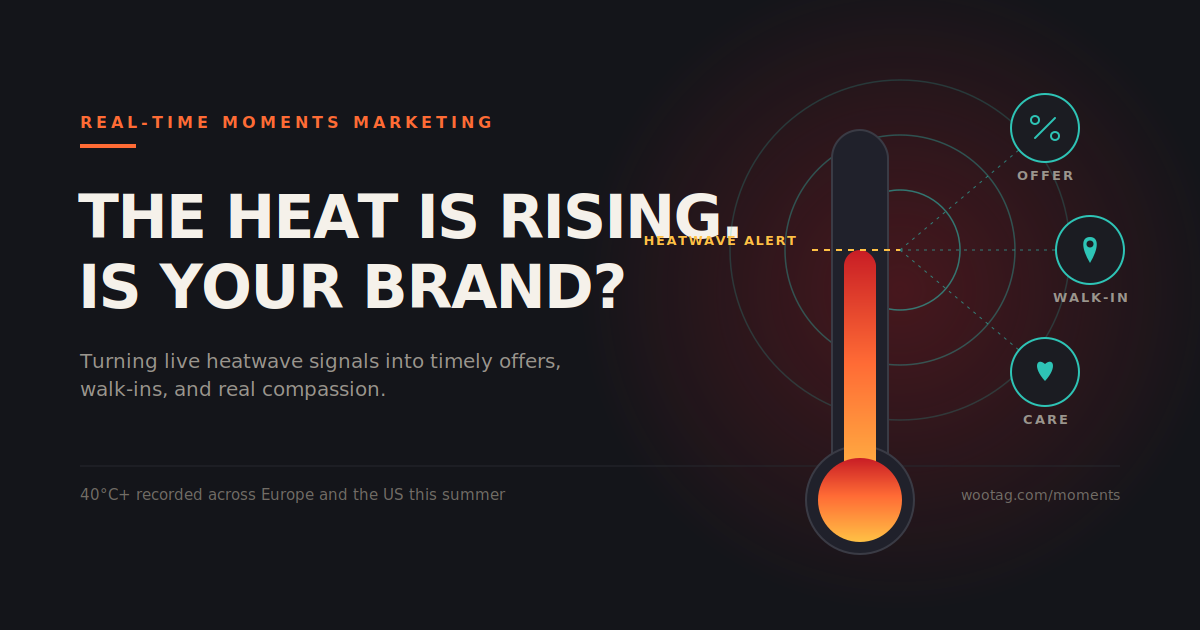
- Offers and discounts — a % off cold beverages, ACs, fans, electrolyte drinks, or sunscreen the moment a heat alert fires in a given city, rather than a seasonal promo that started weeks earlier.
- Promotions tied to relief, not just sales — “free refill days,” extended AC servicing slots, discounted delivery in place of asking people to walk in the heat.
- Walk-in and footfall triggers — hyperlocal nudges that turn a heat alert into a reason to visit an air-conditioned store, café, or mall, converting a real discomfort into real foot traffic.
- Brand compassion — cooling stations, water points, extended store hours as public shelters, health and hydration tips, check-ins on vulnerable customers. This is the part brands most often get wrong by skipping it entirely in the rush toward commerce.
- Dynamic creative and shoppable formats — the same underlying message reshaped automatically for a social feed, a CTV spot, a retail screen, or a programmatic banner, so it lands appropriately wherever the audience already is.
The mix matters more than any single tactic. A pure discount can feel opportunistic when people are genuinely struggling with heat-related health risks; pure compassion with no useful offer can feel like it’s missing the moment commercially. The brands that win combine both — genuine utility wrapped in a real, timely deal — which is why Wootag frames this as a “resonance layer”: creative tone, copy, and offer that adapt to the emotion a signal evokes, whether that’s urgency, relief, or reassurance, not just the fact of the signal itself.
Why this is worth the operational lift
It’s fair to ask whether all this real-time orchestration is worth the effort compared to a well-planned summer campaign. The evidence from adjacent real-time use cases suggests it is. In Wootag’s sports-moments work, pairing brand messaging with live, high-emotion triggers (rather than static sponsorship placements) produced engagement lifts of over 3x and brand recall increases in the 40%+ range, alongside meaningful gains in incremental reach — all from timing the message to the moment rather than the calendar.
The same logic transfers directly to weather. A heatwave alert is, structurally, no different from a wicket falling or a goal being scored: it’s a spike in collective attention and emotional intensity that decays fast. The brand that arrives inside that spike — with a relevant, useful, well-toned message — captures attention that a generic, pre-scheduled ad simply cannot buy at any price, because the relevance itself is time-limited and non-repeatable.
For brands and businesses, the metrics that tend to move when this is done well include:
- Engagement rate — messages tied to a live, personally relevant condition (the actual heat outside someone’s window) consistently outperform generic creative on click-through and interaction.
- Brand recall — emotionally charged moments are simply more memorable, and a brand that shows up inside one borrows some of that memorability.
- Footfall and walk-ins — hyperlocal, weather-triggered offers convert discomfort into a concrete reason to visit a physical location.
- Incremental reach and revenue — audiences reached through moment-based triggers are often incremental to a brand’s always-on campaigns, not a substitute for them.
- Sentiment and brand trust — the compassion layer (cooling shelters, hydration reminders, safety information) builds goodwill that a transactional-only approach cannot, and it’s disproportionately remembered when the news cycle itself is about human hardship.
The line brands need to walk carefully
It’s worth being direct about something here: a heatwave that’s killing people is not simply “content.” Thousands of excess deaths have been reported across Europe this summer, and hospitals, cities, and health authorities have been issuing genuine emergency guidance. Any brand real-time strategy that treats this purely as a sales opportunity — with no acknowledgment of the human cost, no safety information, no restraint where restraint is warranted — will read as tone-deaf rather than responsive.
The brands that will actually benefit are the ones using real-time signal marketing to be genuinely useful first: pointing people toward shade, hydration, cooling infrastructure, and health guidance, and layering commercial offers on top of that utility rather than in place of it. That’s the difference between “opportunistic” and “relevant” — and audiences can tell the difference instantly, especially when the moment is this serious.
The takeaway
The heatwave sweeping Europe and the US this summer is a preview of something structural, not a one-off. Real-world signals — weather, sport, markets, culture — are increasingly the actual context in which people live their day, and static, pre-scheduled marketing calendars are increasingly out of step with that reality. Platforms built to listen to those signals and respond within seconds — pairing offers, promotions, walk-in triggers, and genuine compassion — aren’t just a nice-to-have anymore. They’re becoming the baseline expectation for what it means for a brand to be paying attention at all.
