

Lionel Messi turned 39 mid-tournament and marked it with a midnight workout instead of a party. Cristiano Ronaldo’s international career ended not with a trophy but with a late Spanish substitute’s winner. Cape Verde — a nation of half a million people making its World Cup debut — pushed the defending champions to extra time and, for a few days, out-trended a celebrity wedding. Erling Haaland has scored in fourteen consecutive competitive games and just eliminated five-time champions Brazil.
None of that was in anyone’s media plan. That’s the point and the importance of Moments!
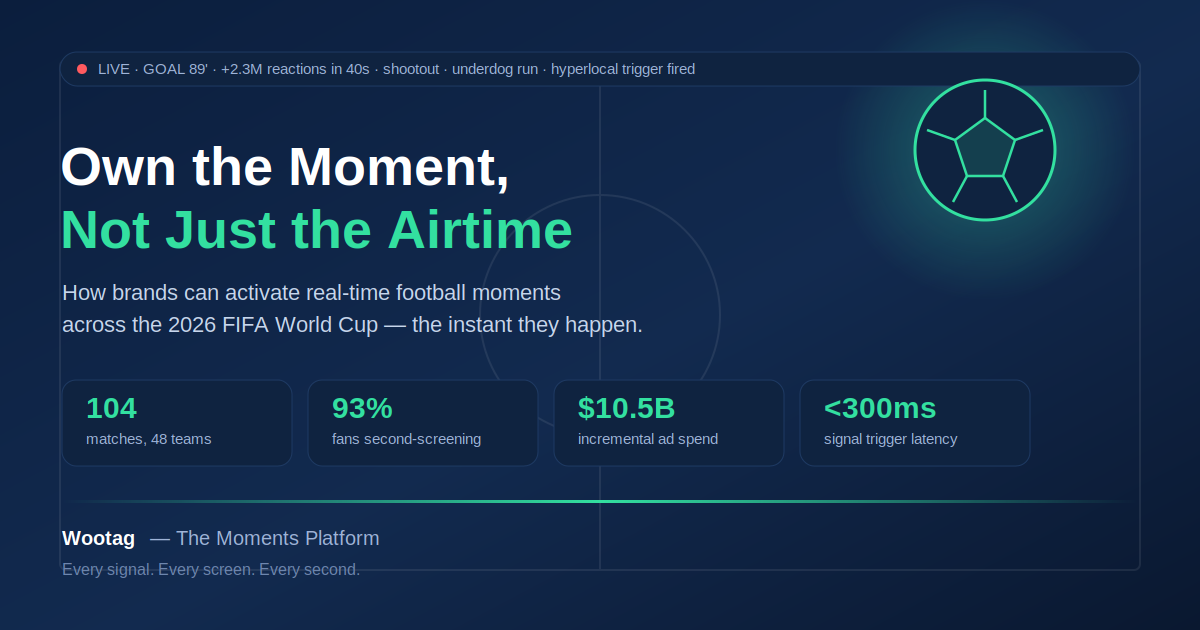
The 2026 FIFA World Cup — the first with 48 teams, hosted across the United States, Mexico and Canada, running 104 matches over 39 days — is now in the quarterfinal stretch, and it has already produced more unscripted, emotionally charged moments than most brands could storyboard in a year. The tournament will reach billions of viewers before the final whistle blows in East Rutherford on July 19. The question for marketers isn’t whether this audience is enormous. It’s whether their brand can show up inside the moment — the goal, the shootout, the underdog run, the halftime scroll — rather than just around it.
The Real Battleground Isn’t the Pitch. It’s the Second Screen.
For years, “World Cup marketing” meant a 30-second spot and a war room refreshing Twitter. That playbook is now outdated for two reasons: scale and screen behavior.
On scale, the numbers are hard to overstate. The tournament’s four-year commercial cycle is projected to generate around $11 billion in revenue, with the event itself expected to contribute close to $41 billion to global GDP and support over 800,000 jobs, according to Forbes’ reporting on FIFA’s commercial build-out. In the US alone, projected total economic impact runs into the tens of billions of dollars.
But reach was never the scarce resource — attention is. And attention has migrated to a second screen. Industry research cited by marketing outlet LBBOnline found that a large majority of fans reach for their phones during breaks in play, checking their devices repeatedly throughout a match, messaging friends the instant a goal goes in, and firing up group chats to react in real time. Crucially, most of those fans say they’re open to hearing from brands during those breaks — but only if the content is actually relevant to what’s happening in the match. Separate research from GWI found that World Cup viewers who are “second-screen natives” are meaningfully more likely to search for products, look up information tied to what they’re watching, and engage on social apps while the TV is on. Other industry estimates put the share of fans second-screening during matches above 90%.
That’s a narrow, valuable window: relevance decays within seconds of the moment that created it. A brand that reacts an hour after Haaland’s goal isn’t reacting to a moment anymore — it’s reacting to old news.
The Uncomfortable Ad-Spend Reality
Here’s the honest caveat brands need to hear before they double their World Cup budget: bigger tournament, smaller guaranteed return.
WARC Media’s Global Ad Trends report on the 2026 World Cup forecasts the tournament will inject roughly $10.5 billion into global ad spend — a real but modest 1.1% incremental lift, and notably smaller than the boost the 2018 Russia World Cup delivered. Audiences haven’t shrunk; they’ve fragmented. Global linear TV viewership for the World Cup fell nearly 12% between 2018 and 2022 even as total audience grew, because viewers shifted to connected TV, highlights, clips and social — not away from football, but away from the broadcast slot brands paid to own.
The implication is direct: buying a single premium placement and hoping it “owns” the tournament is a weaker bet in 2026 than it was in previous cycles. The opportunity has moved from owning a moment in advance to capturing the conversation as it happens — across whichever screen the fan is actually looking at.
What’s Actually Working: Reacting to the Moment, Not the Match
Look at how sponsors and non-sponsors alike are already adapting. Visa built its “Tap In” campaign around real players and real moments rather than generic tournament association. Coca-Cola built an anthem and multiple creative cuts specifically designed to be re-cut and redeployed as the tournament’s emotional beats — comebacks, near-misses, celebrations — unfold. DoorDash’s “Deliver Us to Fútbol” campaign leaned on the at-home watch-party occasion rather than the stadium. Dove Men+Care paired its campaign with limited product drops and in-city activations timed to specific match windows, according to Brand Innovators’ ad tracker.
The common thread isn’t bigger budgets. It’s tighter timing — creative and offers built to activate the instant a real signal fires, not the week the campaign launches.
This is precisely the operating model behind Wootag’s Moments Platform: listen, contextualize, adapt, activate. Instead of a single hero spot, the platform ingests live sports signals in real time — goals, last-minute winners, upsets, buzzer-beating finishes — and maps each one to brand-safe creative, dynamic offers and hyperlocal triggers within a sub-second window. A goal in the 89th minute doesn’t have to wait for tomorrow’s ad refresh; it can trigger a shoppable overlay, a location-based offer to fans near the stadium, or a re-cut social asset the moment the net ripples — pushed simultaneously across CTV, programmatic, social feeds and retail screens.
For a 39-day, 104-match tournament with matches kicking off across three time zones, that kind of always-listening infrastructure matters more than any single creative concept. No human war room can monitor 104 matches around the clock without burning out — which is exactly the concern creative leaders have flagged heading into this tournament, warning that brands need distributed teams and pre-built response systems rather than one exhausted team trying to sprint a 39-day marathon.
A Practical Framework for Brands This Tournament
1. Build for the break, not the broadcast. With most fans checking phones during stoppages and a strong majority open to brand content there — provided it’s relevant — the highest-value real estate isn’t the ad break. It’s the 30 seconds after a goal, in the feed the fan is already scrolling.
2. Let real signals write the creative brief. An upset, a red card, a penalty shootout, a hometown underdog run — each carries a distinct emotional register (shock, tension, joy, pride). Static campaigns can’t flex across all of them. Dynamic, signal-triggered creative can match tone to moment instead of forcing one tone across 104 unpredictable matches.
3. Localize aggressively. With host cities spread across a continent and matches split across markets with wildly different kickoff times relative to local evenings, hyperlocal activation — a walk-in offer near a stadium, a regionally tuned message tied to a specific team’s fanbase — will outperform one-size-fits-all national campaigns.
4. Respect the guardrails. Only official partners can use FIFA’s protected marks — “World Cup,” the emblem, the mascot, official slogans — in commercial messaging. Non-sponsors can absolutely build campaigns around the cultural moment (football, summer, national pride, the shared experience of watching), but need to stay clear of ambush-marketing lines: no tournament imagery, no giveaways implying official association, no activity in FIFA-designated exclusion zones. This isn’t a small print detail — it’s a real legal and reputational risk, and it should shape the brief from day one, not get bolted on afterward.
5. Plan for endurance, not a single sprint. Thirty-nine days is long enough that a single “always-on” team will degrade in quality by the quarterfinals. Whether that’s human shift rotation or an automated signal-detection layer doing the heavy lifting, brands need infrastructure built to last the whole tournament, not just opening weekend.
The Honest Caveat
It’s worth saying plainly: real-time moment marketing is not a guaranteed multiplier on every campaign. Ad-spend growth this cycle is modest, audience fragmentation is real, and a poorly judged “reactive” post — one that reads as opportunistic rather than genuinely relevant — can do more brand damage than staying quiet. The tournament’s biggest human moments (Cape Verde’s run, Ronaldo’s final match, Messi’s last World Cup) carry real emotional weight for millions of fans; brands that try to hijack that emotion purely for a sales moment risk the same backlash that has hit tone-deaf “newsjacking” in other contexts. The brands winning this tournament, per multiple agency leads quoted in recent coverage, are the ones showing up with something genuinely additive — not the ones posting the most.
The Bottom Line
The World Cup was always the biggest stage in sport. What’s changed in 2026 is the speed at which the stage resets — a new signal every few minutes, across 104 matches, for 39 days, read by a second-screen audience that has already decided whether your brand is worth their attention before your creative team finishes its coffee.
The tournament doesn’t reward brands for showing up. It rewards brands for showing up on time — at the goal, at the upset, at the moment the group chat lights up. That’s not a campaign concept. It’s an operating model and learn all about how you can tap into real-time via Moments Platform from Wootag.
Sources: LBBOnline (Snapchat/agency research on second-screen fan behavior); GWI World Cup Fan Segmentation study; eMarketer second-screen forecasts; Forbes (FIFA commercial impact reporting); WARC Media Global Ad Trends: FIFA World Cup 2026; Brand Innovators FIFA World Cup Ad Tracker 2026; YouGov World Cup audience research; match data via ESPN, Yahoo Sports and Sofascore as of July 9, 2026.
